Finding great talent is one of the biggest challenges startups face.
When you're hiring with a small team and ambitious growth goals, manually sourcing candidates, screening resumes, and coordinating interviews can quickly become overwhelming.
That is where recruitment software can make a real difference.
The right platform helps you automate repetitive tasks, reach qualified candidates faster, and build a scalable hiring process as your company grows.
In this guide, you'll learn:
- What to look for in recruitment software for startups
- The 9 best recruitment software solutions in 2026
- How these tools compare across features and pricing
- Tips for choosing the right platform for your hiring needs
What to Look for in Recruitment Software for Startups
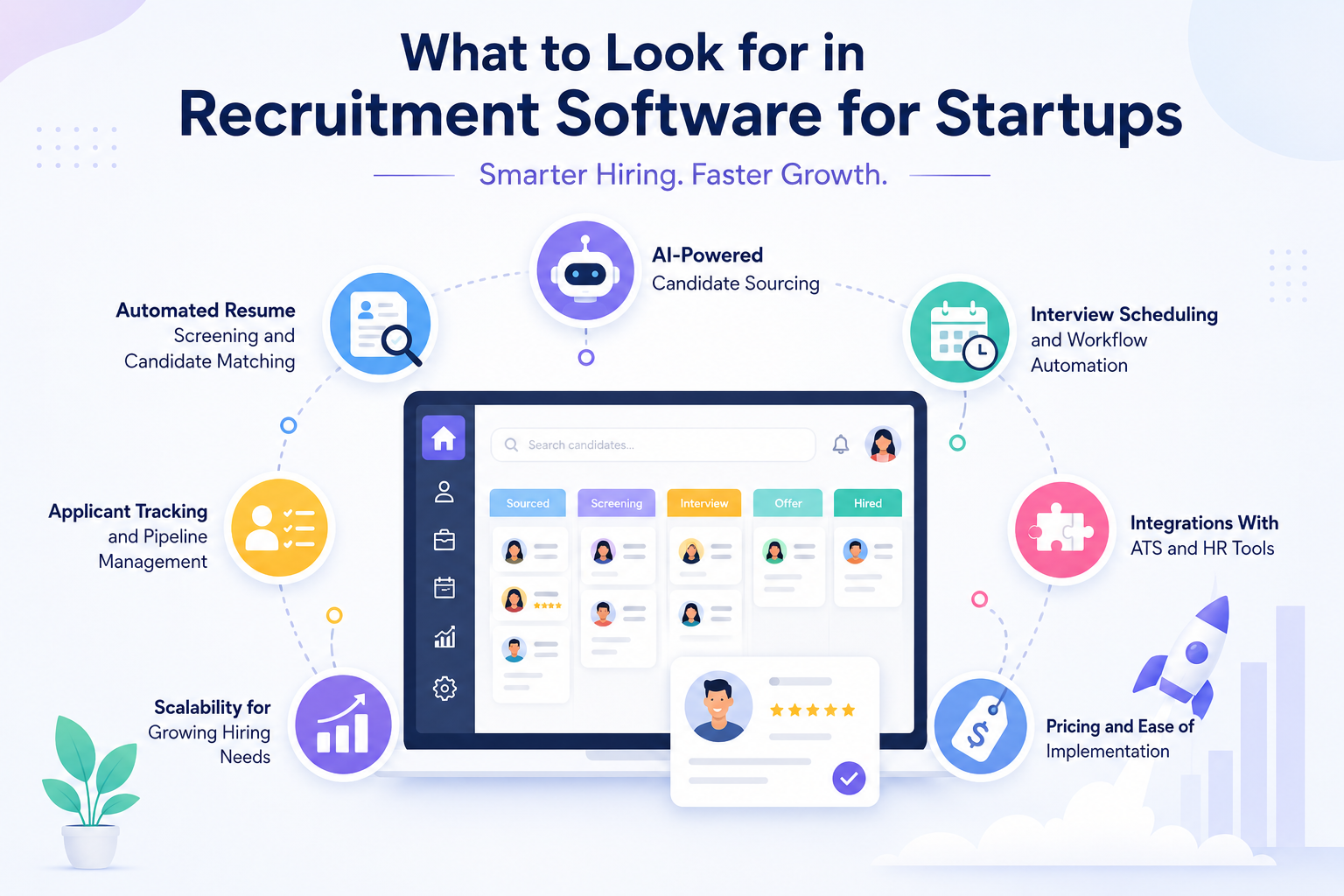
Not all recruitment software is built for startup hiring needs.
While some platforms focus on enterprise-level processes, startups need tools that help them move quickly without adding complexity.
The best recruitment software should reduce manual work, improve hiring efficiency, and support your growth as hiring demands increase.
AI-Powered Candidate Sourcing
Finding qualified candidates is often the most time-consuming part of recruitment. A strong sourcing engine helps you discover talent faster without relying solely on job applications.
Look for software that can search across multiple talent sources from a single platform.
Key sourcing capabilities include:
- AI-driven candidate discovery
- Access to multiple job boards and talent databases
- Passive candidate sourcing
- Advanced search and filtering
- Candidate profile enrichment
The wider the talent pool, the easier it becomes to find candidates who match your requirements.
Suggested Reading:
Candidate Sourcing Channels That Deliver Better Hires FastAutomated Resume Screening and Candidate Matching
As application volume grows, manually reviewing every resume becomes difficult. Automated screening helps you identify qualified candidates within minutes instead of hours.
Modern recruitment software uses AI to evaluate resumes against job requirements and rank candidates based on fit.
Look for features such as:
- Resume parsing
- AI-based candidate scoring
- Skills matching
- Experience-based filtering
- Automated shortlisting
This helps your team spend more time interviewing top candidates instead of reviewing large numbers of applications.
Interview Scheduling and Workflow Automation
Scheduling interviews may seem simple, but it often creates delays in the hiring process. Coordinating calendars, sending reminders, and managing follow-ups can consume valuable recruiter time.
Recruitment software should automate these repetitive tasks.
Useful automation features include:
- Calendar synchronization
- Self-service interview booking
- Automated reminders
- Candidate follow-ups
- Interview workflow management
A smoother scheduling process helps reduce drop-offs and improves the candidate experience.
Applicant Tracking and Pipeline Management
As hiring activity increases, keeping track of every candidate manually becomes challenging. An applicant tracking system helps organize your entire recruitment pipeline in one place.
You should be able to monitor candidate progress from application to offer stage.
Important ATS capabilities include:
- Centralized candidate database
- Custom hiring stages
- Pipeline visibility
- Candidate communication history
- Team collaboration tools
A well-structured pipeline makes it easier to identify bottlenecks and move candidates through the process efficiently.
Integrations With ATS and HR Tools
Recruitment software rarely works in isolation. Most startups already use tools for HR management, communication, payroll, and workforce planning.
The right platform should integrate seamlessly with your existing technology stack.
Common integrations to look for include:
- ATS platforms
- HRIS systems
- Calendar tools
- Email platforms
- Video interview software
- Collaboration tools
Strong integrations eliminate duplicate work and help maintain accurate hiring data across systems.
Scalability for Growing Hiring Needs
The hiring requirements of a startup can change quickly. A platform that works well for five hires a month may struggle when your company needs to hire fifty.
Choosing scalable software helps avoid costly migrations later.
Evaluate whether the platform can support:
- Higher application volumes
- Multiple hiring teams
- Additional job openings
- Global recruiting efforts
- Advanced reporting needs
Scalable recruitment software grows alongside your business and supports future expansion.
Pricing and Ease of Implementation
Budget is an important consideration for most startups. However, the cheapest option is not always the most cost-effective in the long run.
Focus on overall value rather than price alone.
When evaluating pricing, consider:
- Monthly or annual subscription costs
- User-based pricing models
- Setup fees
- Integration costs
- Feature limitations
Implementation should also be straightforward.
A platform with a simple setup process, intuitive interface, and minimal training requirements can help your team start hiring efficiently much faster.
Once you understand these core evaluation criteria, it becomes much easier to compare recruitment platforms and identify the solution that best fits your startup's hiring goals.
9 Best Recruitment Software for Startups in 2026
Now that you know what features matter most, the next step is finding a platform that fits your hiring goals, budget, and growth plans.
Here are some of the best recruitment software solutions startups can consider in 2026.
1. Leelu AI
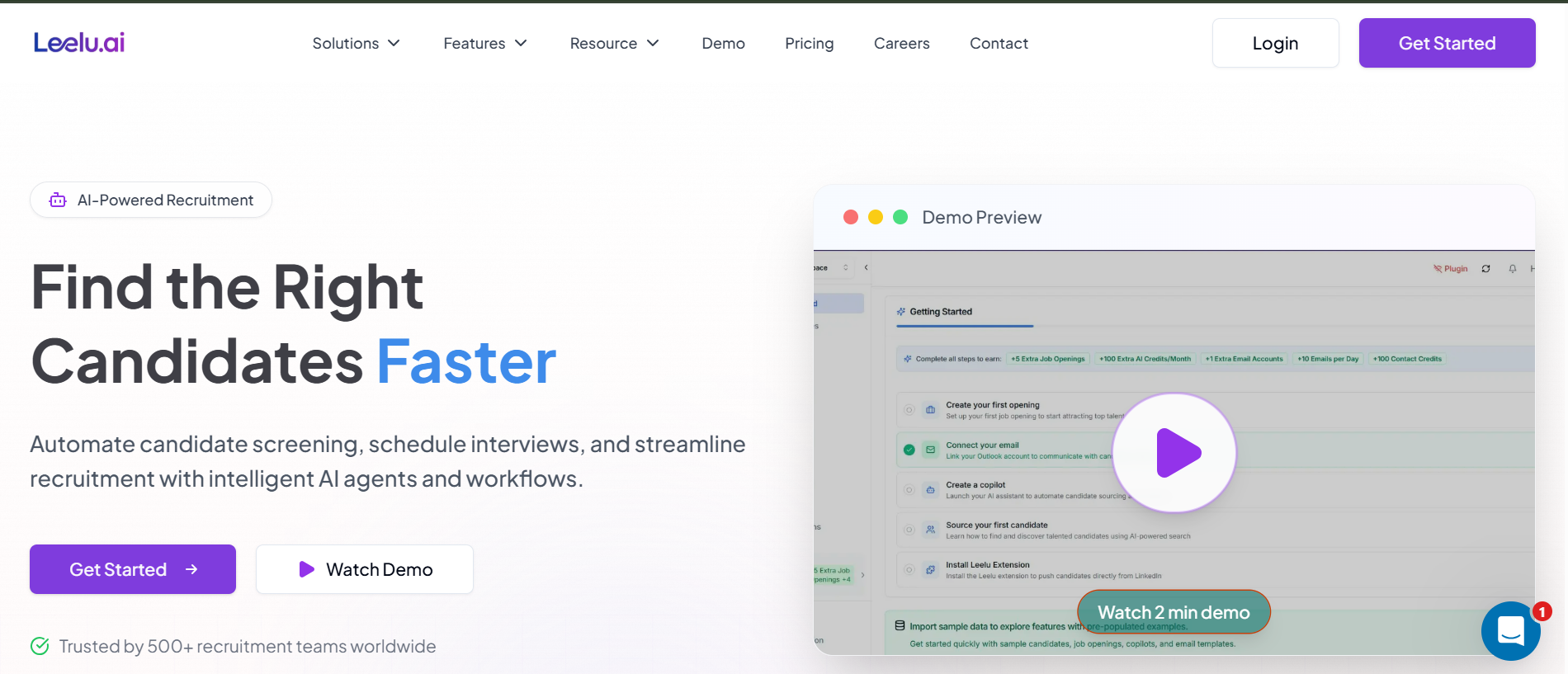
Leelu AI is an AI recruiting copilot designed to automate the entire hiring workflow.
Unlike traditional recruiting platforms that focus mainly on applicant tracking, Leelu helps startups source, screen, engage, and schedule candidates from a single platform.
Key Features
- Access to 500M+ candidate profiles across multiple sources
- AI-powered candidate sourcing
- AI resume screening and candidate matching
- Personalized email, LinkedIn, and SMS outreach
- Automated follow-ups and candidate engagement
- AI interview scheduling
- ATS integrations and exports
- Advanced recruiting analytics and reporting
- Autonomous AI recruiting agents
Pros and Cons
Pros
- End-to-end recruiting automation
- Affordable startup-friendly pricing
- Multi-channel outreach capabilities
- Fast implementation and setup
- Unlimited job openings and candidates
Cons
- Newer platform compared to established ATS vendors
- Some advanced integrations may require higher plans
Best For
Startups, recruiting agencies, and growing teams that want to automate sourcing, outreach, screening, and scheduling without building a large recruiting team.
Pricing
- Starter: $79/month
- Growth: $149/month
- Scale: $249/month
- Agency Pro: Custom pricing (contact sales)
2. Workable
Workable is one of the most popular recruitment platforms for small and mid-sized businesses. It combines applicant tracking, candidate sourcing, and hiring collaboration tools in a user-friendly interface.
Key Features
- Applicant Tracking System (ATS)
- Access to 400M+ candidate profiles
- AI-powered sourcing tools
- Job posting across 200+ job boards
- Interview scheduling
- Candidate assessments
- Reporting and analytics
- HR management capabilities
Pros and Cons
Pros
- Easy to use and deploy
- Strong sourcing database
- Extensive integrations
- Suitable for growing teams
Cons
- Pricing increases as headcount grows
- Several advanced features require paid add-ons
Best For
Startups and SMBs looking for an all-in-one recruiting and HR platform.
Pricing
For companies with 1–20 employees:
- Standard Plan: $299/month
- Premier Plan: Starts at $599/month
- Add-ons such as texting, assessments, and video interviews cost extra.
3. Greenhouse
Greenhouse is a structured hiring platform known for helping organizations build consistent and scalable recruiting processes. It is widely used by fast-growing technology companies and enterprises.
Key Features
- Advanced ATS functionality
- Structured interview workflows
- Candidate scorecards
- Automated recruiting workflows
- Diversity and inclusion tools
- Hiring analytics
- Extensive integration ecosystem
Pros and Cons
Pros
- Highly customizable hiring workflows
- Strong reporting capabilities
- Excellent collaboration features
- Enterprise-grade scalability
Cons
- Higher learning curve
- Pricing is not publicly available
- May be expensive for early-stage startups
Best For
High-growth startups and scaling companies that need structured hiring processes.
Pricing
- Custom pricing
- Plans include Core, Plus, and Pro
- Pricing depends on hiring volume, company size, and feature requirements.
4. Lever
Lever combines applicant tracking and candidate relationship management (CRM) into a single platform. Its focus on relationship-driven recruiting makes it a strong option for companies hiring both active and passive candidates.
Key Features
- ATS and CRM functionality
- Automated recruiting workflows
- Candidate nurturing campaigns
- Recruitment analytics
- Chrome sourcing extension
- Referral tracking
- 100+ integrations
Pros and Cons
Pros
- Strong ATS and CRM combination
- User-friendly interface
- Good automation capabilities
- Effective candidate relationship management
Cons
- Pricing is not publicly available
- Advanced reporting can be limited
- Can become costly for smaller teams
Best For
Growing startups that want both applicant tracking and long-term candidate relationship management.
Pricing
- Custom pricing
- Pricing depends on company size, hiring volume, and required modules.
- Contact Lever's sales team for a quote.
5. Breezy HR
Breezy HR is a recruitment platform designed for small and growing businesses. It combines applicant tracking, automation, and collaborative hiring tools in a simple interface.
Key Features
- Applicant Tracking System (ATS)
- AI-powered recruiting assistance
- Automated candidate workflows
- Resume parsing
- Interview self-scheduling
- Video interviewing
- Career site builder
- Reporting and analytics
- Slack and HR software integrations
Pros and Cons
Pros
- Easy to set up and use
- Free plan available
- Strong automation capabilities
- Unlimited users on paid plans
Cons
- Advanced features are limited to higher-tier plans
- AI capabilities may require additional credits
Best For
Small startups and growing companies that need an affordable ATS with automation features.
Pricing
- Bootstrap: Free
- Startup: $189/month
- Growth: $329/month
- Business: $529/month
6. JazzHR
JazzHR is a recruiting platform built specifically for small and mid-sized businesses. It focuses on simplifying hiring workflows while providing the flexibility to scale as recruiting needs grow.
Key Features
- Applicant Tracking System
- AI-powered candidate matching
- Job board syndication
- Resume management
- Structured interviews
- Workflow automation
- Reporting and analytics
- LinkedIn Recruiter integration
Pros and Cons
Pros
- Designed for SMB hiring
- Easy-to-use interface
- Strong automation features
- Good value for growing teams
Cons
- Limited sourcing capabilities compared to newer AI platforms
- Advanced reporting requires higher plans
Best For
Startups and SMBs looking for an ATS with recruiting automation and structured hiring workflows.
Pricing
- Hero: $1,000/year
- Plus: $3,480/year ($290/month equivalent)
- Pro: $5,508/year ($459/month equivalent)
7. Ashby
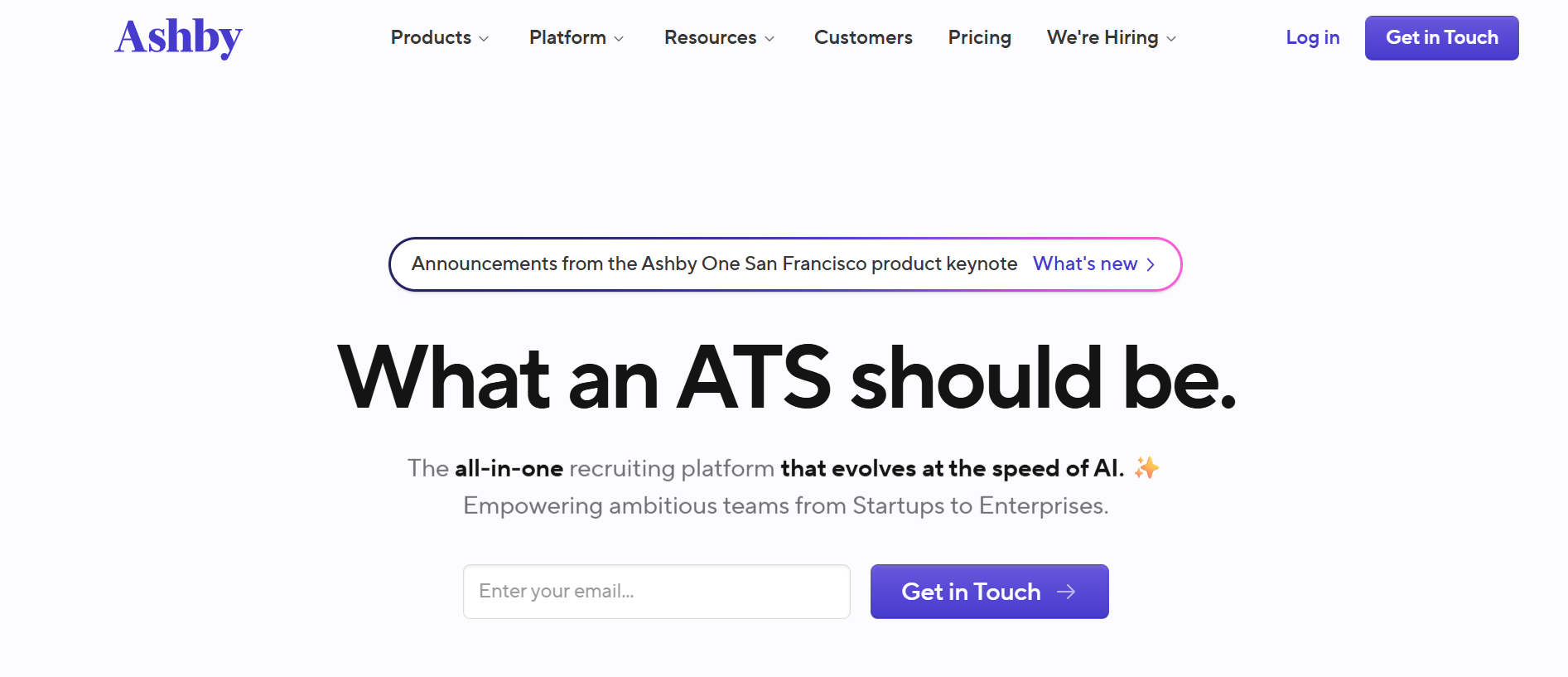
Ashby has become one of the fastest-growing recruiting platforms among technology startups. It combines ATS, sourcing, CRM, scheduling, and recruiting analytics into a single system.
Key Features
- Applicant Tracking System
- Recruiting CRM
- Candidate sourcing tools
- Advanced analytics
- Interview scheduling
- Automated workflows
- Pipeline forecasting
- Custom recruiting reports
Pros and Cons
Pros
- Powerful analytics and reporting
- Modern user experience
- Strong ATS and CRM combination
- Excellent scalability
Cons
- Pricing is not publicly disclosed
- Can be expensive as teams grow
- Requires onboarding to unlock advanced capabilities
Best For
Venture-backed startups, scale-ups, and technology companies that rely heavily on data-driven hiring.
Pricing
- Custom pricing
- Pricing is based on company size, recruiter seats, and hiring requirements
- Contact Ashby for a personalized quote
8. Zoho Recruit
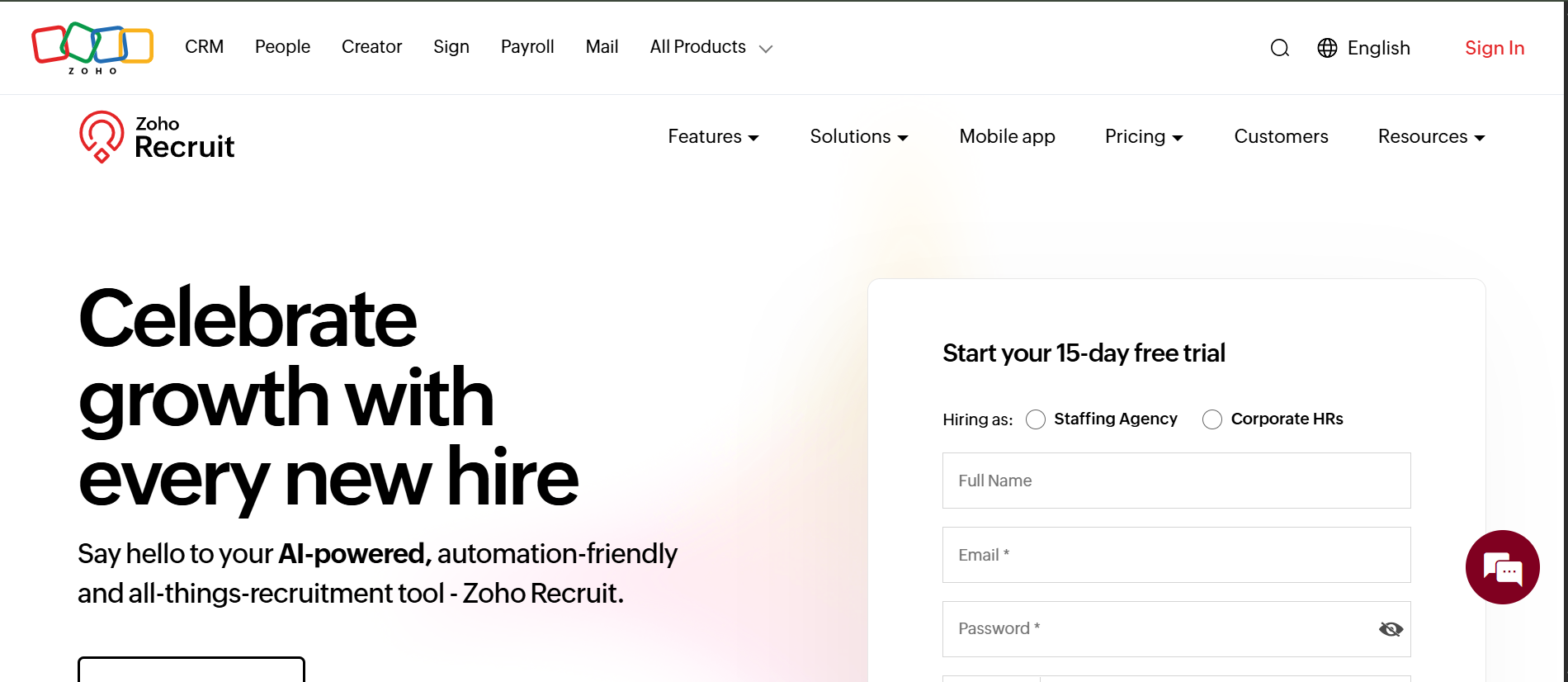
Zoho Recruit is a cloud-based recruiting platform that supports both corporate hiring teams and staffing agencies. It is known for its flexibility and integration with the broader Zoho ecosystem.
Key Features
- Applicant Tracking System
- Resume parsing
- Candidate sourcing tools
- Workflow automation
- AI-powered recruiting assistant
- Custom hiring pipelines
- Advanced reporting
- Integration with Zoho applications
Pros and Cons
Pros
- Affordable pricing structure
- Highly customizable
- Strong automation features
- Extensive integrations
Cons
- User interface can feel complex initially
- Advanced customization requires setup time
Best For
Startups already using Zoho products or teams looking for a budget-friendly recruiting solution.
Pricing
- Free: Up to 1 user
- Standard: $30/user/month
- Professional: $60/user/month
- Enterprise: $90/user/month
9. Manatal
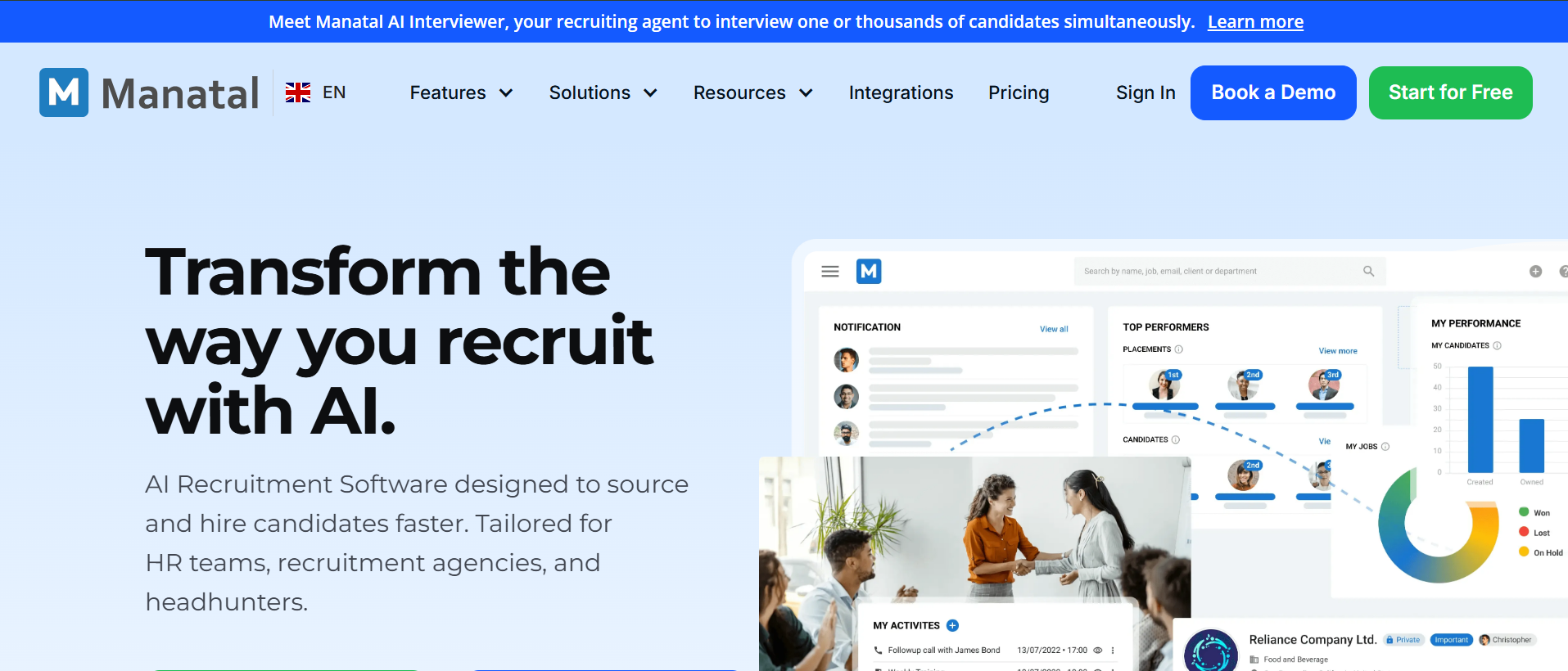
Manatal is an AI-powered recruitment platform that combines applicant tracking, candidate sourcing, and talent recommendations.
It has gained popularity among startups because of its affordability and automation capabilities.
Key Features
- AI candidate recommendations
- ATS functionality
- Resume parsing
- Social media enrichment
- Candidate scoring
- Recruitment CRM
- Interview management
- Recruiting analytics
Pros and Cons
Pros
- Affordable pricing
- Strong AI capabilities
- Easy implementation
- Good sourcing and enrichment tools
Cons
- Limited enterprise-level customization
- Fewer native integrations than larger competitors
Best For
Startups and recruiting agencies looking for AI-powered recruiting software without enterprise-level costs.
Pricing
- Professional: $15/user/month
- Enterprise: $35/user/month
- Enterprise Plus: Custom pricing
Recruitment Software Comparison Table
After reviewing each platform individually, it helps to compare them side by side.
This makes it easier to identify which solution aligns best with your startup's hiring goals, budget, and growth plans.
Side-by-Side Comparison of the Best Recruitment Software for Startups
While every platform on this list can support startup hiring, the best choice depends on how much automation, sourcing power, and scalability your team needs.
If your goal is to automate the entire recruiting process from sourcing to interview scheduling, platforms like Leelu AI stand out.
For companies prioritizing structured hiring, advanced analytics, or ATS capabilities, solutions such as Greenhouse, Lever, and Ashby may be a better fit.
How to Choose the Best Recruitment Software for Startups
With so many recruitment platforms available, choosing the right one can feel overwhelming. The best solution is not necessarily the one with the most features, but the one that aligns with your hiring goals, team size, and growth plans.
Suggested Reading:
How Recruitment Automation Is Transforming Hiring in USADefine Your Hiring Goals First
Before comparing software options, take time to understand what you want to achieve.
A startup hiring a few employees each quarter will have different requirements than a company scaling multiple teams simultaneously.
Ask yourself:
- How many roles do you hire for each month?
- Do you need help with sourcing candidates?
- Are you struggling with screening and scheduling?
- Do you plan to expand hiring over the next 12 months?
Clear hiring goals make it easier to identify the features that truly matter.
Evaluate Essential Recruitment Features
Once your goals are defined, focus on the capabilities that will help you achieve them.
Some platforms primarily offer applicant tracking, while others provide end-to-end recruiting automation.
Look for features such as:
- AI-powered candidate sourcing
- Resume screening and matching
- Interview scheduling
- Workflow automation
- Candidate engagement tools
- Reporting and analytics
- Applicant tracking capabilities
Prioritizing essential features helps you avoid paying for functionality your team may never use.
Consider Ease of Use and Team Adoption
Even the most powerful recruitment software can create problems if your team finds it difficult to use.
A platform with a clean interface and simple workflows often delivers faster value than one packed with complex features.
When evaluating software, consider:
- User experience
- Learning curve
- Onboarding requirements
- Customer support availability
- Training resources
The easier the platform is to adopt, the faster your team can improve hiring efficiency.
Check Scalability for Future Growth
Your hiring needs today may look very different a year from now.
Choosing a scalable platform prevents the disruption and expense of switching systems as your company grows.
Look for software that can support:
- Increased hiring volume
- Multiple recruiters
- Larger candidate pipelines
- Additional departments
- Advanced reporting needs
Scalable recruiting software allows your hiring process to grow alongside your business.
Compare Pricing and Long-Term Value
Price is always an important consideration for startups. However, focusing only on monthly subscription costs can lead to poor long-term decisions.
Instead, evaluate the overall value each platform delivers.
Consider factors such as:
- Monthly or annual pricing
- Cost per user
- Setup fees
- Additional feature costs
- Automation capabilities
- Potential time savings
A platform that reduces manual recruiting work may generate a stronger return on investment even if the upfront cost is higher.
Review Integration Requirements
Recruitment software should fit naturally into your existing workflow.
If the platform cannot connect with your current tools, your team may end up managing data across multiple systems.
Review whether the software integrates with:
- ATS platforms
- HRIS systems
- Calendar applications
- Email platforms
- Video interviewing tools
- Collaboration software
Strong integrations help create a more efficient and connected hiring process.
Questions to Ask Before Making a Decision
Before committing to a platform, ask a few critical questions that can help you avoid costly mistakes later.
Some useful questions include:
- Does the platform solve our biggest hiring challenges?
- Can it support our future hiring plans?
- How much manual work can it eliminate?
- What level of customer support is available?
- Are there any hidden costs or limitations?
- How easy is it to implement and manage?
- Does it integrate with our current technology stack?
The answers to these questions often reveal whether a platform is truly the right fit for your startup.
Conclusion
Hiring the right talent quickly can be a major competitive advantage for startups.
The best recruitment software helps you streamline sourcing, screening, scheduling, and candidate management while reducing manual work.
Whether you need end-to-end AI recruiting automation, a powerful ATS, or a scalable hiring platform, the right solution depends on your hiring goals and growth plans.
By evaluating features, pricing, integrations, and scalability, you can choose a recruitment platform that supports faster hiring and helps your startup build strong teams with confidence.
Frequently Asked Questions
What is the best recruitment software for startups?
The best recruitment software depends on your hiring needs, budget, and growth plans. Platforms like Leelu AI, Workable, Greenhouse, and Lever are popular choices for startups.
Do startups need recruitment software?
Yes. Recruitment software helps startups automate sourcing, screening, scheduling, and candidate tracking, allowing teams to hire faster with fewer resources.
How much does recruitment software cost?
Pricing varies by platform. Startup-friendly solutions can start as low as $15–$79 per month, while advanced platforms may cost several hundred dollars per month or require custom pricing.
What features should startups look for in recruitment software?
Look for AI-powered sourcing, resume screening, interview scheduling, applicant tracking, workflow automation, reporting, and integrations with HR tools.
Can recruitment software integrate with existing HR systems?
Most modern recruitment platforms offer integrations with ATS, HRIS, email, calendar, and collaboration tools to streamline hiring workflows and reduce manual data entry.


