Hiring today isn’t a shortage problem—it’s a relevance problem.
Most companies don’t struggle to get candidates. They struggle to get the right candidates—fast enough to hire.
You post a job, get hundreds of applications, and it feels like success. But once screening starts, most aren’t relevant—and by the time you find the right ones, they’re already gone.
This isn’t rare. It’s how hiring works for most teams today.
The issue isn’t effort—it’s relying on candidate sourcing channels that don’t deliver speed, quality, and scale together.
To fix this, you need a sourcing strategy that actually works.
What Makes a Candidate Sourcing Channel “High-Performing”?
Not every sourcing channel is designed for the same outcome.
Some are great for volume. Some are better for niche roles. Some help you move fast.
The key is understanding how to evaluate them based on your hiring goals.
1. Speed to Hire: How Quickly Can You Engage Candidates?
Speed determines who gets access to top talent first.
High-performing channels reduce the time between:
- Discovering a candidate
- Reaching out
- Starting a conversation
For example, platforms that allow immediate outreach or automated workflows significantly improve response times.
In contrast, channels that require manual searching and delayed communication slow down the process.
Even a delay of 2–3 days can make a difference in competitive hiring markets.
2. Candidate Quality: Are You Reaching the Right Talent?
A strong sourcing channel should help you find candidates who are:
- Relevant to the role
- Aligned with required skills
- Within the right experience range
Channels that focus only on active job seekers often miss high-quality passive candidates.
For example, niche communities or targeted sourcing approaches tend to produce fewer candidates—but with much higher relevance.
This reduces screening time and improves hiring outcomes.
3. Cost Per Hire: Are You Getting Real Value?
Cost isn’t just about money—it’s about time and effort as well.
A low-cost channel that requires heavy manual work may actually be more expensive in the long run.
Similarly, high-cost channels like agencies may deliver results faster but aren’t always sustainable.
The goal is to balance:
- Cost
- Speed
- Quality
And optimize for long-term efficiency.
4. Scalability: Can It Support Growth?
What works for a single role often fails when hiring increases.
A scalable sourcing channel should:
- Handle multiple roles simultaneously
- Support automation
- Maintain consistency in results
For example, manual outreach might work for 10 candidates—but not for 500.
This is where technology starts playing a crucial role.
Comparison Table: Evaluating Candidate Sourcing Channels
Read More: Ultimate Candidate Sourcing Strategies for the Recruitment Team
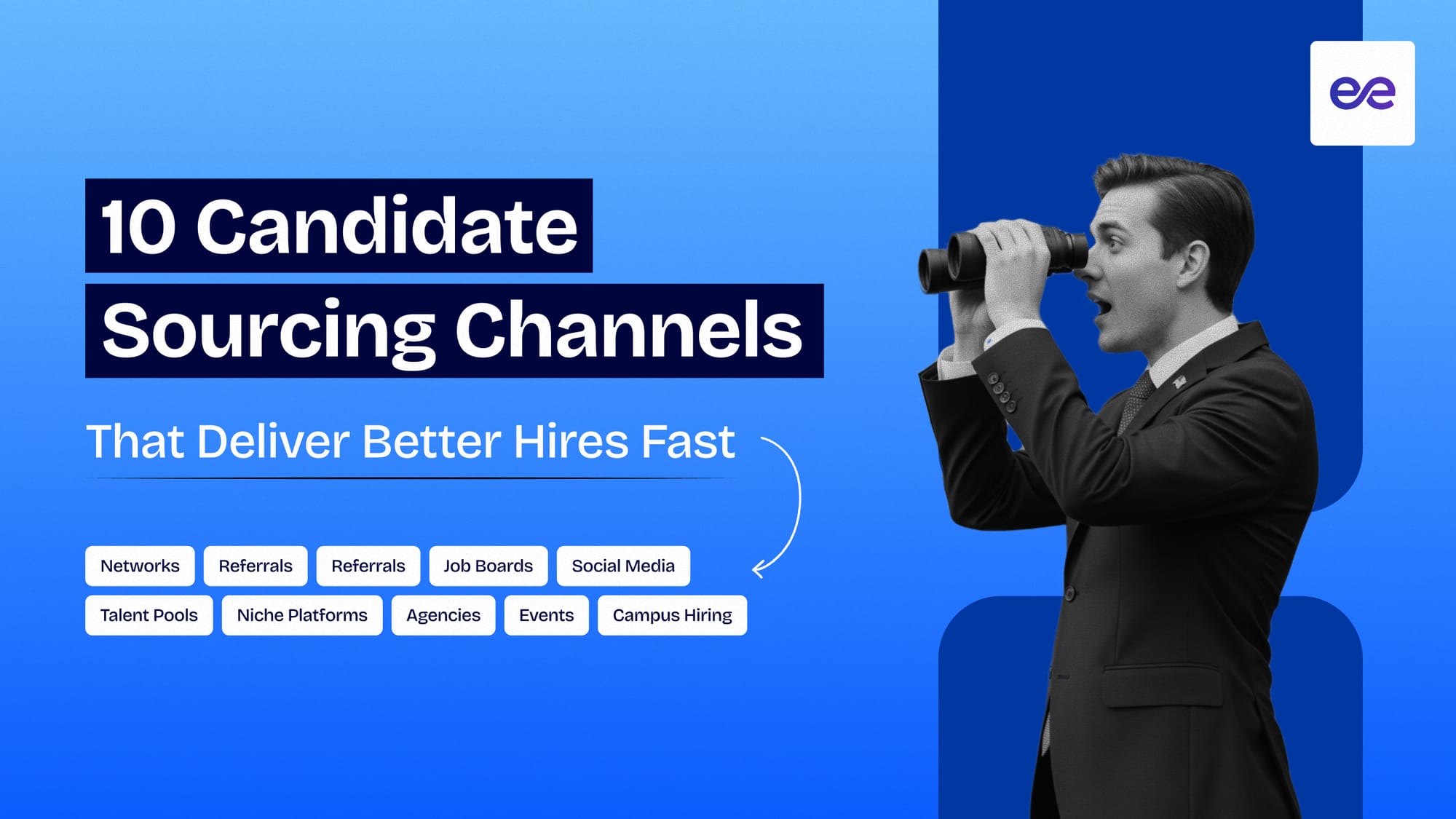
The 10 Candidate Sourcing Channels That Actually Work
By now, it’s clear that no single sourcing channel can solve every hiring challenge.
Some channels give you speed. Some give you quality. Some help you scale.
The goal isn’t to pick one—it’s to understand how each works and when to use it.
Let’s break down the 10 sourcing channels that consistently deliver results when used the right way.
1. Professional Networks (e.g., LinkedIn)
Professional networks have become the default starting point for most recruiters—and for good reason.
They give you access to:
- A large pool of professionals across industries
- Detailed profiles with experience, skills, and activity
- The ability to directly reach out to passive candidates
This makes them especially effective for mid-to-senior roles, where candidates are not actively applying but open to the right opportunity.
However, the biggest challenge is saturation.
Candidates on these platforms often receive multiple messages daily. Even strong opportunities get ignored if the outreach isn’t highly relevant.
Another limitation is cost—premium access and recruiter tools can become expensive over time.
How to use it better:
Instead of broad searches, use Boolean search techniques to narrow down highly relevant candidates. Combine that with personalized outreach to stand out in crowded inboxes.
2. Employee Referrals
Referrals remain one of the most reliable sourcing channels—but they’re often underused.
Why they work:
- Employees refer candidates they trust
- Candidates already have some context about the company
- Conversion rates are significantly higher
For example, a referred candidate is far more likely to respond, interview, and accept an offer compared to someone sourced cold.
But referrals have one limitation—they don’t scale easily.
Most companies rely on passive referral programs, waiting for employees to suggest candidates. Without a structured approach, this channel stays underutilized.
How to use it better: Actively run referral campaigns, incentivize participation, and align referrals with specific roles rather than keeping it open-ended.
3. AI-Powered Sourcing Platforms
As hiring demands grow, manual sourcing becomes the biggest bottleneck. This is where AI-powered platforms change the game.
Instead of treating sourcing, screening, and outreach as separate steps, platforms like Leelu.ai bring everything together into one workflow.
With AI-powered sourcing, you can:
- Discover candidates across multiple platforms without switching tools
- Enrich candidate profiles automatically with relevant data
- Screen candidates based on role fit
- Send personalized outreach at scale
- Move candidates faster into interviews
For example, instead of spending hours manually searching and messaging candidates, recruiters can focus on engaging only the most relevant ones.
The key advantage here isn’t just automation—it’s consistency and scale.
How to use it better: Use AI to handle repetitive tasks (search, enrichment, outreach) while focusing your time on conversations and decision-making.
4. Job Boards (Indeed, Naukri, etc.)
Job boards are one of the oldest and most widely used sourcing channels—and they still play an important role.
They are especially effective for:
- Entry to mid-level roles
- High-volume hiring
- Roles where candidates are actively looking
The biggest advantage is volume—you can generate a large number of applications quickly.
But that’s also the biggest drawback.
High volume often means:
- Low relevance
- More screening effort
- Slower decision-making
How to use it better:
Use structured job descriptions, add pre-screening questions, and apply filters to reduce irrelevant applications early.
5. Talent Communities & Internal Talent Pools
Most companies overlook one of their strongest sourcing channels—their own database.
Every past applicant, previous candidate, or silver-medalist (someone who almost got hired) is part of a potential talent pool.
These candidates:
- Already know your company
- Have shown interest before
- Require less convincing
This makes them ideal for faster hiring cycles.
For example, instead of starting from scratch, a recruiter can revisit past candidates who were a strong fit but not selected earlier.
How to use it better: Maintain and organize your talent pool properly. Tag candidates by skills, roles, and experience so they can be easily rediscovered.
6. Social Media Channels
Social media is not just for marketing—it’s increasingly becoming a sourcing channel.
Platforms like Twitter, Instagram, and niche communities allow companies to:
- Build employer brand
- Share insights and culture
- Attract inbound interest
Unlike direct sourcing, this channel works more indirectly.
Candidates discover your company through content, engagement, or community presence—and then show interest.
How to use it better: Focus on consistency. Share real work, team stories, and insights instead of just job posts. Engage with comments and conversations to build credibility and trust over time.
7. Niche Job Boards & Communities
General platforms give you volume. Niche platforms give you precision.
For example:
- Developers → GitHub
- Designers → Dribbble or Behance
- Writers → specialized communities
These platforms attract candidates who are deeply involved in their craft.
The result?
- Fewer candidates
- Much higher relevance
How to use it better: Instead of broad outreach, engage with candidates through their work—comment on projects, understand their contributions, and personalize your message accordingly.
8. Recruitment Agencies
Recruitment agencies are often used when speed is critical or roles are hard to fill.
They bring:
- Pre-screened candidates
- Industry expertise
- Faster shortlisting
This makes them useful for:
- Leadership roles
- Urgent hiring needs
However, the trade-off is cost. Agency fees can be significant, especially for senior roles.
How to use it better:Use agencies selectively—for roles where internal sourcing is too slow or ineffective. Clearly define role requirements and success criteria upfront to improve candidate quality.
9. Campus Recruiting & Early Talent Programs
For entry-level hiring, campus recruiting remains one of the most effective strategies.
It allows companies to:
- Build early talent pipelines
- Train candidates from scratch
- Reduce hiring costs
This approach is less about immediate results and more about long-term planning.
How to use it better: Build relationships with institutions and create structured programs instead of one-time hiring drives.
10. Events, Hackathons & Meetups
Events give you access to candidates in a completely different way.
Instead of reaching out cold, you:
- Interact directly
- See candidates in action
- Build real connections
Hackathons, meetups, and industry events are especially useful for identifying high-potential candidates who are actively engaged in their field.
How to use it better:Participate actively—don’t just sponsor. Engage, mentor, and build relationships. Follow up quickly with strong candidates after the event to maintain momentum and interest.
How to Choose the Right Candidate Sourcing Channel (Decision Framework)
Now that you’ve seen all the options, the next question is:Which one should you use?
The answer depends on your hiring goal.
A. If You Need to Hire Fast
Speed comes from reducing manual effort and leveraging existing networks.
Focus on:
- AI-powered sourcing platforms
- Employee referrals
- Internal talent pools
These channels allow you to move quickly from discovery to outreach without starting from scratch.
B. If You Need High-Quality Candidates
Quality comes from targeting the right environments.
Focus on:
- Niche communities
- Referrals
- Personalized outreach
These channels may produce fewer candidates, but they significantly improve relevance.
C. If You’re Hiring at Scale
Scale requires consistency and volume.
Focus on:
- Job boards
- AI-powered tools
This combination allows you to generate pipelines while maintaining efficiency.
D. If You’re Hiring for Hard-to-Fill Roles
These roles require deeper sourcing strategies.
Focus on:
- AI-driven candidate discovery
- Passive candidate outreach
Instead of waiting for candidates, you actively identify and engage them.
How Leelu.ai Helps You Scale Candidate Sourcing
As you combine multiple sourcing channels, one challenge becomes clear—managing everything efficiently.
This is where Leelu.ai plays a critical role.
Instead of switching between tools and workflows, it brings everything into one system:
- Aggregates candidates from multiple sourcing channels
- Uses AI to identify high-fit candidates
- Automates candidate profile screening
- Enables personalized outreach at scale
- Simplifies interview scheduling
More importantly, it significantly reduces the manual work involved in sourcing and outreach—two of the most time-consuming parts of recruitment.
For example, a recruiter handling multiple roles no longer needs to manually search across platforms, copy candidate data, or send individual outreach messages. The system handles these repetitive tasks automatically, freeing up time for meaningful conversations and better hiring decisions.
This shift allows HR teams to move from manual execution to strategic hiring.
The result is not just faster hiring—but more consistent and scalable outcomes.
Leelu doesn’t replace sourcing channels—it makes them work together efficiently while eliminating the manual effort behind them.
Conclusion
Hiring isn’t about using more candidate sourcing channels—it’s about using them smarter.
Most teams already have access to multiple channels, but hiring still slows down due to manual work and disconnected workflows. The real challenge is finding the right candidates quickly, without wasting time on repetitive tasks.
High-performing teams solve this by combining channels strategically and removing bottlenecks.
That’s where Leelu.ai makes the difference—bringing sourcing, screening, and outreach into one system while automating manual HR work.
The result? Faster, more consistent hiring.
Because today, the advantage doesn’t come from sourcing more—it comes from sourcing smarter.
Frequently Asked Questions
How do I know if my sourcing channels are actually working?
Track metrics like response rates, qualified candidate ratio, time-to-hire, and offer acceptance rate—not just number of applications.
Can small teams effectively use multiple sourcing channels?
Yes, but only with the right tools and workflows. Without automation, managing multiple channels becomes time-consuming and inefficient.
How often should I update my sourcing strategy?
Regularly. Hiring markets change quickly, so reviewing channel performance every quarter helps maintain efficiency.


