Hiring today often feels slower than it should be, especially when candidates expect quick and personal communication.
If you are still relying only on emails, you are likely missing responses, delaying conversations, and losing great talent along the way.
That is where texting software for recruiting starts to make a real difference by helping you connect faster and more effectively.
In this guide, you will explore:
- The top texting software for recruiting
- Key features you should look for
- Pricing insights to help you choose the right tool
Key Features to Look for in Texting Software for Recruiting
Once you understand why texting matters in recruiting, the next step is choosing the right tool.
But not all texting platforms are built the same, and picking the wrong one can actually slow you down instead of helping you move faster.
Here are the key features you should focus on when evaluating texting software for recruiting.
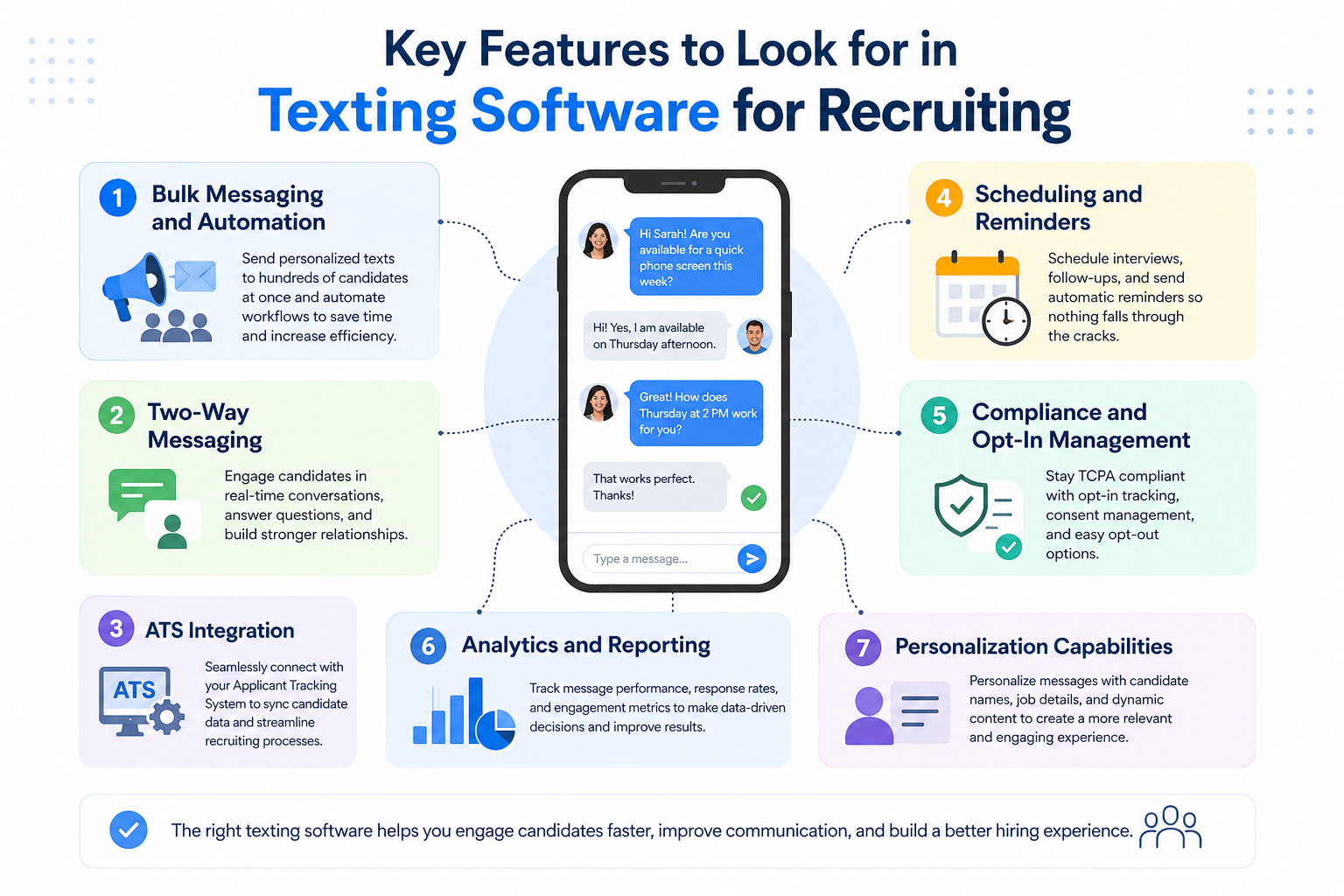
1. Bulk Messaging and Automation
When you are hiring at scale, sending messages one by one quickly becomes impossible to manage.
Bulk messaging lets you reach hundreds of candidates at once while automation ensures follow-ups, reminders, and initial outreach happen without manual effort.
This not only saves time but also keeps your hiring process moving even when you are not actively managing it.
2. Two-Way Messaging
Recruiting is not just about sending messages, it is about having conversations.
Two-way messaging allows candidates to reply directly, ask questions, and stay engaged without switching platforms.
This creates a smoother experience and increases the chances of getting faster responses from candidates.
3. ATS Integration
If your texting tool does not integrate with your ATS, you will end up juggling multiple systems.
A good platform should sync candidate data, conversations, and updates directly with your ATS so everything stays in one place.
This reduces manual work and ensures your hiring pipeline stays organized and up to date.
4. Scheduling and Reminders
Coordinating interviews can take more time than actually conducting them.
With built-in scheduling and automated reminders, you can let candidates book time slots and receive reminders without constant back-and-forth.
This reduces no-shows and makes the process easier for both you and the candidate.
5. Compliance and Opt-In Management
Texting comes with strict compliance requirements, especially when it comes to candidate consent.
Your software should handle opt-ins, opt-outs, and maintain proper records to ensure you stay compliant with regulations.
This protects your brand while still allowing you to communicate effectively.
6. Analytics and Reporting
You cannot improve what you do not measure.
Analytics helps you understand message delivery rates, response rates, and overall engagement so you can optimize your outreach strategy.
Over time, this data helps you refine your messaging and improve hiring outcomes.
7. Personalization Capabilities
Even when you are sending messages at scale, they should not feel generic.
Personalization features allow you to tailor messages based on candidate data, role, or interaction history.
This makes your communication feel more relevant, increasing the likelihood of candidates responding and staying engaged.
Suggested Reading:
How to Set Up Recruiting Email Automation for Faster Hiring ProcessTop 9 Texting Software for Recruiting
Now that you know what features actually matter, the next step is choosing the right tool that fits your hiring workflow.
Each platform comes with its own strengths, so the goal is not to find the “best” one, but the one that aligns with how you hire and communicate.
Let’s break down some of the top texting software for recruiting, starting with three popular options.
1. TextRecruit
If your focus is candidate engagement through SMS and chat, TextRecruit is built specifically for recruiting teams.
It is designed to help you start conversations faster and keep candidates engaged throughout the hiring process.
Key Features
- Bulk SMS campaigns to reach candidates at scale
- Two-way messaging for real-time conversations
- Chatbots to automate initial candidate interactions
- ATS integrations with popular systems
- Interview scheduling through messaging workflows
These features make it easier for you to move candidates from first touchpoint to interview without delays.
Pricing
TextRecruit does not publicly list its pricing.
You will need to request a demo or contact their sales team to get a custom quote based on your hiring needs.
2. Sense
If you are looking for a more comprehensive engagement platform beyond just texting, Sense offers a broader solution.
It combines messaging, automation, and AI-driven workflows to manage the entire candidate journey.
Key Features
- Omnichannel communication including SMS, email, and chat
- AI-powered automation for follow-ups and engagement
- Talent engagement workflows for different hiring stages
- Deep ATS and CRM integrations
- Candidate experience tracking and optimization
This makes Sense a good fit if you want to build long-term relationships with candidates, not just send messages.
Pricing
Sense follows a custom pricing model.
Pricing typically depends on company size, hiring volume, and feature requirements, so you will need to contact their team for details.
3. SimpleTexting
If you want a straightforward and easy-to-use texting tool, SimpleTexting is a strong option.
It is not built exclusively for recruiting, but it works well for teams that want a simple SMS solution without complex setup.
Key Features
- Bulk messaging and scheduled campaigns
- Two-way SMS conversations
- Contact list management and segmentation
- Auto-replies and basic automation
- Easy-to-use interface with quick setup
This makes it ideal if you want to get started quickly without a steep learning curve.
Pricing
SimpleTexting offers transparent pricing based on message volume.
Plans typically start at a monthly subscription, with costs increasing as your messaging needs grow.
You can choose a plan based on how many messages you expect to send each month.
4. EZ Texting
If you want a marketing-focused texting platform that can also support recruiting, EZ Texting is a flexible option.
It works well for teams that want simple campaigns along with basic automation.
Key Features
- Bulk messaging with campaign management tools
- Contact segmentation for targeted outreach
- Automated responses and drip campaigns
- MMS support for richer candidate communication
- Reporting dashboard for campaign performance
This helps you manage outreach in a more structured way without adding too much complexity.
Pricing
EZ Texting offers tiered pricing based on message volume and features.
Plans typically start with a monthly subscription, and costs increase depending on how many contacts and messages you manage.
5. Sakari
Sakari is built more for business messaging but fits well into recruiting workflows that need reliable SMS automation.
It focuses on clean integrations and scalable messaging.
Key Features
- Two-way SMS messaging with team inbox
- Automated messaging workflows and triggers
- CRM and ATS integrations via API and Zapier
- Message scheduling and delivery tracking
- Global messaging capabilities
This makes it a good fit if you want flexibility and integration with your existing tools.
Pricing
Sakari uses a subscription-based model with usage-based pricing.
You typically pay a monthly fee plus messaging costs depending on volume and regions.
6. TextUs
TextUs is designed specifically for recruiting and HR teams that rely heavily on candidate communication.
It focuses on real-time engagement and collaboration.
Key Features
- Two-way messaging with shared team inbox
- Bulk messaging and campaign capabilities
- ATS integrations with major recruiting platforms
- Click-to-text browser extensions
- Analytics to track engagement and response rates
These features help you keep candidate communication fast and organized across your team.
Pricing
TextUs offers custom pricing based on team size and usage.
You will need to request a demo to get detailed pricing based on your hiring needs.
7. Emissary
Emissary takes a slightly different approach by combining texting with conversational AI.
It is built for teams that want to automate large parts of candidate communication.
Key Features
- AI-driven conversational messaging
- Automated candidate engagement workflows
- SMS and chat-based communication
- Integration with ATS and recruiting systems
- Candidate screening through automated conversations
This allows you to reduce manual communication while still maintaining engagement.
Pricing
Emissary follows a custom pricing model.
Costs depend on the level of automation, integrations, and hiring scale you require.
8. Twilio
If you need full control and customization, Twilio is more of a developer-first platform than a ready-made recruiting tool.
It is ideal if you want to build your own texting workflows from scratch.
Key Features
- Programmable SMS APIs for custom workflows
- Global messaging infrastructure
- Automation through custom logic and triggers
- Integration flexibility with any ATS or system
- Scalable messaging for high-volume use cases
This gives you maximum flexibility but requires technical resources to set up and manage.
Pricing
Twilio uses a pay-as-you-go pricing model.
You are charged per message sent or received, making it flexible but variable depending on usage.
9. Textline
Textline is a business texting platform that works well for recruiting teams focused on communication and collaboration.
It balances ease of use with practical recruiting features.
Key Features
- Shared inbox for team-based messaging
- Two-way SMS communication
- Message templates for faster outreach
- Automation for responses and workflows
- Analytics to track conversation performance
This makes it suitable for teams that want a clean and collaborative texting experience.
Pricing
Textline offers subscription-based pricing with different tiers.
Plans vary based on the number of users, features, and messaging limits, so you can choose one that fits your team size and needs.
How to Choose the Right Texting Software for Your Recruiting Needs
By now, you have seen multiple tools and how they compare.
But choosing the right texting software for recruiting comes down to understanding your own hiring process first, not just the tool features.
Here is how you can make a decision that actually works for your team.
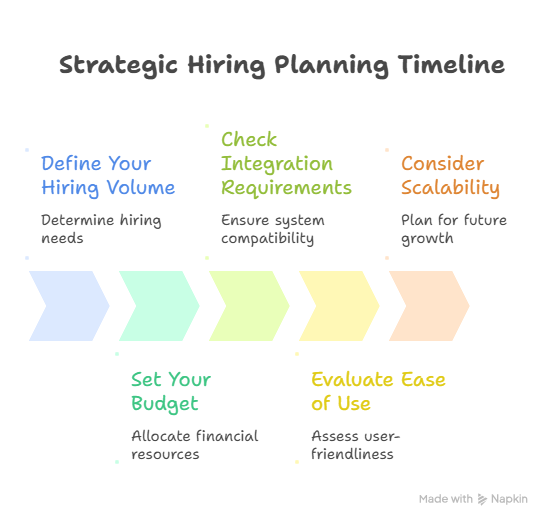
1. Define Your Hiring Volume
Start by looking at how many roles you typically hire for and how often.
If you are hiring occasionally, a simple texting tool with basic automation will be enough.
But if you are managing high-volume hiring, you will need:
- Bulk messaging at scale
- Automated workflows
- Candidate engagement tracking
Your hiring volume directly determines how advanced your texting software needs to be.
2. Set Your Budget
Budget is not just about what you can spend, but what value you expect in return.
If you are a small team, tools with transparent pricing can help you stay in control of costs.
For larger teams or agencies, investing in a recruiting-focused platform with custom pricing can make sense because:
- You save time through automation
- You reduce manual effort
- You improve hiring speed
Think of it as balancing cost with efficiency gains.
3. Check Integration Requirements
Your texting software should fit into your existing workflow, not disrupt it.
If you already use an ATS, make sure the tool integrates seamlessly so you do not have to switch between platforms.
Look for:
- Native ATS integrations
- CRM or HR system compatibility
- API access if you need flexibility
The smoother the integration, the less manual work your team will deal with.
4. Evaluate Ease of Use
Even the most powerful tool will fail if your team does not use it properly.
That is why ease of use matters more than you might expect.
Choose a platform that:
- Is intuitive for your team
- Requires minimal training
- Helps you get started quickly
This ensures faster adoption and better results from day one.
5. Consider Scalability
What works for you today might not work six months from now.
As your hiring needs grow, your texting software should be able to scale with you.
Look for tools that can:
- Handle increasing message volume
- Support larger teams
- Offer advanced automation as you grow
This way, you avoid switching tools later and keep your hiring process consistent.
How Leelu Helps You Combine Texting with End-to-End Recruiting Automation
At this point, you have seen how texting can improve candidate communication.
But the real impact happens when texting is not just a standalone tool, but part of a complete recruiting workflow.
This is where Leelu.ai helps you go beyond basic messaging and actually streamline your entire hiring process.
1. Automate candidate outreach across channels including SMS
Instead of manually reaching out to candidates one by one, Leelu lets you automate outreach across multiple channels including SMS, and email..
You can engage candidates instantly and keep conversations moving without constant manual effort.
2. Personalize communication at scale beyond basic texting tools
Basic texting tools let you send messages, but personalization often stays limited.
Leelu uses candidate data and AI to tailor messages based on role, skills, and interactions, so your outreach feels relevant even at scale.
3. Manage conversations and follow-ups from a single platform
Handling conversations across different tools can quickly become messy.
With Leelu, you can manage all candidate interactions, replies, and follow-ups from one unified platform without switching between systems.
4. Connect outreach with sourcing, screening, and scheduling
Texting becomes more powerful when it is connected to the rest of your hiring process.
Leelu links outreach directly with sourcing, AI screening, and interview scheduling, helping you move candidates from first contact to interview much faster.
5. Improve engagement while reducing manual recruiter effort
When communication, automation, and workflows are connected, your efficiency improves naturally.
Leelu reduces repetitive tasks, keeps candidates engaged with timely responses, and helps you focus more on decision-making instead of manual coordination.
Suggested Reading:
Recruitment Automation: Step-by-Step Guide for HR’sCommon Mistakes to Avoid
Even with the right texting software for recruiting, small mistakes can reduce your results more than you expect.
Most of these issues are not about the tool itself, but how you use it in your hiring process.
Here are some common mistakes you should actively avoid.
1. Ignoring Compliance Rules
Texting candidates is not the same as sending emails, and compliance is not optional here.
If you message candidates without proper consent or ignore opt-out requests, it can lead to legal issues and damage your employer brand.
Make sure you:
- Collect clear opt-ins before messaging
- Provide easy opt-out options
- Maintain records of consent
This keeps your communication both safe and professional.
2. Sending Generic Messages
Candidates can instantly tell when a message is copied and pasted.
If your outreach feels generic, it reduces trust and lowers response rates.
Instead of sending the same message to everyone:
- Personalize messages using candidate data
- Mention relevant skills or roles
- Keep the tone conversational and human
Even small personalization can make a big difference in engagement.
3. Delayed Responses
Texting works because it is fast, but that advantage disappears if your responses are slow.
When candidates reply and do not hear back quickly, they often lose interest or move on.
To avoid this:
- Use automated replies for initial responses
- Set up alerts for incoming messages
- Keep response time as short as possible
Speed is one of the biggest reasons texting improves recruiting outcomes.
4. Over-Automation
Automation can save time, but too much of it can make your communication feel robotic.
If every message sounds scripted, candidates may disengage.
A better approach is to balance automation with human interaction:
- Automate repetitive tasks like follow-ups
- Keep important conversations human
- Review automated messages regularly
This way, you maintain efficiency without losing the personal touch that candidates value.
Conclusion
Choosing the right texting software for recruiting is not just about features, but how well it fits into your hiring workflow.
When you focus on speed, personalization, and automation, texting becomes a powerful way to engage candidates and move them through the pipeline faster.
The key is to balance efficiency with human interaction so your communication never feels robotic.
Take time to evaluate your hiring needs, test a few tools, and choose one that scales with you.
When done right, texting can significantly improve response rates, reduce delays, and help you hire better talent faster.
Frequently Asked Questions
1. Is texting really effective for recruiting?
Yes, texting helps you reach candidates faster and improves response rates significantly.It works best when you need quick engagement and faster hiring decisions.
2. Do you need candidate consent before sending texts?
Yes, getting clear opt-in is mandatory before sending any messages.This ensures compliance and protects your employer brand.
3. Can texting software integrate with your ATS?
Most tools offer integrations with popular ATS platforms.This helps you manage candidate data and conversations in one place.
4. Is texting software suitable for small teams?
Yes, many tools offer simple and affordable plans for small teams.You can start small and scale as your hiring needs grow.