
Staffing agencies have a different recruiting challenge than most in-house hiring teams. A recruiter may be working on several job orders for different clients at the same time, each with its own requirements, deadlines, and candidate pool.
The work quickly adds up: finding candidates, reviewing resumes, screening profiles, sending outreach, following up, scheduling interviews, submitting candidates, and keeping records updated.
As the number of open positions grows, doing all of this manually becomes difficult to sustain.
That is where a recruiting platform for staffing agencies can help. The right platform can centralize candidate data, automate repetitive recruiting tasks, speed up sourcing, and help recruiters manage more hiring activity without adding the same amount of manual work.
Let’s get started
What Is a Recruiting Platform for Staffing Agencies?
A recruiting platform for staffing agencies is software designed to help recruiters manage the process of finding, evaluating, engaging, and moving candidates through the hiring pipeline.
Depending on the platform, this can include:
- Candidate sourcing
- Resume and profile screening
- Candidate matching
- Candidate database management
- Automated outreach
- Follow-ups
- Interview scheduling
- Candidate pipeline management
- Reporting and analytics
- ATS and CRM integrations
The main difference is the volume and complexity these platforms need to support.
An internal recruiting team might work on a defined set of positions for one company. A staffing agency may handle dozens or hundreds of job orders across multiple clients, often while working against tight placement deadlines.
Example
Suppose an agency receives 15 new job orders in a week.
Recruiters need to identify qualified candidates for each position, contact them, follow up, schedule interviews, and submit the strongest candidates to clients.
Without automation, recruiters spend a significant amount of time moving between sourcing tools, spreadsheets, email, and their ATS.
A recruiting platform can bring several of those activities into one workflow, reducing the amount of repetitive work recruiters need to perform manually.
Sure — this section can be much tighter while still explaining why each feature matters. I’d use this version:
What Should Staffing Agencies Look for in a Recruiting Platform?
A staffing agency needs more than a tool to store resumes. Recruiters have to source candidates, identify the right matches, engage them, and move them through the hiring process quickly. The right recruiting platform should reduce this manual workload while helping recruiters handle more job orders.
1. Candidate Sourcing
The platform should help recruiters quickly find candidates based on skills, experience, job title, location, and other job requirements. Access to multiple candidate sources is also useful for reaching passive candidates who aren't actively applying.
Example: A recruiter looking for a senior Java developer can use filters to narrow thousands of profiles to candidates with the required skills and experience.
2. AI Candidate Matching
A large candidate database is only useful if recruiters can find relevant profiles quickly. AI matching can compare job requirements with candidate profiles and prioritize stronger matches.
This is already a practical use of AI in staffing. A 2025 Staffing Hub report found that 43% of staffing agencies using AI used it for job matching, while 45% used it for resume parsing and database cleanup.
3. Automated Outreach
Once recruiters find suitable candidates, they need to contact them. Automated outreach helps agencies send personalized messages to multiple candidates without manually writing every email.
This allows recruiters to spend more time having conversations with qualified candidates rather than handling repetitive outreach.
4. Automated Follow-Ups
Candidates may not respond to the first message. Automated follow-ups keep communication going without requiring recruiters to manually set reminders for every candidate.
For example, a recruiter can send an initial message, follow up after a few days, and send a final follow-up if there is still no response.
5. Candidate Rediscovery
Staffing agencies often have thousands of candidates already stored in their ATS or database. A recruiting platform should make it easy to search this existing pool when a new job arrives.
Example: A candidate who wasn't suitable for a previous role may now perfectly match a new client requirement. Rediscovery lets recruiters find that candidate instead of starting a new search.
6. ATS and CRM Integrations
The recruiting platform should work with the systems the agency already uses. Integrations can keep candidate information, job orders, recruiter activity, and client data connected.
This reduces duplicate data entry and prevents recruiters from constantly switching between different systems.
7. Reporting
Recruiting agencies need to know which activities are actually producing placements. Useful metrics include:
- Time-to-fill
- Time-to-submit
- Candidate response rate
- Submission-to-interview rate
- Interview-to-placement rate
- Placements per recruiter
- Candidate source performance
These insights can help agencies identify which recruiters, sourcing channels, and processes are delivering the best results.
8. Scalability
The platform should continue to work as the agency grows. It should support more recruiters, candidates, clients, job orders, and recruiting activity without creating additional manual work.
For example: An agency growing from 10 to 40 recruiters needs a platform that can handle a larger candidate database and higher recruiting volume without forcing the team to change systems again.
10 Best Recruiting Platforms for Staffing Agencies
The best platform depends on what is slowing down your recruiting operation. Some platforms are strongest in sourcing, while others focus on ATS functionality, candidate engagement, AI matching, or broader staffing operations.
At a glance:
1. Leelu AI — Best for AI-Powered Recruiting Automation
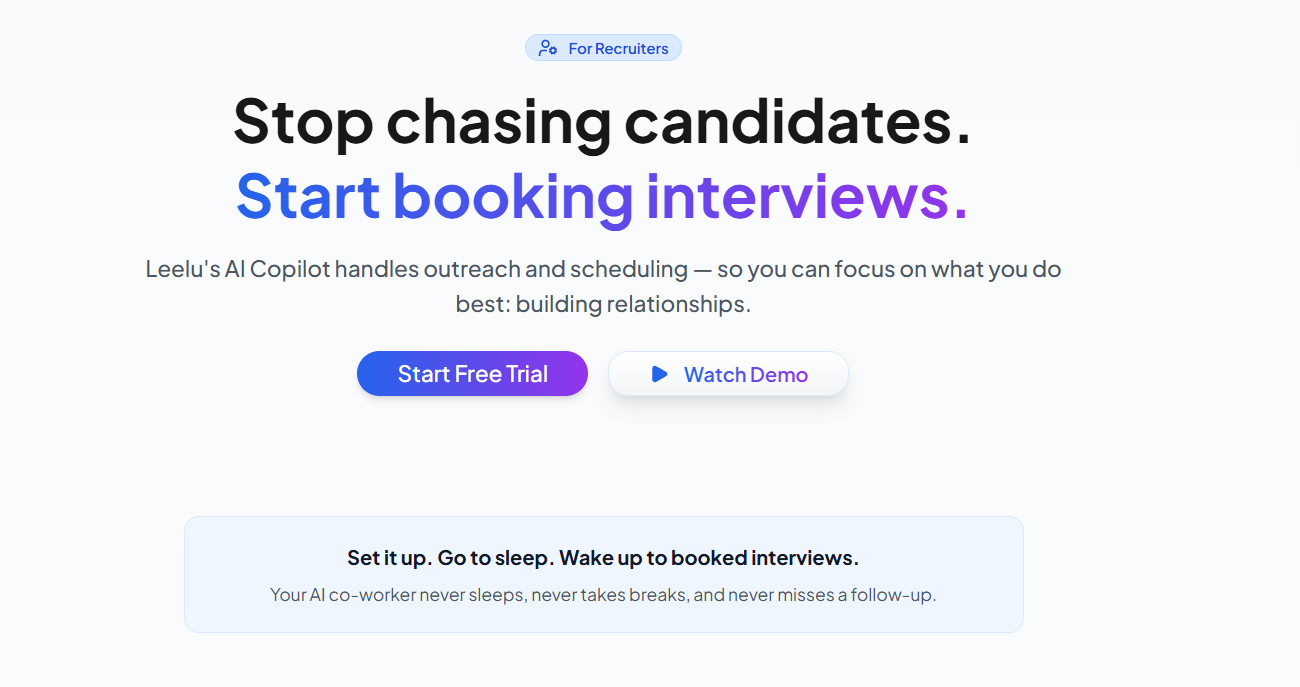
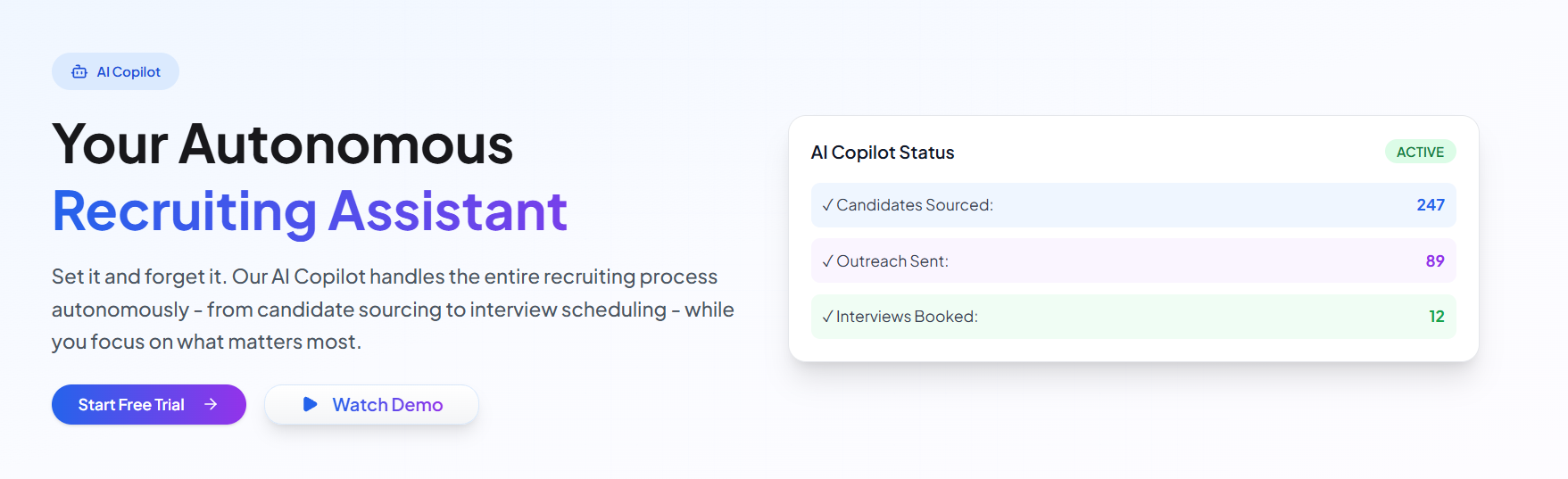
Leelu AI is designed around automating repetitive recruiting activities, including candidate sourcing, screening, outreach, follow-ups, and interview scheduling.
For staffing agencies, that combination is useful because recruiters often need to repeat the same activities across multiple job orders.
Leelu states that its platform can source from 500M+ candidate profiles across LinkedIn, job boards, and ATS systems. It also reports 10× faster sourcing and a 95% reduction in time spent on recruiting tasks. These are Leelu's own product claims rather than independent industry benchmarks.
Key features
- 500M+ candidate profiles across LinkedIn, job boards, and ATS databases
- 1,000+ resumes screened in minutes with AI scoring
- 100–300 personalized messages daily across email and LinkedIn
- 24/7 automated follow-ups with AI-driven candidate responses
- 10+ recruiting platforms integrated for multi-source candidate sourcing
- 24-hour hiring workflow from sourcing to interview scheduling
- 48% average candidate response rate with personalized outreach
- 85% time saved compared with manual recruiting processes
Why staffing agencies may use Leelu
The biggest advantage is reducing the amount of manual work between receiving a job requirement and getting qualified candidates into the interview process.
Example
A staffing agency receives a requirement for 20 software engineers.
Instead of having recruiters manually search profiles, evaluate every candidate, write individual outreach messages, and create follow-up reminders, Leelu can automate several of these steps.
The recruiter can then focus on reviewing the strongest matches, speaking with candidates, and working with the client.
Best for: Staffing agencies looking to increase recruiter capacity through AI-powered sourcing and recruiting automation.
Pricing:
Starts at $79/month, with a free trial available. The platform focuses on AI-powered recruiting automation rather than traditional staffing operations.
Pros
- Automates sourcing, screening, outreach, follow-ups, and interview scheduling.
- Searches across 500M+ candidate profiles and multiple recruiting platforms.
- Reduces repetitive recruiter work across the hiring workflow.
Cons
- More focused on recruiting automation than CRM functionality.
- Does not provide broader staffing back-office capabilities.
2. Bullhorn — Best for Staffing and Recruiting Operations
Bullhorn is built specifically for staffing and recruiting firms, with capabilities covering applicant tracking, customer relationship management, recruiting, and staffing operations.
Its staffing focus makes it particularly relevant for agencies managing multiple clients and job orders.
Key features
- 4,500+ small agencies use Bullhorn for staffing operations
- Resume parsing automatically converts resumes into searchable candidate profiles
- AI Search & Match ranks candidates by job fit
- 350+ Marketplace partners extend recruiting and staffing workflows
- 90+ AI prompts support common recruiting tasks
- Custom workflows automate processes based on agency requirements
- Real-time analytics track recruiter and staffing performance
- Gmail and Outlook integration manages recruiting directly from inboxes
Why staffing agencies may use Bullhorn
Agencies that need a broader system for managing both candidate and client relationships can benefit from having recruiting and staffing operations connected.
Example
A staffing firm working with dozens of clients can manage job requirements, candidates, submissions, and client interactions within a connected system rather than relying on separate spreadsheets and applications.
Best for: Staffing agencies looking for an established platform for managing recruiting and staffing operations.
Pricing:
Starts at $99/user/month, with no free trial listed. Pricing can vary based on the setup and requirements of your staffing business.
Pros
- Combines ATS and CRM functionality for staffing agencies.
- Supports candidate, client, job, and staffing management.
- Offers integrations and reporting for broader recruiting operations.
Cons
- Can require more setup and training than simpler recruiting tools.
- AI automation is not its primary focus.
3. JobDiva — Best for High-Volume Staffing
JobDiva is a cloud-based applicant tracking and recruiting platform designed for staffing and recruiting organizations.
Its focus on candidate management and recruiting workflows makes it suitable for agencies that need to work with large candidate databases.
Key features
- DivaMatch: Hands-free candidate-to-job matching for recruiters
- Talent Cluster: Mass actions across candidate records
- DivaReach: Text-enabled candidate engagement and outreach
- Resume Parser: Automatically extracts information from candidate resumes
- Candidate Portal: Lets candidates upload resumes and find matching jobs
- Live Interview: Supports video interviews during recruiting
- DivaVMS: Manages vendor and staffing workflows
- Team Dashboard: Provides company-wide recruiting activity insights
- DivaFinancials: Supports staffing financial and billing processes
- Zoom Integration: Schedules video meetings from candidate records
Why staffing agencies may use JobDiva
High-volume agencies need to quickly search and reuse candidates already in their database.
Example
An agency receives a new Java developer requirement. Instead of immediately beginning a new external search, recruiters can search their existing candidate database for people who previously matched similar requirements.
Best for: Staffing agencies managing large candidate databases and high recruiting volumes.
Pricing:
JobDiva uses custom pricing, so you need to request pricing based on your requirements. A demo is available rather than a standard free trial.
Pros
- Built for high-volume staffing and recruiting operations.
- Strong candidate database and search capabilities.
- Helps recruiters manage large candidate pools and recruiting workflows.
Cons
- Pricing is not publicly standardized.
- Less focused on advanced AI-powered recruiting automation.
4. Ceipal — Best for AI-Driven Staffing Workflows
Ceipal provides recruiting and staffing software with capabilities for applicant tracking, candidate sourcing, recruiting automation, and workforce management.
Its AI-focused capabilities are particularly relevant for agencies looking to automate candidate identification and recruitment workflows.
Key features
- 25+ job board integrations for wider candidate sourcing
- 70%+ larger talent pool through AI sourcing
- 4× faster placements with AI-powered matching
- 60% higher recruiter productivity through workflow automation
- 80% less recruitment bias using people analytics
- 90% submission accuracy with candidate assessments
- 2× higher placement retention using people analytics
- 24/7 automated resume parsing and candidate harvesting
- AI chatbot screening for high-volume candidate engagement
- Real-time dashboards for recruiter and staffing analytics
Why staffing agencies may use Ceipal
Agencies handling large numbers of candidates can use automation to reduce repetitive search, screening, and workflow-management tasks.
Example
A recruiter receives a highly specific technical requirement. Instead of manually reviewing hundreds of profiles, automated matching can help narrow the database to candidates who more closely fit the requirement.
Best for: Staffing firms looking for AI and automation within a broader staffing platform.
Pricing:
Starts at $25/user/month, with a free trial available. It combines recruiting, staffing, AI, automation, and workforce management capabilities.
Pros
- Combines ATS, CRM, sourcing, matching, and automation.
- AI features can help recruiters identify and prioritize relevant candidates.
- Useful for agencies handling large candidate volumes.
Cons
- Its broad feature set can require time to configure.
- Smaller agencies may not need all of its staffing-focused capabilities.
5. Avionté — Best for Staffing Back-Office and Recruiting
Avionté combines recruiting and staffing capabilities with tools for managing broader staffing operations.
This makes it useful for agencies that want recruiting connected with other parts of their staffing workflow.
Key features
- 25,000+ active users across staffing organizations
- 4.6M W-2s processed annually through its platform
- $15B payroll processed annually through Avionté
- 1,000+ staffing agencies use Avionté's platform
- 50–75% less recruiter admin time through automation
- $130K+ annual savings from automated payroll and invoicing
- 4-to-1 recruiter efficiency for processing 120 candidates daily
- 150+ standard reports for staffing analytics and performance
- AI Matching Agent surfaces top-fit candidates from existing databases
- AI interviews generate candidate qualification summaries automatically
Why staffing agencies may use Avionté
Agencies can benefit when recruiting data needs to flow into other operational processes after a candidate is placed.
Example
A temporary staffing agency can manage candidates during recruitment and then continue managing their staffing lifecycle after placement.
Best for: Staffing companies that need recruiting connected to broader staffing operations.
Pricing:
Avionté uses custom pricing based on your staffing requirements. A demo is available for agencies evaluating the platform.
Pros
- Connects recruiting with broader staffing operations.
- Includes ATS, CRM, payroll, back-office, and reporting capabilities.
- Useful for temporary and contract staffing businesses.
Cons
- Broader functionality can make the platform more complex.
- AI-powered recruiting automation is less central to its offering.
6. Recruit CRM — Best for Recruitment Agency CRM
Recruit CRM combines applicant tracking with CRM functionality, making it useful for recruitment agencies that need to manage both candidates and clients.
Key features
- 5,000+ job boards: Multipost jobs across thousands of recruitment channels.
- 5,000+ integrations: Connect recruiting workflows with external apps and tools.
- 1,000 automation tasks: Automate repetitive workflows per user monthly.
- 500 enrichment credits: Find missing candidate emails and phone numbers.
- AI candidate matching: Matches qualified candidates to roles automatically.
- AI resume parsing: Converts resumes into structured candidate profiles.
- Automated email, SMS, LinkedIn sequences: Runs personalized candidate outreach automatically.
- Advanced analytics: Creates custom reports, dashboards, and performance alerts.
- 3,000+ job boards across 100+ countries: Expand job distribution globally.
- 30,000 records per entity: Supports large candidate and client databases.
Why staffing agencies may use Recruit CRM
Recruiters don't work only with candidates. They also need to manage client relationships, job requirements, submissions, and business development activity.
Example
A recruiter can manage a client's open position, associate candidates with that job, track candidate stages, and maintain client communication from the same system.
Best for: Recruitment agencies that want ATS and CRM capabilities together.
Pricing
Starts at $69/user/month, with a free trial available. It combines recruiting, CRM, candidate management, and workflow automation.
Pros
- Combines ATS and CRM in one platform.
- Helps manage candidates, clients, jobs, and communication.
- Useful for agencies balancing recruiting with client management.
Cons
- May not offer the same depth of staffing back-office features as enterprise platforms.
- Advanced workflows may require additional configuration.
7. Loxo — Best for Sourcing and Outreach
Loxo combines recruiting CRM functionality with candidate sourcing and outreach capabilities.
Its sourcing-oriented features can be useful for agencies that frequently recruit passive candidates.
Key features
- 850M+ professionals: Search Loxo’s global talent database for candidates.
- 75% of professionals: Access verified personal and work contact information.
- 1.2B people: Loxo AI analyzes talent connections and patterns.
- 500% more efficient: AI automates sourcing, screening, and candidate list creation.
- 4.5× higher response rates: Automated follow-ups improve candidate engagement.
- 5× output: Multi-channel outreach supports higher recruiting activity.
- 125,000+ recruiters: Use Loxo’s recruitment CRM globally.
- 10+ tools replaced: Combines sourcing, ATS, CRM, outreach, and AI.
Why staffing agencies may use Loxo
Agencies recruiting for specialized positions often cannot rely entirely on inbound applicants. They need tools that help identify and engage passive talent.
Example
A recruiter searching for a senior cybersecurity professional can build a targeted candidate list and use automated outreach to begin conversations with potential candidates.
Best for: Agencies focused on proactive sourcing and candidate outreach.
Pricing
Starts at $169/user/month, with a free tier available. Its pricing reflects its broader sourcing, CRM, outreach, and recruiting capabilities.
Pros
- Strong candidate sourcing and outreach capabilities.
- Useful for finding and engaging passive candidates.
- Combines sourcing, ATS, CRM, and recruiting automation.
Cons
- Higher starting price than many competing recruiting platforms.
- May offer more functionality than agencies looking for a basic ATS need.
8. Vincere — Best for Recruitment Agency Management
Vincere is a recruitment operating system built for recruitment and staffing businesses. It brings candidate management, CRM, job management, automation, reporting, and integrations into one platform.
For staffing agencies, this combination is useful because recruiters need to manage two sides of the business at the same time: finding and placing candidates and maintaining client relationships. Keeping these activities connected can make it easier to move from a new job requirement to candidate submission and placement.
Key features
- 22,000+ recruiters: Used worldwide across recruitment agencies.
- 3× performance: AI recruitment software claims to outperform traditional ATS systems.
- 1,000+ automated tasks: Automates repetitive recruitment and administrative workflows.
- 300+ hours reclaimed annually: Reduces administrative work through automation.
- 43% higher placement success: AI matching improves candidate-placement outcomes.
- 2× faster business wins: AI helps agencies close roles and win business faster.
Why staffing agencies may use Vincere
Vincere can be useful for agencies that don't want candidate management and client management to operate as separate processes.
Recruiters can manage candidate pipelines alongside client and job information, giving teams greater visibility into which candidates are being considered for which roles and where each job stands.
This can be particularly useful for agencies managing multiple clients and vacancies simultaneously.
Example
A recruitment agency receives a new requirement from an existing client.
The recruiter can create the job, identify suitable candidates, track their progress through the recruitment pipeline, communicate with the client, and monitor the eventual placement within the same system.
Instead of managing job information in one tool and client activity in another, the agency has a connected view of the recruitment process.
Best for: Recruitment agencies that want candidate, client, job, and recruiting activity managed within one platform.
Pricing
Starts at £69/user/month, with a demo available. It combines recruitment operations, CRM, candidate management, automation, and reporting.
Pros
- Connects candidate, client, job, and recruitment activity.
- Supports ATS, CRM, sourcing, automation, and reporting.
- Well suited to agencies managing multiple clients and vacancies.
Cons
- Broader functionality can require more setup and onboarding.
- Less focused on AI-first recruiting automation.
9. Zoho Recruit — Best for Flexible Recruiting Workflows
Zoho Recruit is an applicant tracking and recruitment platform that provides tools for candidate sourcing, resume management, recruitment automation, communication, and reporting.
Its flexibility can be useful for staffing agencies because different types of recruitment don't always follow the same process. A permanent placement may require a different workflow from temporary staffing or contract recruitment.
Key features
- 75+ job boards: Publish openings across free, paid, and premium boards.
- 250 resumes/day: Parse resumes with the Standard plan.
- 500 resumes/day: Parse resumes with the Professional plan.
- Unlimited resume parsing: Available with the Enterprise plan.
- 750 active jobs: Enterprise supports high-volume job management.
- 50+ integrations: Connect recruiting workflows with external business applications.
- AI candidate matching: Zia ranks candidates against job requirements.
- AI screening bot: Screens candidates using predefined assessments and criteria.
- Automated workflows: Trigger application updates, scheduling, approvals, and follow-ups.
- 800,000+ recruiters: Zoho Recruit says its platform serves this user base.
Why staffing agencies may use Zoho Recruit
The platform allows agencies to customize recruitment workflows around their own processes rather than forcing every job through the same pipeline.
This can help agencies organize candidates based on different hiring stages, job types, clients, or recruitment requirements.
It can also be useful for agencies that already use other Zoho products and want their recruiting process to fit into the wider business software ecosystem.
Example
Consider an agency handling both permanent and contract placements.
For permanent roles, recruiters may use stages such as:
Sourced → Screened → Interview → Client Review → Offer → Placed
For contract roles, the agency may need additional steps related to availability, documentation, or assignment details.
Custom workflows can help recruiters manage these different processes without maintaining separate spreadsheets for each type of recruitment.
Best for: Staffing and recruitment agencies that need flexible workflows and customizable recruitment processes.
Pricing
Starts at $30/recruiter/month, with a free plan and 15-day trial. It offers customizable workflows for different recruitment and staffing processes.
Pros
- Flexible recruitment workflows and customization options.
- Includes ATS, sourcing, automation, communication, and reporting.
- Works well for agencies already using the wider Zoho ecosystem.
Cons
- Advanced customization can require additional setup.
- AI capabilities are less central than AI-first recruiting platforms.
10. Manatal — Best for Small and Growing Staffing Agencies
Manatal is a cloud-based recruitment platform that combines applicant tracking, candidate sourcing, recruitment CRM, AI-assisted recommendations, collaboration, and reporting.
For smaller staffing agencies, the priority is often different from that of a large enterprise staffing company. They may need a platform that covers the core recruiting workflow without introducing unnecessary complexity.
Manatal can help agencies organize candidates, manage job openings, collaborate with recruiters, and keep recruitment activity in one place.
Key features
- 700M+ candidate database: Source candidates through Manatal’s People-Match AI extension.
- 2,500+ job boards: Publish openings across global and specialized channels.
- 10+ sourcing platforms: Find candidates through LinkedIn, Indeed, GitHub, SEEK, Xing, and more.
- 20+ social platforms: Enrich candidate profiles with additional public information.
- Unlimited AI interviews: Screen candidates automatically using requirement-based video interviews.
- AI candidate recommendations: Score and rank candidates against job requirements.
- 15 jobs and 10,000 candidates: Included in the Professional plan.
- Unlimited jobs and candidates: Available with the Enterprise plan.
- 24/7 AI screening: Conduct automated candidate interviews around the clock.
- 14-day free trial: Test the platform without a credit card.
Why staffing agencies may use Manatal
A growing agency may start with a small recruiting team and a relatively simple process. As the number of clients and job openings increases, managing candidate information through spreadsheets, email, and separate databases becomes harder.
A centralized recruitment platform can give recruiters one place to manage candidate profiles, job openings, communication, and pipeline activity.
The AI-assisted recommendations can also help recruiters identify potentially relevant candidates instead of manually reviewing the entire candidate pool.
Example
A staffing agency with eight recruiters is managing 40 active job openings.
As the agency takes on more clients, recruiters need to keep track of which candidates are being considered for each role and where those candidates are in the process.
Using a centralized platform, recruiters can organize candidates by job, collaborate with team members, and monitor candidate progress without relying on separate spreadsheets.
As the agency grows, the same system can support a larger recruiting operation.
Best for: Small and growing staffing agencies that need core recruiting, candidate management, and collaboration features without a highly complex staffing system.
Pricing
Starts at $15/user/month, with a 14-day free trial. It focuses on core recruiting, candidate management, AI recommendations, and collaboration.
Pros
- Combines ATS, sourcing, CRM, AI recommendations, and reporting.
- Accessible option for small and growing staffing teams.
- Keeps core recruiting activities in one platform.
Cons
- May not provide the depth of back-office functionality larger staffing firms need.
- Some larger agencies may require more advanced staffing capabilities.
How to Choose the Right Recruiting Platform for Your Staffing Agency
Start with the biggest bottleneck in your current process.
If sourcing takes too long
Look for:
- Large candidate databases
- Multi-source sourcing
- Advanced search
- AI sourcing
If screening is slowing recruiters down
Look for:
- Resume parsing
- AI matching
- Candidate scoring
- Automated screening
If recruiters struggle with candidate engagement
Look for:
- Automated outreach
- Personalization
- Follow-up sequences
- Email or SMS integrations
If recruiters are overloaded
Look for:
- Workflow automation
- Bulk actions
- Automated scheduling
- AI recruiting assistants
If your agency is growing
Look for:
- Multi-user collaboration
- Reporting
- ATS/CRM integrations
- Permissions
- Scalable pricing
- Large-volume candidate management
How Much Does Recruiting Software for Staffing Agencies Cost?
Recruiting software pricing varies significantly from one platform to another. Some tools charge per recruiter or user, while others price their software based on candidate volume, features, job postings, or the size of the agency.
The total cost can depend on:
- Number of recruiters and users: Most platforms charge more as you add recruiters, hiring managers, or other team members.
- Candidate volume: Some platforms limit the number of candidate records, searches, or profiles you can access within a plan.
- Job volume: Agencies managing a large number of open positions may need plans that support more active job orders.
- AI usage: AI sourcing, matching, screening, personalization, and other AI features may be included in higher-tier plans or charged separately.
- Database access: Platforms with built-in candidate databases may charge based on access to their talent pool, search credits, or contact information.
- Automation features: Advanced workflows, automated outreach, follow-ups, and candidate engagement may only be available on higher plans.
- Integrations: Connecting the platform with job boards, email, calendars, payroll systems, or other business tools may require specific plans or additional fees.
- Enterprise requirements: Large staffing agencies may need custom permissions, dedicated support, advanced reporting, security controls, or additional integrations.
However, agencies shouldn't evaluate recruiting software based only on its monthly subscription price. A cheaper platform is not necessarily more cost-effective if recruiters still spend hours on manual sourcing, screening, data entry, or follow-ups.
The more useful question is:
How does this platform affect recruiter productivity, placement volume, and the overall cost of making a placement?
Example
Imagine a staffing agency pays $1,000 per month for recruiting software. That equals $12,000 per year in software costs.
If the platform helps the agency generate five additional placements each month, the agency should compare the $1,000 software expense with the revenue or gross margin generated from those placements.
The calculation becomes even more useful when the platform also reduces manual work. For example, if automation saves recruiters several hours each week, that recovered time can be used to source more candidates, manage additional job orders, or spend more time with clients.
This gives agencies a clearer way to evaluate software ROI than simply comparing subscription prices. The goal is not to find the cheapest recruiting platform. It is to find one that delivers enough productivity and placement value to justify its cost.
Recruiting Platform Checklist for Staffing Agencies
Before choosing a recruiting platform, use this checklist to evaluate whether it can support your agency's current workflow and scale with your team.
Candidate Sourcing & Management
- ☐ Can it source candidates from multiple channels?
- ☐ Can recruiters search and rediscover candidates already in the database?
- ☐ Does it offer AI-powered candidate matching?
- ☐ Can recruiters create and manage talent pools?
- ☐ Can the platform detect or prevent duplicate candidate records?
Recruiting Automation
- ☐ Can it automate candidate screening?
- ☐ Can recruiters create automated outreach campaigns?
- ☐ Does it support automated candidate follow-ups?
- ☐ Can AI personalize candidate messages?
- ☐ Can candidates schedule interviews without recruiter back-and-forth?
- ☐ Can repetitive pipeline and administrative tasks be automated?
ATS & CRM Capabilities
- ☐ Does it provide both ATS and CRM functionality if your agency needs both?
- ☐ Can recruiters manage multiple clients and job orders?
- ☐ Can recruiters track candidate stages and activity history?
- ☐ Can multiple recruiters collaborate on candidates and vacancies?
- ☐ Can the platform manage client, candidate, and placement information in one place?
Integrations & Scalability
- ☐ Does it integrate with the tools your recruiters already use?
- ☐ Can it connect with job boards, email, calendars, and other recruiting tools?
- ☐ Can it handle your current candidate and job volume?
- ☐ Will it support additional recruiters and clients as your agency grows?
- ☐ Can you customize workflows, fields, permissions, or pipelines when needed?
Reporting & ROI
- ☐ Can you track time-to-fill and time-to-hire?
- ☐ Can you measure recruiter productivity and placement performance?
- ☐ Can managers monitor candidate pipeline activity?
- ☐ Does it provide reports that help identify recruitment bottlenecks?
- ☐ Can you measure whether automation is reducing manual work and improving placement output?
Pricing & Support
- ☐ Is pricing predictable as your team grows?
- ☐ Are important AI, automation, or integration features included in your plan?
- ☐ Are there additional charges for users, credits, database access, or integrations?
- ☐ Does the vendor provide onboarding and customer support?
- ☐ Is there a free trial or demo that lets your team test real recruiting workflows?
Tip: Don't just check features on a vendor's website. During a demo or trial, test a real workflow from creating a job and finding candidates to sending outreach, scheduling interviews, moving candidates through the pipeline, and measuring results.
This helps you determine whether the platform actually fits your recruiters' day-to-day work.
Suggested Reading:
How to Design a Candidate Selection Test That Reduces Mis-HiresConclusion
The best recruiting platform for staffing agencies is one that fits your workflow, team size, and hiring goals. Agencies should look beyond pricing and feature counts and focus on whether the platform can reduce their biggest recruiting bottlenecks.
Whether you need better candidate sourcing, AI matching, automated outreach, ATS functionality, or CRM capabilities, choose tools that improve recruiter productivity.
The right platform should reduce repetitive tasks while giving recruiters more time to evaluate candidates, build client relationships, and make successful placements.
As your agency grows, scalability, integrations, and automation should also remain key considerations.
Frequently Asked Questions
Can a recruiting platform manage both candidates and clients?
Yes. Many staffing platforms combine ATS and CRM capabilities, allowing agencies to manage candidate pipelines alongside client accounts, job orders, contacts, and placements from one system.
How does recruiting software help staffing agencies handle high-volume hiring?
It can automate repetitive tasks such as resume parsing, candidate matching, interview scheduling, email communication, follow-ups, and pipeline updates. This allows recruiters to manage larger candidate pools without handling every step manually.
What recruiting software features matter most when an agency has hundreds of open candidates?
Candidate search, resume parsing, duplicate detection, automated matching, bulk communication, pipeline management, and workflow automation become particularly valuable at higher volumes. These features reduce the amount of manual sorting and administrative work recruiters have to handle.
Can recruiting software replace staffing recruiters?
No. Recruiting software can automate repetitive work and assist with sourcing, matching, communication, and administration, but recruiters still provide the judgment, relationship-building, candidate evaluation, and client understanding needed to make successful placements.
Should a small staffing agency invest in recruiting software?
Usually, yes, especially once recruiters are managing multiple open positions or spending significant time on manual sourcing, data entry, and follow-ups. A simpler platform can be enough initially, with more advanced automation added as the agency grows.


