
Hiring delays rarely happen because companies lack talent. Most delays come from slow workflows, manual processes, and inefficient coordination between hiring teams.
The challenge is that hiring faster can sometimes lead to rushed decisions and poor candidate experiences.
The good news is you can improve hiring speed without sacrificing quality.
With smarter workflows, better communication, and AI-powered recruiting systems, companies can reduce time to hire while still attracting strong candidates.
In this guide, you will learn practical ways to speed up hiring, improve recruitment efficiency, and avoid common hiring bottlenecks.
10 Smart Ways to Reduce Time to Hire
Reducing time to hire starts with identifying the parts of your recruitment process that slow teams down the most.
Manual sourcing, delayed feedback, scattered communication, and repetitive administrative tasks can easily extend hiring timelines.
And the below strategies focus on streamlining every hiring stage, from sourcing and screening to scheduling and evaluation, helping companies reduce hiring delays without compromising candidate quality or experience.
1. Using AI-powered sourcing to identify qualified candidates faster
AI-powered sourcing helps recruiters identify qualified candidates much faster than manual searches.
Instead of searching across multiple platforms separately, AI tools can scan millions of profiles and shortlist relevant candidates instantly.
This helps companies:
- Reduce sourcing time significantly
- Reach passive and active candidates faster
- Improve recruiter productivity
- Expand access to larger talent pools
Platforms like Leelu AI simplify sourcing by searching across LinkedIn, job boards, and ATS systems from one workflow.
Suggested Reading:
AI Candidate Sourcing Tools: 10 Best Solutions for Recruiters (2026 Guide)2. Automating resume screening and candidate shortlisting
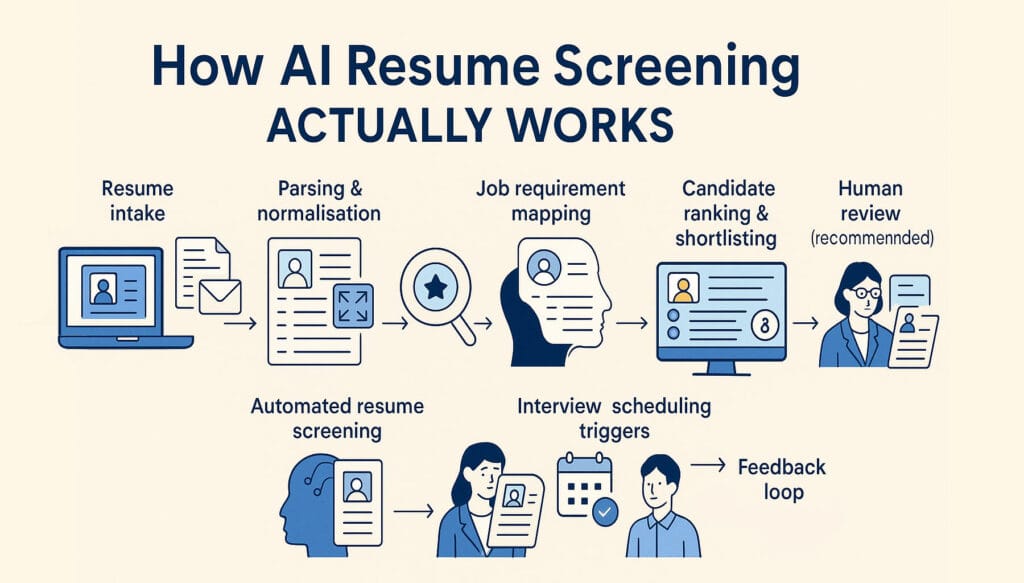
Manual resume screening can slow down hiring, especially when recruiters manage large application volumes.
Automated screening tools help prioritize qualified candidates faster based on skills, experience, and job fit.
This improves recruitment efficiency by:
- Reducing manual review time
- Creating faster shortlists
- Improving candidate prioritization
- Maintaining consistent evaluations
AI-powered screening also allows recruiters to spend more time evaluating strong candidates instead of sorting through every application manually.
3. Building pre-qualified talent pipelines before hiring starts
Waiting until a role opens to begin sourcing often increases time to hire.
Building talent pipelines in advance helps recruiters engage potential candidates before urgent hiring needs arise.
Pre-qualified talent pools help companies:
- Reduce sourcing delays
- Improve hiring readiness
- Speed up candidate outreach
- Fill positions faster
Maintaining relationships with passive candidates also improves long-term hiring consistency and reduces pressure during urgent recruitment cycles.
4. Standardizing candidate evaluation with structured assessments
Inconsistent hiring evaluations often create delays and confusion during decision-making.
Structured assessments help recruiters and hiring managers evaluate every candidate using the same standards.
This creates a more efficient process by:
- Improving evaluation consistency
- Reducing subjective hiring decisions
- Speeding up interview feedback
- Creating clearer hiring alignment
Structured scorecards and role-specific assessments also help teams make faster and more confident hiring decisions.
5. Automating interview scheduling and coordination
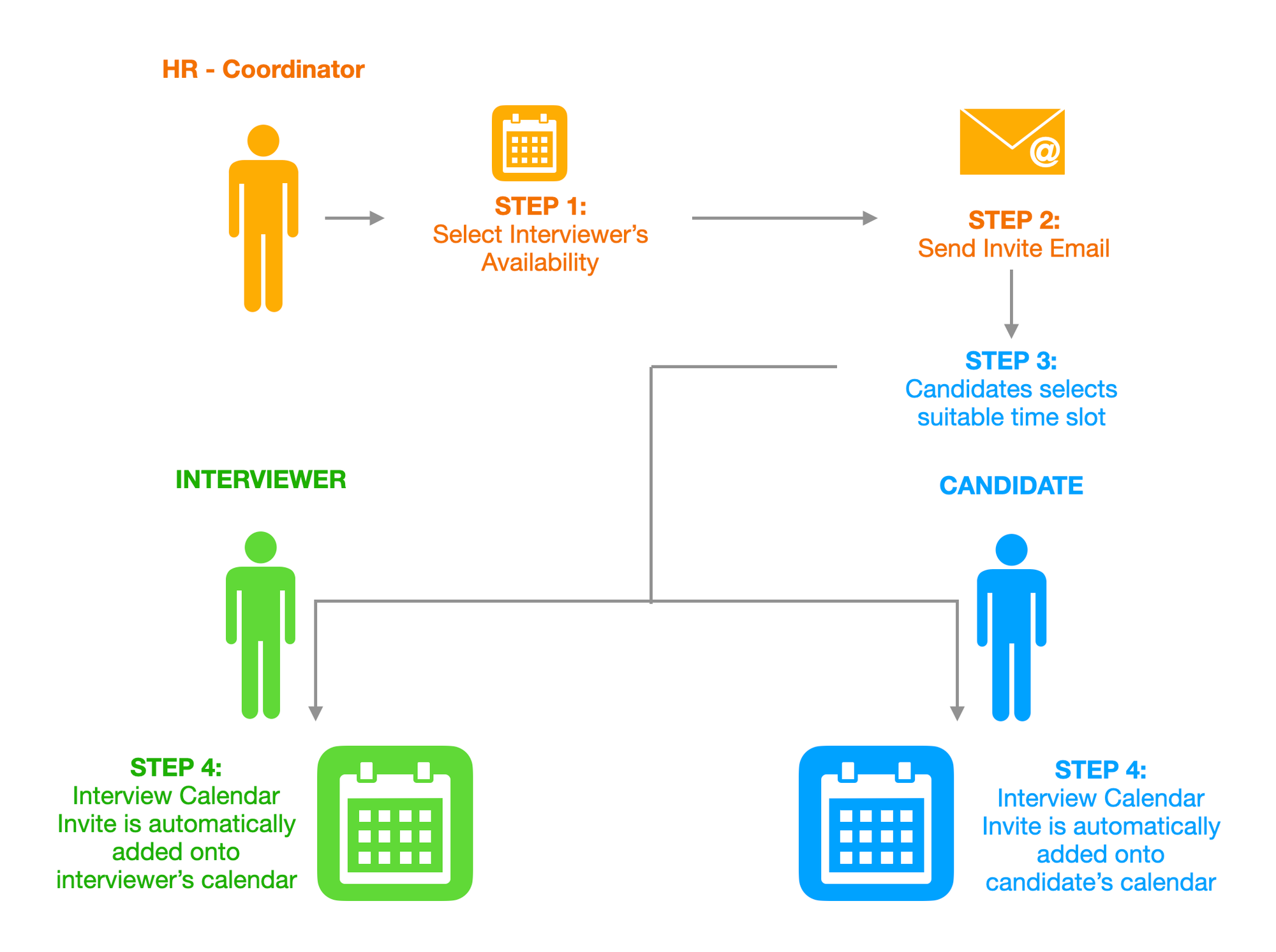
Interview scheduling can become a major hiring bottleneck when recruiters manually coordinate calendars between candidates and hiring managers. Automation simplifies this process significantly.
Automated scheduling helps recruiters:
- Reduce coordination delays
- Eliminate repetitive scheduling emails
- Improve candidate experience
- Speed up interview completion
Platforms like Leelu AI automate scheduling and follow-ups, helping hiring teams move candidates through the recruitment process faster and more efficiently.
6. Using personalized outreach to improve candidate response rates
Generic recruiter messages often get ignored because candidates receive similar outreach from multiple companies.
Personalized communication helps recruiters stand out and build faster engagement with qualified candidates.
Personalized outreach improves hiring efficiency by:
- Increasing candidate response rates
- Creating stronger first impressions
- Improving candidate engagement
- Reducing follow-up delays
AI-powered recruiting tools can automate personalized outreach at scale while keeping messages relevant to each candidate’s background, skills, and experience.
Platforms like Leelu AI help recruiters automate personalized candidate communication without losing authenticity.
7. Streamlining communication between recruiters and hiring managers
Poor communication between recruiters and hiring managers often creates delays in candidate evaluation and approvals.
Clear alignment helps hiring teams move candidates through the pipeline faster.
Streamlined communication helps teams:
- Reduce feedback delays
- Improve hiring alignment
- Speed up decision-making
- Maintain clear candidate expectations
Centralized hiring dashboards and shared workflows also improve visibility across recruitment stages.
When everyone stays aligned on hiring goals and timelines, the process becomes faster, smoother, and more organized.
8. Reducing unnecessary interview rounds and approval delays
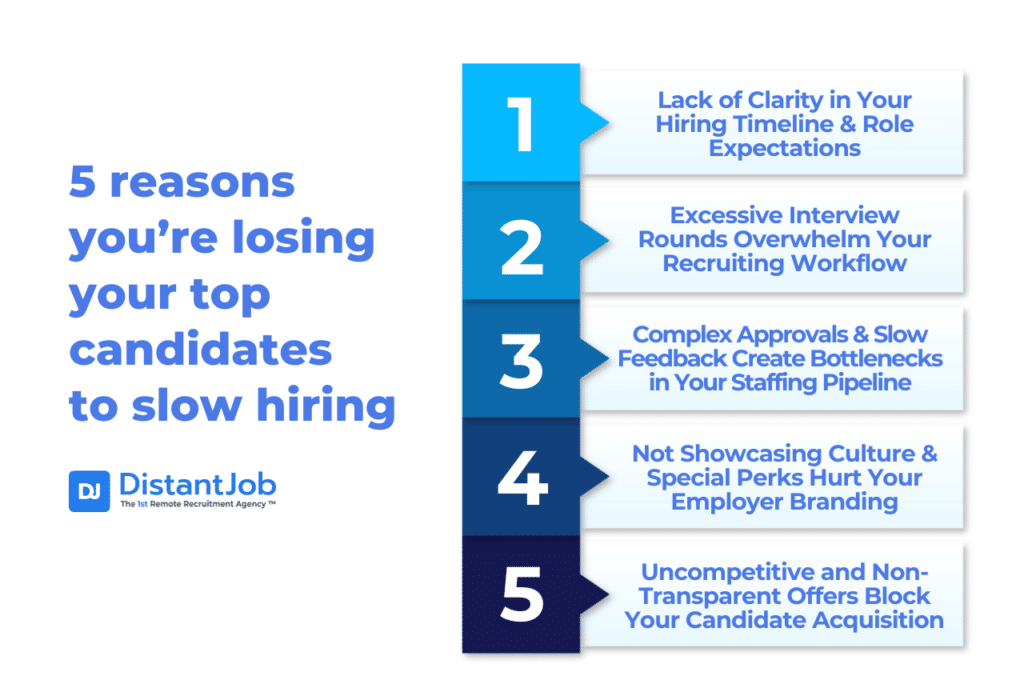
Too many interview rounds can slow down hiring and increase candidate drop-offs. Candidates may lose interest when the process feels repetitive or overly long.
A simplified interview process helps companies:
- Speed up hiring decisions
- Improve candidate experience
- Reduce scheduling delays
- Avoid approval bottlenecks
Structured interviews with clear evaluation goals allow teams to assess candidates efficiently without adding unnecessary stages.
Faster approvals also help companies secure top talent before competitors do.
9. Leveraging recruitment analytics to identify hiring bottlenecks
Recruitment analytics help companies understand where delays happen across the hiring process.
Without hiring data, improving recruitment efficiency becomes difficult.
Analytics help recruiters:
- Track hiring stage performance
- Identify sourcing bottlenecks
- Improve candidate conversion rates
- Optimize hiring workflows continuously
Real-time insights allow teams to make data-driven decisions instead of relying on assumptions.
Platforms like Leelu AI provide hiring analytics that help recruiters monitor sourcing, screening, outreach, and interview performance more effectively.
Suggested Reading:
Top HR Metrics Every HR Professional Should Track10. Centralizing sourcing, screening, and outreach in one workflows
Managing recruitment across multiple disconnected tools often slows down hiring operations.
Recruiters spend unnecessary time switching between sourcing platforms, spreadsheets, emails, and scheduling tools.
A centralized recruitment workflow helps companies:
- Reduce manual data entry
- Improve workflow visibility
- Simplify candidate tracking
- Increase recruiter productivity
Platforms like Leelu AI combine sourcing, screening, outreach, and scheduling into one connected workflow.
This helps recruiters manage hiring processes faster while maintaining better organization and candidate experience.
How Leelu Helps Reduce Time to Hire Efficiently
Reducing time to hire becomes much easier when your recruiting process is connected, automated, and data-driven.
And that is where Leelu.AI comes in.
It is an AI recruiting agent that automates sourcing, candidate screening, outreach, and interview scheduling in one unified workflow.
Instead of relying on disconnected tools and manual coordination, hiring teams can streamline the entire recruitment process from sourcing to interviews within a single platform.
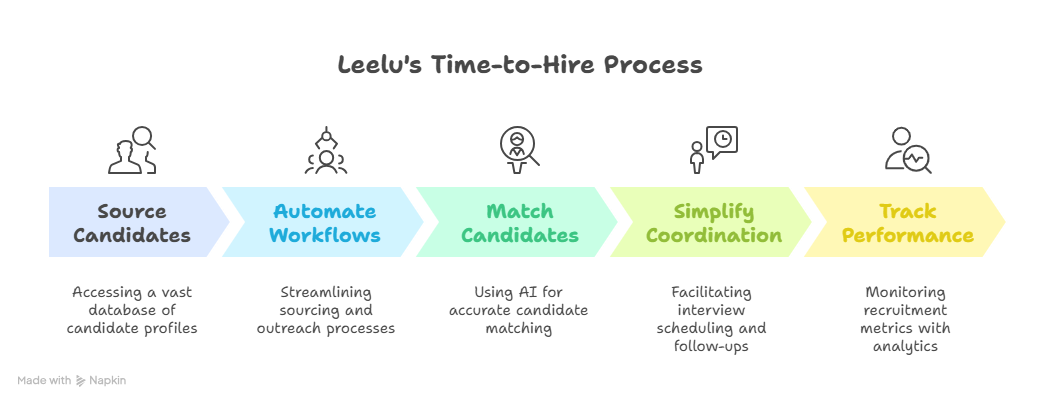
1. Source candidates from 500M+ profiles instantly
Finding qualified candidates manually across multiple platforms can take days.
Leelu AI simplifies this process by helping recruiters source candidates from over 500M+ profiles across LinkedIn, job boards, and ATS systems simultaneously.
This allows hiring teams to identify relevant candidates much faster while expanding their talent reach significantly.
2. Automate candidate sourcing and outreach workflows
Recruiters often spend hours repeating the same sourcing and outreach tasks every day.
Leelu AI automates candidate sourcing, personalized outreach, and follow-up workflows so recruiters can engage candidates at scale without increasing manual workload.
This helps reduce delays in the early stages of recruitment while improving candidate response rates.
3. Match candidates accurately with AI-powered screening
Screening resumes manually can slow down hiring pipelines quickly.
Leelu AI uses AI-powered resume parsing and candidate matching to identify top-fit candidates automatically based on job requirements, skills, and experience.
This helps recruiters shortlist qualified candidates faster and make more accurate hiring decisions.
4. Simplify interview coordination and follow-ups
Interview scheduling often creates unnecessary back-and-forth communication between recruiters, candidates, and hiring managers.
Leelu AI automates interview coordination with smart scheduling workflows, calendar syncing, and automated follow-ups to keep the hiring process moving efficiently.
5. Track recruitment performance with actionable analytics
Improving hiring speed requires visibility into what is slowing the process down.
Leelu AI provides recruitment analytics and hiring insights that help teams identify bottlenecks, track funnel performance, and optimize recruitment workflows for better hiring efficiency.
Common Mistakes That Increase Time to Hire
Many hiring delays are not caused by a lack of candidates.
They usually happen because of inefficient processes, slow decision-making, and avoidable recruitment bottlenecks.
Even small mistakes in the hiring workflow can significantly increase time to hire and cause companies to lose strong candidates.
1. Waiting too long to review applications
One of the biggest hiring mistakes is delaying resume reviews after applications start coming in.
Top candidates often apply to multiple companies at the same time.
If recruiters take too long to screen applications, qualified candidates may already move forward with competitors.
Faster resume review processes help companies engage candidates before interest drops.
2. Using too many interview rounds unnecessarily
Long interview processes slow hiring down and frustrate candidates.
While evaluation is important, excessive interview rounds often create scheduling delays and decision fatigue without improving hiring quality.
Keeping interviews focused and structured helps teams make faster hiring decisions while improving the candidate experience.
3. Depending only on manual sourcing methods
Manual sourcing takes a large amount of recruiter time and limits hiring speed.
Searching multiple job boards and professional networks individually can slow the recruitment pipeline significantly.
Using AI-powered sourcing tools helps recruiters identify qualified candidates faster and scale hiring more efficiently.
4. Poor communication between recruiters and hiring managers
Misalignment between recruiters and hiring managers often creates delays in feedback, approvals, and candidate movement.
Without clear communication, candidates can remain stuck in the hiring pipeline for days.
Shared hiring workflows and centralized communication systems help teams collaborate faster and reduce decision-making delays.
5. Failing to nurture passive candidates for future roles
Many companies only begin sourcing after a position opens.
This increases hiring time because recruiters must start from scratch every time.
Building relationships with passive candidates early helps create a ready-to-engage talent pipeline, making future hiring much faster and more efficient.
Conclusion
Reducing time to hire is not about rushing recruitment decisions. It is about removing inefficiencies that slow your hiring process down unnecessarily.
By improving sourcing, automating repetitive tasks, streamlining communication, and using structured evaluations, companies can hire faster while still maintaining strong hiring quality.
The most successful hiring teams today rely on smarter workflows, better collaboration, and AI-powered recruiting systems to stay competitive in fast-moving talent markets.
Platforms like Leelu AI help businesses simplify sourcing, screening, outreach, and interview coordination in one unified workflow, making it easier to reduce hiring delays and build stronger teams efficiently.
Frequently Asked Questions
1. What is the time to hire in recruitment?
Time to hire measures the number of days between identifying a candidate and successfully hiring them. It helps companies track recruitment speed and efficiency.
2. Why is reducing time to hire important?
A shorter hiring process helps companies secure top candidates faster before competitors do. It also improves recruiter productivity and candidate experience.
3.How can AI help reduce time to hire?
AI automates sourcing, resume screening, outreach, and scheduling tasks. This reduces manual work and speeds up the overall hiring workflow.
4. Does faster hiring reduce candidate quality?
Not necessarily. Faster hiring works best when companies improve workflows and use structured evaluations instead of rushing hiring decisions.
5. What causes long hiring cycles?
Common causes include manual sourcing, delayed feedback, too many interview rounds, and poor communication between hiring teams.


