Recruiting teams rarely struggle because they cannot find any candidates. The harder problem is finding the right candidates quickly, keeping them engaged, and moving them through the hiring process without turning every step into manual work.
That is why AI staffing software has become more practical for recruitment teams in 2026. AI can now support everything from searching large candidate databases and matching skills to job requirements to writing outreach, screening applicants, scheduling interviews, and updating recruiting workflows.
The adoption is already measurable. LinkedIn's 2025 Future of Recruiting research found that 37% of organizations were experimenting with or actively integrating generative AI into recruiting, up from 27% the previous year.
Recruiting professionals using or experimenting with the technology reported saving about 20% of their workweek, or roughly one working day.
But not every AI recruiting platform solves the same problem. Some focus on sourcing, others on conversational recruiting, while platforms such as ATS and recruiting CRM systems combine AI with broader staffing workflows.
Below, we've compared 8 AI staffing software platforms based on their AI capabilities, pricing, etc.
How We Evaluated the Best AI Staffing Software
A large candidate database does not automatically make a recruiting platform useful. We looked at how each tool fits into the actual work recruiters perform every week.
The comparison considers:
- AI sourcing: How effectively the platform helps recruiters discover relevant candidates.
- Candidate matching: Whether AI can compare candidate profiles with job requirements.
- Screening: Tools for reviewing resumes, skills, and candidate fit.
- Outreach: Automated or AI-assisted candidate communication and follow-ups.
- Workflow automation: How much repetitive recruiting work can happen without manual intervention.
- Pricing: Starting cost, user limits, credits, or other measurable pricing restrictions.
- Recruiter feedback: G2 ratings and relevant user feedback where available.
This also means a tool built for a 10-person recruiting team should not be judged in exactly the same way as an enterprise platform supporting thousands of recruiters.
8 Best AI Staffing Software for Recruitment Teams in 2026
Once you look at the tools side by side, the differences become clearer.
1. Leelu AI
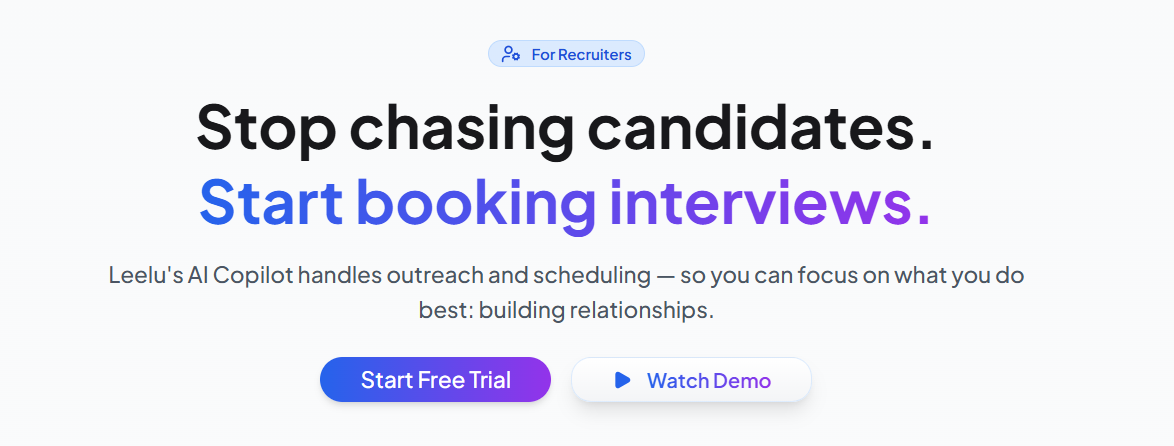
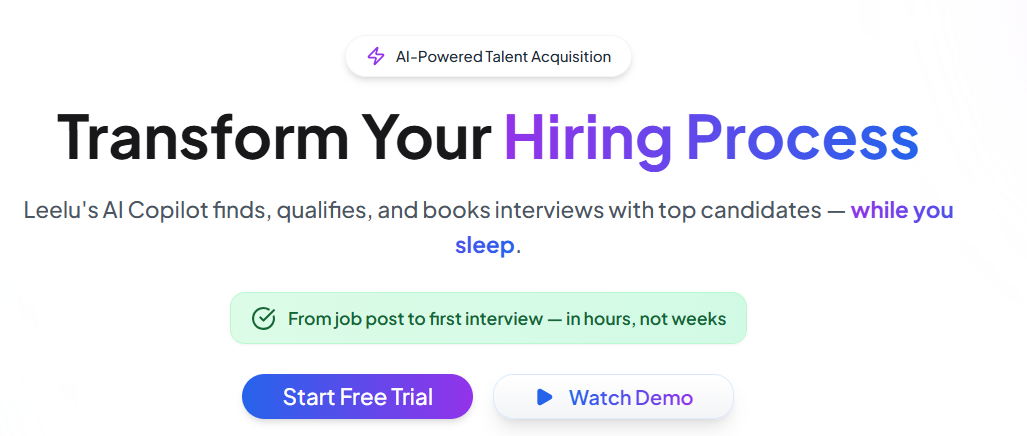
Leelu AI is an AI recruiting platform that automates sourcing, candidate outreach, screening, follow-ups, and interview scheduling.
It can search multiple recruiting sources at once, including LinkedIn, Indeed, Monster, and CareerBuilder, while its AI agents handle candidate engagement through to interview booking. Leelu.ai says its workflow can take a job from posting to a scheduled interview within 24 hours.
Best for: Recruitment teams and staffing agencies that want to automate candidate sourcing and engagement instead of managing each step manually.
Key features
- AI candidate search: Find candidates using natural-language job requirements.
- Multi-platform sourcing: Search LinkedIn, Indeed, Monster, and CareerBuilder from one workflow.
- Autonomous sourcing: Continuously find candidates based on your job requirements and score threshold.
- AI candidate scoring: Rank candidates against role requirements to prioritize relevant profiles.
- Automated outreach: Send personalized messages to candidates without writing each one manually.
- Smart follow-ups: Automatically follow up with candidates who have not responded.
- AI response analysis: Analyze candidate replies and trigger the appropriate next step.
- Interview scheduling: Move interested candidates to interview scheduling with less recruiter coordination.
Pros
- End-to-end automation: Covers sourcing, outreach, follow-ups, and scheduling in one workflow.
- Multiple sourcing channels: Searches several major recruiting platforms from one place.
- Flexible automation: Recruiters can set score thresholds, schedules, and campaign rules.
- Built for volume: Higher plans support more credits, seats, and AI recruiting agents.
Cons
- Usage is plan-dependent: Contact credits and AI recruiting agents increase by plan, so high-volume teams may need a higher tier.
- Some advanced features require higher plans: Multi-platform sourcing, autonomous sourcing, multi-channel outreach, and advanced automation are not all included in Starter.
- AI still needs oversight: Recruiters should review candidate matches, scores, and conversations before relying fully on automated decisions.
Price breakdown
Leelu has four main plans, with pricing based on team size, contact credits, and AI recruiting capacity.
- Starter — $79/month: 1 seat, 500 credits, and 1 AI recruiting agent.
- Growth — $149/month: 5 seats, 2,000 credits, and 2 AI recruiting agents.
- Scale — $249/month: Unlimited seats, 4,000 credits, and unlimited AI recruiting agents.
- Agency Pro — Custom pricing: Up to 5 seats, 10,000 credits, and unlimited AI recruiting agents.
- Add-ons: Extra 500 credits cost $35; additional AI agents cost $99/month.
2. hireEZ
hireEZ is an AI recruiting platform focused on candidate sourcing, engagement, screening, and recruiting workflows. It combines sourcing across LinkedIn and the open web with candidate CRM, outreach, AI screening, interview scheduling, and recruiting analytics. Its current platform is designed to bring several recruiting activities into one workflow.
Best for: Recruitment teams that need AI-powered sourcing and outbound candidate engagement.
Key features
- AI candidate sourcing: Find candidates across LinkedIn and the open web.
- Candidate CRM: Organize prospects, pipelines, and candidate relationships in one place.
- AI recommendations: Identify candidates based on role requirements and profile relevance.
- Contact discovery: Find contact information for candidates you want to engage.
- Outreach and sequencing: Run candidate communication through email, SMS, and InMail.
- AI screening: Use AI to support resume and phone-based candidate screening.
- Interview scheduling: Automate calendar coordination with candidates.
- Recruiting analytics: Track sourcing, engagement, and recruiting activity through reporting and dashboards.
Pros
- Broad recruiting workflow: Combines sourcing, engagement, screening, and scheduling.
- Strong passive sourcing: Useful for recruiters who need to reach candidates who are not actively applying.
- Multi-channel outreach: Supports email, SMS, and InMail engagement.
- Less tool switching: Brings several recruiting activities into one platform.
Cons
- Higher entry price: The current solo plan starts at $494/month.
- More suited to active recruiting teams: Smaller teams may not need the full workflow.
- Verification is important: Teams should test candidate data and workflows against their own hiring requirements.
Price breakdown
hireEZ uses a workflow-based pricing model rather than a simple low-cost per-seat plan.
- Solo — $494/month: Includes a 7-day free trial for individual recruiters.
- Enterprise: Custom pricing based on the recruiting stack and team requirements.
- Enterprise verification: hireEZ offers a four-week verification process before signing for larger deployments.
Suggested Reading:
9 Best HR Automation Tools That Reduce Manual HR Work Fast3. SeekOut
SeekOut is an AI recruiting platform built around talent search, candidate engagement, and talent rediscovery. Its Recruit Core plan provides access to 1B+ profiles, unlimited search, 30+ filters, 500 contact credits, and 1,000 exports per month. Higher plans add ATS rediscovery, inbound screening, and broader recruiting workflows.
Best for: Recruiters sourcing specialized, passive, or hard-to-find candidates.
Key features
- 1B+ candidate profiles: Search a large external talent database.
- AI-powered search: Find candidates using AI-assisted search and matching.
- 30+ filters: Narrow searches using detailed candidate and career criteria.
- Contact credits: Access candidate contact information for outreach.
- Candidate exports: Export profiles to Excel, PDF, or an ATS.
- AI outreach: Create personalized multi-step candidate campaigns.
- ATS rediscovery: Find relevant candidates already stored in your ATS.
- AI screening: Higher plans can evaluate and screen inbound applicants against role requirements.
Pros
- Large talent database: Gives recruiters access to more than 1B profiles.
- Detailed search: 30+ filters help narrow large candidate pools.
- Strong passive sourcing: Designed for finding and engaging candidates beyond inbound applications.
- Multiple recruiting workflows: Higher plans extend from sourcing into ATS rediscovery and screening.
Cons
- Contact limits: Recruit Core includes 500 contact credits per month.
- Exports are capped: The Core plan includes 1,000 exports per month.
- Advanced features cost more: ATS rediscovery, advanced filters, and full-funnel workflows are available on higher plans.
Price breakdown
SeekOut offers both self-serve and custom plans.
- Recruit Core — $149/month: Billed annually; monthly billing is $179/month.
- Recruit Sourcing: Custom per-seat pricing with higher contact and export limits.
- Sourcing + Integration: Custom pricing with ATS rediscovery and unified search.
- Full Recruiting Funnel: Custom pricing for sourcing, screening, integrations, and agentic workflows.
4. Manatal
Manatal combines AI-powered recruitment with ATS, candidate management, sourcing, and workflow automation. Its Professional plan supports 15 jobs and up to 10,000 candidates, while higher plans add unlimited jobs, workflow automation, API access, and other advanced controls.
Best for: Small and growing recruitment teams that want an AI-enabled ATS with transparent pricing.
Key features
- AI candidate enrichment: Enrich candidate profiles with information from social and professional sources.
- AI candidate recommendations: Recommend candidates based on job requirements and profile data.
- CV and resume parsing: Extract skills, experience, and education from candidate resumes.
- AI candidate assessment: Support candidate evaluation with AI-powered assessments.
- ATS: Manage jobs, candidates, hiring pipelines, and recruiter activity.
- Candidate sourcing: Source candidates from multiple channels and job portals.
- Workflow automation: Automate recruiting tasks and pipeline activities on higher plans.
- Recruitment reporting: Track hiring activity and pipeline performance through reports.
Pros
- Transparent pricing: Plans start at $15 per user/month when billed annually.
- ATS plus AI: Combines core applicant tracking with AI recruiting capabilities.
- Good capacity for small teams: Professional supports 15 jobs and 10,000 candidates.
- Scales with team needs: Higher plans add unlimited jobs, candidates, automation, and integrations.
Cons
- Professional has limits: The entry plan is capped at 15 jobs and 10,000 candidates.
- Automation starts higher: Workflow automation is available on Enterprise and Enterprise Plus.
- Advanced integrations cost more: API access, SSO, and custom controls require higher plans.
Price breakdown
Manatal uses a per-user pricing model with three standard tiers.
- Professional — $15/user/month: Billed annually; includes 15 jobs and up to 10,000 candidates.
- Enterprise — $35/user/month: Adds unlimited jobs and candidates plus workflow automation.
- Enterprise Plus — $55/user/month: Adds API access, SSO, custom permissions, priority support, and advanced reporting.
- Custom: Pricing is available for teams requiring custom integrations.
5. Eightfold AI
Eightfold AI is an enterprise talent intelligence platform that uses AI to support sourcing, matching, screening, interviewing, and hiring. Its talent acquisition platform is built around 1.4M+ unique skills and billions of talent data points, with AI agents covering activities from sourcing through interviews.
Best for: Enterprise recruitment teams managing complex hiring and skills-based talent acquisition.
Key features
- AI talent matching: Match candidates to roles using skills, experience, and broader talent signals.
- Skills-based hiring: Evaluate candidates based on skills rather than relying only on job titles or resumes.
- AI sourcing: Identify and engage passive candidates for open positions.
- Talent rediscovery: Reconnect recruiters with suitable candidates already within their talent ecosystem.
- AI screening: Evaluate and rank candidates to reduce manual screening work.
- AI interviewing: Support automated and skills-based candidate interviews.
- Candidate engagement: Personalize candidate communication and engagement across the hiring journey.
- Smart scheduling: Automate interview scheduling and reduce manual coordination.
Pros
- Broad AI coverage: Supports sourcing, screening, interviewing, and hiring in one platform.
- Skills-based matching: Looks beyond basic resume and job-title matching.
- Enterprise scale: Designed for organizations with complex and large-scale talent requirements.
- Agentic workflows: AI agents can handle recruiting tasks while keeping recruiters involved in decisions.
Cons
- Enterprise-focused: The platform may be more than smaller recruiting teams need.
- Custom pricing: There is no simple public monthly plan for comparing costs.
- Implementation can be extensive: Larger organizations may need integrations, configuration, and change management.
Price breakdown
Eightfold AI uses custom enterprise pricing rather than publicly listed monthly plans. Its platform can include talent acquisition, AI agents, integrations, analytics, and other talent intelligence capabilities, so teams need a quote based on their requirements.
6. Paradox
Paradox is a conversational recruiting platform built around its AI assistant, Olivia. It helps recruiters automate candidate screening, interview scheduling, candidate questions, and application workflows through chat, SMS, and mobile experiences. Olivia can also support candidates in 100+ languages, making the platform relevant for high-volume and distributed hiring.
Best for: High-volume recruitment teams that need automated screening, candidate engagement, and interview scheduling.
Key features
- Conversational AI: Let candidates interact with Olivia through natural-language conversations.
- Automated screening: Screen candidates against job requirements before recruiters review them.
- Text-to-apply: Let candidates start applications through SMS or QR codes.
- Candidate engagement: Answer candidate questions and provide updates 24/7.
- Interview scheduling: Automatically schedule, reschedule, and send interview reminders.
- Multi-language support: Olivia can answer candidate questions in 100+ languages.
- Conversational ATS: Manage applications and recruiting workflows through a conversational experience.
- Onboarding automation: Support offer delivery, forms, background checks, and other onboarding steps.
Pros
- Strong for high-volume hiring: Automates repetitive candidate interactions at scale.
- Fast candidate response: Candidates can apply, screen, and schedule without waiting for a recruiter.
- Mobile-first experience: Works through text and mobile conversations instead of long application forms.
- Broad integrations: Connects with platforms such as Workday, SAP SuccessFactors, Greenhouse, Lever, and UKG.
Cons
- Enterprise-focused: The platform is primarily designed for organizations with larger hiring volumes.
- Custom pricing: There is no standard public monthly plan for easy cost comparison.
- Best suited to specific workflows: Teams focused mainly on executive or niche sourcing may not need its high-volume automation.
Price breakdown
Paradox uses custom pricing based on the hiring workflow and organization’s requirements.
- Custom pricing: Contact Paradox for a quote based on hiring volume and required modules.
- Implementation: Pricing can vary depending on integrations, workflows, and deployment requirements.
- Enterprise focus: The platform is generally positioned for larger organizations and high-volume hiring.
7. Gem
Gem is an AI-first recruiting platform that combines sourcing, CRM, outreach, scheduling, ATS, and recruiting analytics. For recruiting firms, its plans support sourcing across 30+ social platforms, while its broader platform can search 800M+ public talent profiles using AI.
Best for: Recruitment teams and staffing firms that want sourcing, candidate engagement, CRM, and analytics in one platform.
Key features
- AI sourcing: Search 800M+ public talent profiles and surface relevant candidates.
- Multi-platform sourcing: Add candidates from LinkedIn and 20+ sourcing sites.
- Recruiting CRM: Store candidate profiles, interactions, and recruiting activity in one database.
- AI candidate ranking: Rank candidates across your pipeline based on role relevance.
- Automated outreach: Create personalized multi-step email and multi-channel sequences.
- Email finding: Find work and personal emails for sourced candidates.
- Interview scheduling: Coordinate interviews without managing scheduling manually.
- Recruiting analytics: Track outreach, sourcing, pipeline, and recruiting performance.
Pros
- All-in-one recruiting workflow: Combines ATS, CRM, sourcing, scheduling, and analytics.
- Large talent pool: AI sourcing can search 800M+ public profiles.
- Strong outreach automation: Supports personalized sequences and automated follow-ups.
- Useful for staffing firms: Includes features for client outreach and candidate management.
Cons
- Higher starting cost: Recruiting-firm plans start at $99/user/month when billed annually.
- Credit limits: Email-finding credits vary significantly by plan.
- Advanced capabilities cost more: AI sourcing, integrations, API access, and advanced analytics depend on the plan.
Price breakdown
Gem has separate pricing for recruiting firms and broader talent acquisition teams.
- Essentials — $99/user/month: Billed annually; includes 150 email-finding credits per user.
- Professional — $149/user/month: Billed annually; includes 750 email-finding credits per user.
- Enterprise — Custom: Adds flexible credits, AI sourcing, ATS connectors, API access, and advanced analytics.
- Monthly billing: Essentials is $139/user/month and Professional is $199/user/month.
- 7-day trial: Both Essentials and Professional include a 7-day trial.
8. Bullhorn
Bullhorn is a staffing and recruiting platform built specifically for agencies managing candidates, jobs, clients, and placements. Its platform combines ATS and CRM capabilities with AI search, matching, automation, data enrichment, and analytics. Bullhorn currently works with 10,000+ customers globally, including more than 4,500 small staffing agencies.
Best for: Staffing and recruiting agencies that need an ATS, CRM, and AI automation in one platform.
Key features
- Applicant tracking: Manage candidates, applications, jobs, and hiring pipelines.
- Recruitment CRM: Manage client relationships and sales pipelines alongside recruiting activity.
- AI search and matching: Find and match candidates against open roles.
- AI data enrichment: Automatically add useful information to candidate records.
- Resume parsing: Extract candidate information from resumes into the ATS.
- Process automation: Automate repetitive recruiting and staffing workflows.
- AI outreach and engagement: Higher tiers support multi-step candidate engagement.
- Real-time analytics: Track recruiting, staffing, and business performance through live reporting.
Pros
- Built for staffing agencies: The platform is designed around candidate, job, and client relationships.
- ATS plus CRM: Recruitment and sales activity can be managed in one system.
- Strong AI expansion: Higher tiers add AI matching, enrichment, outreach, and agentic workflows.
- Large customer base: Used by 10,000+ staffing and recruiting organizations globally.
Cons
- AI starts at higher tiers: AI search and matching are included in Pro and Max rather than Starter.
- Advanced plans are custom-priced: Teams need a quote for the full AI-powered platform.
- More complex for small teams: Agencies needing only basic sourcing may not need the complete platform.
Price breakdown
Bullhorn offers four main platform editions for small staffing agencies.
- Starter — $99/user/month: Includes ATS, resume parsing, client management, and job posting.
- Core — $165/user/month: Adds custom workflows, LinkedIn integrations, and marketplace access.
- Pro — Custom pricing: Adds recruitment CRM, AI search and matching, AI enrichment, automation, and analytics.
- Max — Custom pricing: Adds agentic AI workflows, screening, matching, outreach, chatbot, and interview scheduling.
- Implementation: Starter, Core, and Pro include free implementation; Max is quoted separately.
How to Choose AI Staffing Software for Your Recruitment Team
The right platform depends less on how many AI features it has and more on where your recruiters are losing time.
If sourcing is the bottleneck, prioritize platforms with large candidate databases, advanced filters, AI matching, and contact discovery.
If recruiters already have enough candidates but cannot review them quickly enough, screening and ranking capabilities become more important.
For teams struggling with candidate engagement, look for automated outreach, follow-ups, conversational AI, and scheduling.
Staffing agencies may need to go further and prioritize an integrated ATS and CRM because recruiters are managing both candidates and clients.
Before signing a contract, check:
- Candidate volume: How many profiles or applicants can you process each month?
- AI limits: Are AI searches, matches, messages, or actions capped?
- Contact credits: How many email or phone lookups are included?
- User limits: Does the advertised price apply to one recruiter or multiple users?
- ATS integrations: Can candidate information move automatically between systems?
- Automation: Which recruiting steps can actually run without manual intervention?
- Data quality: How frequently is candidate and contact information refreshed?
- Reporting: Can you measure recruiter productivity and hiring outcomes?
- Implementation: How long will setup, migration, and training take?
The most useful comparison is therefore not simply "$15 versus $149 per month." It is what the team gets for that spend and how much manual recruiting work disappears from the workflow.
How Much Does AI Staffing Software Cost?
AI staffing software can range from $15 per user/month for entry-level recruiting platforms to $100+ per user/month for more advanced sourcing and recruiting systems, while enterprise platforms often require custom pricing.
The subscription price is only one part of the calculation. Look at:
- Monthly or annual subscription
- Number of recruiter seats
- Candidate or contact credits
- Email/phone lookup limits
- AI usage limits
- ATS/CRM integration costs
- Implementation fees
- Premium support
- Additional data or export charges
For example, a $99 platform that includes hundreds of contact credits and automated workflows may have a very different effective cost from a cheaper platform that requires separate tools for sourcing, enrichment, outreach, and scheduling.
A simple way to evaluate the economics is:
Cost per recruiter hour saved = Monthly software cost ÷ recruiter hours saved per month
That gives recruitment teams a more useful metric than comparing subscription prices alone.
Final Takeaway
AI staffing software is becoming less about adding an AI assistant to one recruiting task and more about connecting the entire workflow.
A sourcing-heavy team may benefit most from a platform with a large talent database and advanced search. A high-volume employer may care more about automated screening, candidate conversations, and scheduling. A staffing agency may need AI capabilities built directly into its ATS and CRM.
The important question is not simply "Which AI staffing software has the most features?"
It is "Which parts of our recruiting workflow are consuming the most recruiter time, and can this platform reliably take that work off their plate?"
That is the comparison that will tell you whether an AI staffing platform is actually useful for your team—not just whether it has AI in its product description.
Frequently Asked Questions
Can AI staffing software work with an existing ATS?
Yes. Many AI staffing platforms can connect with an existing ATS or recruiting system through integrations or APIs. Before choosing one, check whether it supports your current ATS and whether candidate data, notes, outreach activity, and status updates can sync between systems.
Does AI staffing software replace recruiters?
No. AI staffing software is generally used to automate repetitive recruiting tasks such as candidate discovery, resume screening, outreach, follow-ups, and scheduling. Recruiters still make decisions about candidate fit, communication, interviews, and hiring.
How accurate are AI candidate matches?
Accuracy depends on the platform, the quality of its candidate data, and how clearly the hiring criteria are defined. AI matching should be treated as a way to prioritize candidates rather than as a final hiring decision.
What should I check before buying AI staffing software?
Look beyond the number of AI features. Check candidate database coverage, sourcing credits, contact limits, ATS integrations, automation capabilities, user limits, data controls, implementation requirements, and the actual cost at your expected hiring volume.
Is AI staffing software useful for high-volume hiring?
Yes. Automation can be particularly useful when recruiters need to process large candidate pools, send high volumes of outreach, screen applicants against consistent criteria, or schedule many interviews. The right platform depends on the volume and type of hiring involved.