Healthcare recruiting has a problem that goes beyond the number of open positions.
You need to find people with the right experience, skills, credentials, location, availability, and role fit. At the same time, qualified candidates may be considering multiple opportunities, which means delays can cost you good talent.
Then there is the work happening behind the scenes.
Recruiters spend hours searching profiles, reviewing resumes, sending follow-ups, coordinating interviews, and keeping applicant tracking systems updated. Much of this work is necessary, but not all of it requires recruiter judgment.
That is where AI in healthcare recruiting can become useful.
The question isn't whether AI can automate recruiting. It is about knowing which parts of healthcare recruitment you should automate, where human judgment still matters, and how you can make the process faster without creating new risks.
In this guide, you'll explore:
- Why healthcare recruiting has unique challenges
- 8 practical use cases for AI in healthcare recruiting
- How AI can improve recruiting efficiency and candidate experience
Why Healthcare Recruiting Is Different
Healthcare hiring isn't simply about finding someone whose resume contains the right job title.
You may need to evaluate several requirements at the same time. A candidate might have the right experience but live too far away. Another might have the right specialty but lack a required certification.
Depending on the role, you may need to consider:
- Clinical specialty
- Relevant experience
- Skills
- Licenses and certifications
- Location
- Shift availability
- Employment type
- Role-specific requirements
- Candidate availability
- Compensation expectations
This makes healthcare recruiting a matching problem as much as a sourcing problem.
Healthcare recruiting has a matching problem, not just a sourcing problem
→ Imagine you're hiring an ICU nurse
A candidate may have several years of nursing experience and match the title "Registered Nurse." But if your opening requires ICU experience, a specific license, night-shift availability, and a particular location, the title alone tells you very little.
You need to look at how those requirements come together.
This is where AI can help you move beyond basic keyword searches. Instead of looking for isolated terms, an AI recruiting system can help you evaluate candidates against multiple job requirements and prioritize profiles that appear more relevant.
The recruiter still needs to review the information and make the appropriate hiring decision.
The value comes from reducing the time spent finding those candidates in the first place.
→ Recruiters also have a time problem
Finding candidates is only one part of the recruiting workflow.
Once you identify someone, you still need to reach out, follow up, answer questions, coordinate interviews, update records, and keep the candidate moving through the process.
When these tasks are handled manually, small delays can accumulate quickly.
AI can help by taking over repetitive parts of the workflow while allowing recruiters to spend more time on conversations, hiring-manager collaboration, candidate evaluation, and situations that need human attention.
That distinction matters.
The goal isn't to remove the recruiter from the process. It is to give the recruiter more time to do the work where judgment actually matters.
Yes — for the 8 use cases, I’d make each one feel different instead of giving all eight the same “AI does X” explanation. You can mix stats, mini case studies, practical examples, visual suggestions, and recruiter scenarios. That will make the section much more engaging without making it unnecessarily long.
8 Practical Use Cases for AI in Healthcare Recruiting
Healthcare recruiting isn't just about finding more candidates. Recruiters have to identify people with the right skills and credentials, keep them engaged, move them through interviews quickly, and often do all of this while dealing with urgent staffing needs. AI can support different parts of that process.
1. AI-Powered Candidate Sourcing
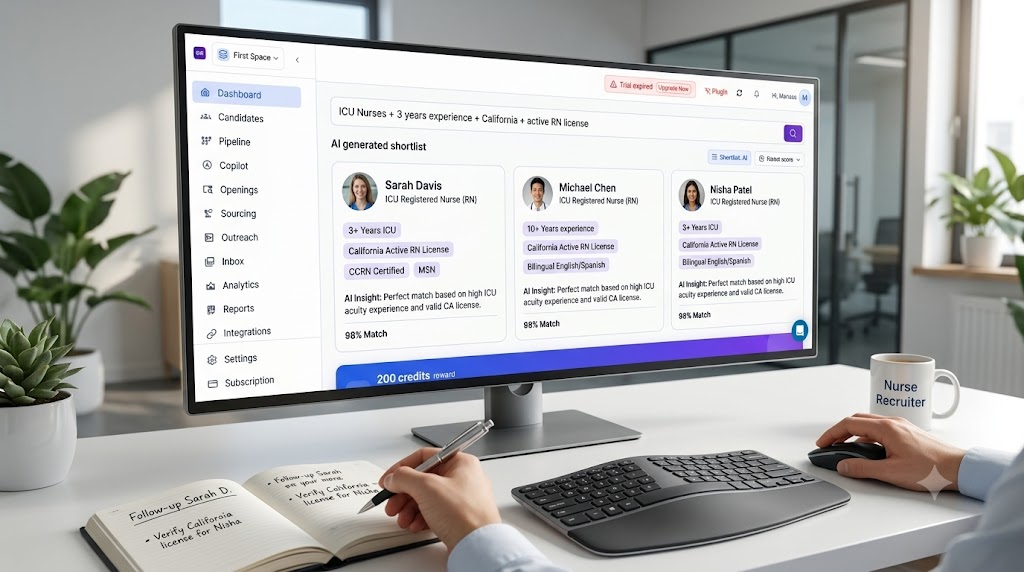
Finding qualified healthcare professionals can take hours, particularly for specialized roles such as registered nurses, physicians, therapists, and technicians. AI can search across candidate databases and identify profiles based on skills, experience, location, certifications, and other role requirements.
For example: Instead of manually searching hundreds of profiles for an ICU nurse, a recruiter can use AI to narrow the pool to candidates with relevant critical-care experience and required credentials.
2. Resume Screening and Candidate Matching
Healthcare recruiters can receive hundreds of applications for a single opening, making manual resume review slow and inconsistent. AI can scan resumes against job requirements and highlight candidates who appear to match the role.
At Kauvery Hospitals, an AI-powered recruitment system was used for resume parsing, screening, candidate ranking, and sourcing. The organization reported up to 78% reduction in time-to-hire and 3X more candidates sourced.
The recruiter still reviews the shortlisted candidates, but AI reduces the amount of manual sorting involved.
Mini example: Job: ICU Nurse
AI looks for: ICU experience + RN qualification + required skills + location
Recruiter: Reviews the shortlisted profiles and validates credentials.
3. Automated Candidate Outreach
Finding a candidate is only the first step. Healthcare professionals may already be working, so recruiters often need personalized outreach and multiple follow-ups to get a response.
AI can help create personalized messages based on a candidate's experience, specialty, or role and automate follow-ups without requiring recruiters to manually track every conversation.
Real-world example: The Aspen Group reported saving 3–5 minutes per candidate on personalized outreach using an AI sourcing agent. For a 50-candidate project, that can add up to several hours.
4. 24/7 Candidate Engagement
Healthcare professionals don't always search for jobs during standard office hours. Someone finishing a night shift may apply at 2 a.m., while another candidate may have questions over the weekend.
AI chatbots and recruiting assistants can respond to common questions, collect information, and keep candidates moving even when recruiters aren't online.
At Houston Methodist, 52% of candidates were reported to chat with its recruiting chatbot outside normal business hours, including candidates interested in difficult-to-fill night-shift positions.
Think of it as:Candidate applies at 11:30 p.m. → AI responds → answers basic questions → collects details → recruiter follows up later.
5. Interview Scheduling
Scheduling interviews can become a surprisingly large administrative task when candidates, recruiters, and hiring managers have different schedules. AI can compare availability, send scheduling options, handle reminders, and manage rescheduling.
Essentia Health reported a 100% increase in interviews scheduled after implementing conversational AI for candidate capture and scheduling.
This is particularly useful for healthcare teams hiring across multiple shifts, locations, or high-volume roles.
6. Re-Engaging Past Candidates
Your ATS may already contain people who applied previously but weren't hired. Instead of starting every search from zero, AI can help identify past applicants who may now match an open position.
For example, a candidate who applied for a nursing role six months ago may now have the experience or availability needed for a new opening.
AI can help recruiters:
- Search previous applicants
- Match them to new openings
- Prioritize relevant candidates
- Send personalized re-engagement messages
This turns existing candidate data into another potential source of talent.
7. High-Volume Healthcare Hiring
Some healthcare organizations need to recruit large numbers of people for similar roles, making manual screening and scheduling difficult to manage.
AI can help automate repetitive steps such as application screening, candidate questions, scheduling, and follow-ups while recruiters focus on qualified candidates.
Real-world example: MultiCare Health System used AI to automate candidate registration, screening, and scheduling for recruiting events. The organization reported a 25% increase in event hires and a 22% decrease in cost per hire.
8. Tracking and Improving the Recruiting Funnel
AI can also help recruiters understand where candidates are getting stuck. Instead of looking only at the number of hires, teams can track where candidates drop off between application, screening, interview, and offer.
For example:
1,000 applications → 300 screened → 100 interviews → 40 offers → 30 hires
If most candidates are disappearing between screening and interviews, recruiters have a clear area to investigate.
This becomes especially useful because recent healthcare hiring data identifies candidate drop-off, interviewer availability, and delayed feedback as important sources of hiring friction.
The bigger idea: AI isn't just about doing recruiting tasks faster. It can help recruiters see where the process is slowing down and what needs attention.
Benefits of AI in Healthcare Recruiting
Now that you've seen where AI can fit into the workflow, the benefits become easier to understand.
The biggest advantage isn't simply that AI can perform individual tasks faster.
It is that several small improvements can add up across the entire recruiting process.
1. Shorter time to identify qualified candidates
AI can reduce the manual effort involved in sourcing, resume screening, and candidate matching.
Instead of spending hours searching and reviewing profiles, recruiters can start with a prioritized group of candidates and focus their attention on evaluating them.
That can help shorten the distance between opening a role and identifying people worth contacting.
2. More recruiter capacity
Recruiters have limited time.
Every hour spent searching databases, sending routine follow-ups, or coordinating calendars is an hour that cannot be spent building candidate relationships or working with hiring managers.
Automating repetitive tasks gives recruiters more capacity without necessarily requiring additional headcount.
3. Greater candidate reach
Manual sourcing can limit how many candidates a recruiter can realistically identify and contact.
AI can search larger candidate pools and support outreach at a scale that would be difficult to manage manually.
This can be particularly useful when you need to recruit for multiple roles or maintain a steady pipeline of candidates.
4. Faster candidate communication
Candidate experience can suffer when communication takes too long.
Automated responses and follow-ups can reduce unnecessary gaps between interactions.
Instead of waiting for a recruiter to return to a message, candidates can receive timely responses for routine parts of the process.
5. More consistent initial screening
When you define clear screening criteria, AI can apply those criteria consistently across a large number of profiles.
That can reduce some of the variation that comes from manually reviewing hundreds of resumes under time pressure.
But consistency should not be confused with fairness.
An AI system can consistently apply criteria that are poorly designed or produce biased outcomes. That's why screening criteria, system performance, and human oversight still matter.
6. Better visibility into the recruiting funnel
When recruiting activities happen across disconnected tools, it can be difficult to understand what's happening across the entire pipeline.
A connected AI recruiting workflow can give you a clearer view of sourcing, engagement, screening, scheduling, and other stages.
That makes it easier to identify bottlenecks and understand where your recruiting process needs attention.
Challenges of Using AI in Healthcare Recruiting
AI can simplify many recruiting tasks, but healthcare organizations need safeguards to use it responsibly. Here are five common challenges and practical ways to address them.
1. Bias in Candidate Screening
AI can reproduce patterns or biases present in the data it learns from, which may affect how candidates are screened or ranked.
Solution:
- Regularly test AI screening results for unexpected patterns.
- Review the criteria used to rank candidates.
- Keep human recruiters involved in important hiring decisions.
2. Inaccurate Candidate Information
AI can process resumes and profiles quickly, but candidate information may be outdated, incomplete, or unverified.
Solution:
- Use AI to organize and prioritize information.
- Verify important qualifications, licenses, and experience.
- Require recruiter review before making decisions based on AI outputs.
3. Data Privacy and Security
Recruiting systems handle sensitive candidate information, so organizations need to know how AI tools collect, store, and process that data.
Solution:
- Check what candidate data the tool collects.
- Review access controls and data-retention policies.
- Confirm how the tool integrates with existing ATS and HR systems.
4. Lack of Transparency
A candidate score or recommendation can be difficult to trust when recruiters don't understand why the AI produced it.
Solution:
- Choose tools that provide clear reasoning or relevant evaluation criteria.
- Give recruiters visibility into AI recommendations.
- Allow human review when results seem unclear or incorrect.
5. Over-Automation
Automating too much of the recruiting process can make candidate interactions feel impersonal, especially during sensitive conversations.
Solution:
- Automate repetitive tasks such as scheduling and follow-ups.
- Keep humans involved in complex or sensitive interactions.
- Use AI to support recruiters rather than replace human judgment.
How to Use AI in Healthcare Recruiting Without Losing Human Oversight
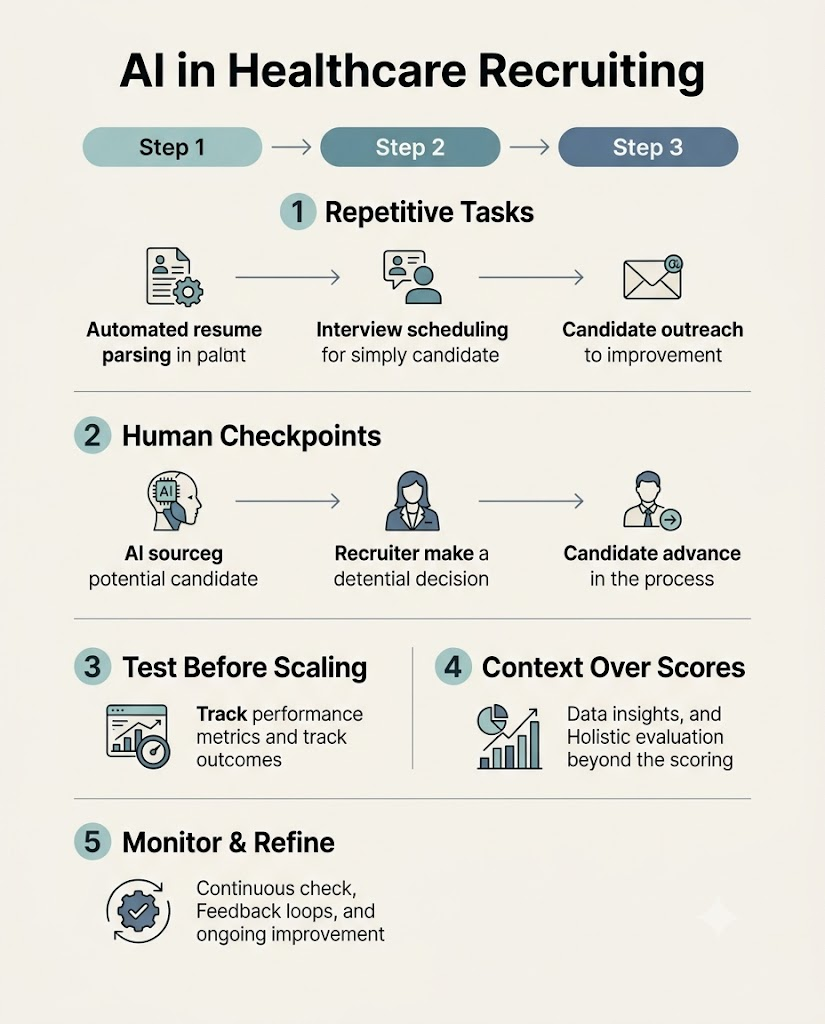
The most useful AI recruiting workflow isn't the one with the most automation.
It is the one where automation is applied deliberately.
You want AI to remove repetitive work while keeping people responsible for decisions that require context, judgment, and accountability.
Start with repetitive tasks
Begin with tasks that consume significant time but don't require complex judgment.
Good starting points can include:
- Candidate sourcing
- Resume parsing
- Initial outreach
- Follow-ups
- Interview scheduling
- Data entry
- Recruiting reports
These tasks can reduce recruiter workload without requiring you to hand over the entire hiring process to an AI system.
Define human checkpoints
Before implementing AI, decide where recruiters need to review the output.
For instance:
AI identifies candidates → Recruiter reviews candidates → Candidate progresses
This is different from:
AI identifies candidate → Candidate automatically advances or is rejected
The first approach uses AI to support the workflow while keeping the recruiter involved.
That distinction becomes increasingly important as the consequences of a decision become more significant.
Test before scaling
You don't have to automate your entire recruiting process on day one.
Start with a defined group of roles and compare the workflow before and after implementation.
Track metrics such as:
- Time to shortlist
- Recruiter effort
- Candidate response rates
- Candidate drop-off
- Time to interview
- Quality of shortlisted candidates
- Accuracy of extracted candidate information
The goal is to determine whether AI is actually improving the process rather than assuming it will.
Monitor the system after launch
Implementation isn't the finish line.
You need to continue checking how the system performs as your roles, candidate pools, workflows, and requirements change.
A process that works well for one type of healthcare role may not work exactly the same way for another.
Regular monitoring gives your recruiting team an opportunity to identify errors, unexpected outcomes, or areas where the workflow needs adjustment.
Give recruiters context, not just scores
A candidate score can be useful.
But a score alone doesn't tell a recruiter enough.
Your recruiters need to understand why a candidate was surfaced and which parts of the job requirements appear to match the candidate's profile.
That context helps recruiters validate AI output instead of treating it as an unquestionable recommendation.
The best workflow is therefore not AI decides, recruiter follows.
It is AI processes, recruiter evaluates, and the organization remains accountable.
How Leelu Can Support the Healthcare Recruiting Workflow
Once you know which parts of healthcare recruiting are worth automating, the next challenge is connecting those tasks into one workflow.
That's where an AI recruiting copilot can become useful.
Leelu is positioned as an AI recruiting copilot that automates sourcing, profile screening, outreach, and interview scheduling end-to-end.
Its messaging also positions the platform around finding candidates that match job requirements across 500M+ profiles from sources including LinkedIn, Indeed, Monster, and ATS systems.
Instead of treating sourcing, screening, outreach, scheduling, and reporting as separate activities, Leelu's workflow connects them into an end-to-end recruiting process.
From candidate sourcing to interview scheduling
The workflow can be thought of as:
Create job → Source → Aggregate → Screen → Match → Engage → Follow up → Schedule → Sync → Optimize
Here's how those stages map to Leelu's stated capabilities:
The practical value is less about adding another AI tool to your recruiting stack and more about reducing the number of manual handoffs between recruiting stages.
What Should You Automate—and What Should Stay Human?
The easiest way to approach AI recruiting is to divide your workflow into two categories.
Automate the repetitive work.
Keep humans responsible for decisions that require context, judgment, and accountability.
This doesn't mean every task in the first column should happen without human review.
It means these are areas where AI can handle more of the repetitive workload while recruiters remain involved at the points that matter.
The same principle applies to healthcare recruiting.
You can automate the search without automating accountability.
You can automate scheduling without automating judgment.
You can automate follow-ups without removing the recruiter from important conversations.
The goal isn't to automate the recruiter. It's to automate the work that prevents the recruiter from recruiting.
Conclusion
Healthcare recruiting involves many repetitive tasks, from finding and screening candidates to outreach, follow-ups, scheduling, and updating recruiting data. These activities can take time away from the conversations and decisions that require human attention.
AI can reduce this workload by helping recruiters find relevant candidates, prioritize profiles, personalize outreach, automate follow-ups, coordinate interviews, and track the recruiting funnel.
However, AI shouldn't replace human judgment. Start by automating repetitive tasks, add human checkpoints, and monitor results before scaling.
The goal is simple: let AI handle repetitive work while recruiters focus on decisions and candidate relationships.
Frequently Asked Questions
Can AI verify healthcare licenses and certifications?
AI can help organize and flag candidate credentials, but recruiters should verify licenses, certifications, and other regulated qualifications through the appropriate sources before making a hiring decision.
Can AI reduce candidate drop-off during healthcare hiring?
Yes. AI can help keep candidates engaged by sending timely reminders, answering routine questions, and simplifying scheduling. This can reduce delays that cause candidates to lose interest or move on to another opportunity.
Can AI help recruiters fill urgent healthcare roles faster?
AI can speed up time-consuming steps such as candidate sourcing, profile matching, outreach, and interview scheduling. This can help recruiters move qualified candidates through the process faster, although hiring speed still depends on candidate availability and other factors.
Can AI personalize outreach to healthcare professionals?
Yes. AI can use information such as a candidate's skills, experience, specialty, or career history to create more relevant outreach. Recruiters should still review messages to make sure they are accurate and appropriate for the candidate.