
Recruiters often receive hundreds of resumes for a single job opening. Reviewing every resume manually can quickly become time-consuming, especially when you need to compare candidates against the same job requirements.
That is where ATS resume screening helps. An Applicant Tracking System can parse resumes, identify relevant information, and help recruiters narrow a large applicant pool to candidates worth reviewing.
But an ATS does not replace recruiter judgment. You still need to understand what the system looks for and where automated screening can fall short.
In this guide, you’ll learn:
- How ATS resume screening works
- What information an ATS looks for in a resume
- How keywords and job requirements influence screening
- Why qualified candidates can still get overlooked
- How recruiters can make the screening process more effective
- How AI-powered resume screening can support faster candidate matching
What Does an ATS Look for in a Resume?
Understanding what an ATS screening resume evaluates can help you create a more effective screening process.
Relevant Keywords and Skills
Keywords remain an important part of resume screening because they help systems identify whether a candidate's experience aligns with the position.
Suppose your job description requires:
- Salesforce
- CRM management
- Lead generation
- B2B sales
- Five years of experience
A candidate whose resume clearly contains these skills and experiences is easier for the system to match against those requirements.
However, keyword presence alone should not determine whether someone is qualified.
A candidate might mention a technology once without having meaningful experience using it.
Job Titles and Experience
The ATS can also use previous job titles and employment history to understand a candidate's background.
For example, a candidate applying for a Senior Product Manager position may have previously worked as a Product Manager, Product Lead, or similar role.
Recruiters should therefore avoid treating an exact job-title match as the only indicator of suitability.
Education and Certifications
Some positions require specific degrees, licenses, or certifications.
An ATS can help identify these details and apply them as screening criteria when they are genuinely required for the role.
For regulated or highly specialized positions, this can make initial screening much easier.
How Does ATS Resume Screening Work?
When a candidate applies for a job, their resume does not simply land in a recruiter's inbox for manual review.
According to Jobvite’s 2025 Recruiter Nation Report, recruiters spend significant time reviewing and screening candidates, making automation increasingly important as application volumes grow.
The ATS first processes the application and turns the resume into structured candidate information. It can then compare that information with the requirements of the open position and help recruiters prioritize candidates for review.
Think of it as a first-pass screening layer between the application and the recruiter.
ATS Resume Screening Process at a Glance
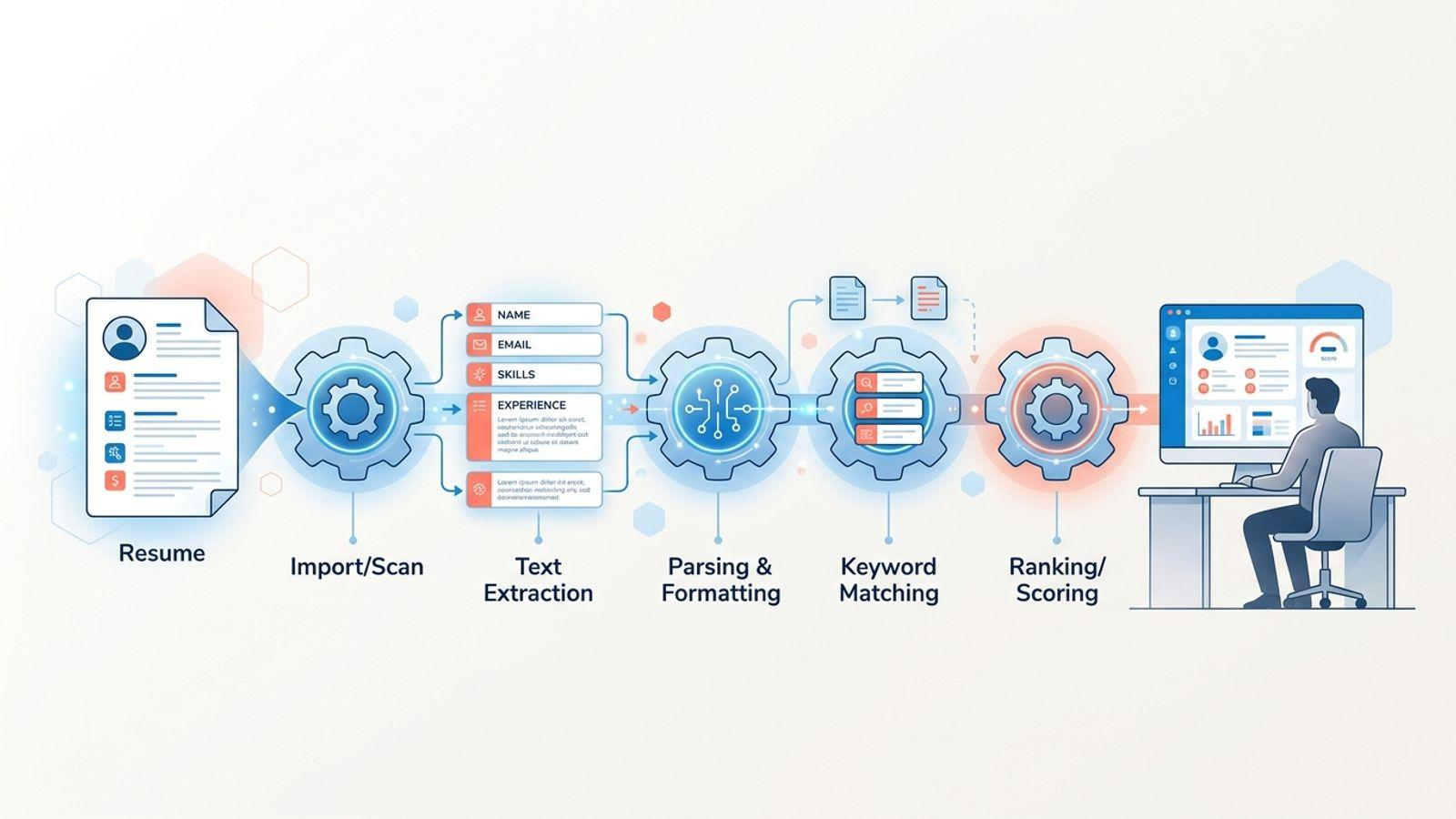
The process typically follows these stages:
1. Resume submitted
↓
2. Resume parsed
↓
3. Candidate information extracted
↓
4. Information matched against job requirements
↓
5. Candidates filtered or scored
↓
6. Recruiter reviews the strongest matches
Let's walk through what happens at each stage.
1. The ATS Parses the Resume
The first step is resume parsing.
When you receive a resume, the ATS processes the document and identifies information that can be stored as structured candidate data.
Instead of treating the resume as one large block of text, the system can identify different sections and attributes, such as:
- Candidate name and contact information
- Current and previous job titles
- Work experience
- Skills
- Education
- Certifications
- Companies worked for
- Dates and duration of employment
Consider a candidate applying for a Cloud Engineer position.
Their resume might include:
“Managed cloud infrastructure using AWS and Terraform across production environments.”
During parsing, the system may identify:
Skill: AWS
Skill: Terraform
Experience area: Cloud infrastructure
Context: Production environment
This structured information gives the ATS something it can use for the next stage of screening.
Important distinction: Parsing and screening are not the same thing.
Parsing is about understanding and organizing the resume. Screening happens when the system uses that information to determine how closely the candidate matches the job requirements.
2. The ATS Identifies Relevant Candidate Information
Once the resume has been parsed, the ATS can organize the information into a candidate profile.
For instance, imagine you're hiring for a Senior Java Developer role.
Your requirements might include:
The ATS can use these details to make the candidate easier to evaluate against the position.
This is especially useful when you're dealing with hundreds or thousands of applications because recruiters don't have to manually extract the same information from every resume.
3. The ATS Matches the Resume With Job Requirements
This is where ATS resume screening becomes more useful for recruiters.
The system compares information extracted from the resume with the requirements associated with the job.
Suppose your job description says you need:
- 5+ years of Java experience
- Spring Boot
- SQL
- AWS
- Experience building enterprise applications
Now consider two applicants.
Candidate A
- 7 years Java
- 5 years Spring Boot
- 6 years SQL
- 3 years AWS
- Enterprise application development
Candidate B
- 2 years Java
- 1 year Spring Boot
- SQL
- No AWS experience
- Primarily frontend development
Candidate A would generally appear more aligned with the stated requirements.
The ATS can use this information to help recruiters prioritize Candidate A for review.
Where Keywords Matter
Keywords can play an important role in this matching process.
If your job description mentions “Spring Boot”, a resume containing that specific skill gives the system a clear signal that the candidate has relevant experience.
But keyword matching alone does not tell you whether the candidate is actually good at Spring Boot.
A candidate could simply list a technology in a skills section without demonstrating meaningful experience with it.
That's why recruiters should look at skills in context, rather than relying only on keyword presence.
4. The ATS Applies Screening Criteria
After matching candidate information with the job requirements, the system can apply screening criteria configured for the role.
These criteria can vary depending on the ATS and how your recruiting team has set up the screening process.
For example, you might define:
Must-have requirements
- Work authorization
- 5+ years of relevant experience
- Java
- Spring Boot
Preferred requirements
- AWS
- Kubernetes
- Enterprise application experience
This distinction matters.
If AWS is preferred but not mandatory, you may not want to automatically eliminate candidates who don't have AWS experience.
A strong ATS screening process should help you prioritize candidates without unnecessarily removing people who could still be qualified.
5. Candidates Can Be Filtered or Ranked
Once candidates have been evaluated against your screening criteria, the ATS can help recruiters narrow the applicant pool.
The exact method depends on the system.
Some workflows rely heavily on filters, while others can assign scores or rankings based on candidate-job fit.
Imagine receiving 1,000 applications for a technical position.
Instead of starting with 1,000 resumes and manually checking every profile, you could use screening criteria to identify candidates who meet the most important requirements first.
The recruiter can then spend more time reviewing the strongest matches.
The goal isn't simply to reject more candidates.
The goal is to reduce repetitive screening work so you can spend more time evaluating candidates who deserve closer attention.
6. Recruiters Review the Shortlisted Candidates
This is the stage where human judgment becomes especially important.
An ATS can help answer:
“Which candidates appear to match the requirements?”
A recruiter still needs to answer:
“Is this actually the right person for the role?”
For instance, two candidates may both have five years of Java experience.
But one may have spent those five years building large-scale enterprise applications, while the other has primarily worked on smaller internal tools.
The ATS can help surface both candidates.
Your recruiter needs to investigate the depth, relevance, progression, and context behind that experience.
That's why ATS resume screening should be treated as a screening and prioritization mechanism, rather than the final hiring decision.
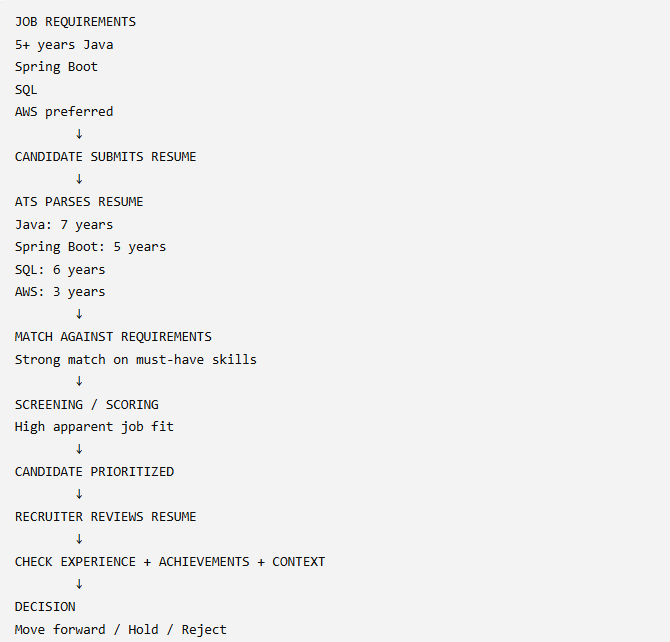
A Simple Example of the Complete ATS Screening Flow
Here's how the entire process could look for a recruiter hiring a Senior Java Developer:
What This Means for Recruiters
The biggest advantage of ATS screening isn't that it makes the hiring decision for you.
It's that it helps you move from a large, unstructured applicant pool to a more manageable group of candidates.
That becomes even more valuable when you're hiring at scale.
AI-powered resume screening can take this further by parsing resumes and scoring candidates against job requirements. Leelu's AI Resume Parser + Scoring capability is positioned to automatically parse and rank candidates based on job fit, including screening thousands of candidates in minutes.
This creates a more streamlined flow:
Applications → AI parsing → Candidate matching → Ranking → Recruiter review
That lets recruiters spend less time extracting information from resumes and more time deciding which candidates are genuinely worth moving forward.
Suggested Reading:
10 Best AI Recruiting Software Tools for Smarter HiringWhy Qualified Candidates Can Get Missed During ATS Screening
ATS screening can make recruiting more efficient, but automated filtering is not perfect.
A candidate may have the right experience but describe it differently from the wording used in your job description.
Consider a job requiring “customer success management.”
A qualified candidate might describe a similar experience using phrases such as “client retention,” “customer lifecycle management,” or “account growth.”
If your screening approach depends too heavily on exact keyword matches, that candidate could receive less visibility despite having relevant experience.
That is why recruiters should use ATS screening as a starting point for evaluation rather than the final hiring decision.
How Recruiters Can Improve ATS Resume Screening
The quality of ATS screening depends heavily on how you define the role and evaluate candidates.
Start With Clear Job Requirements
Separate requirements into three groups:
- Must-have: Essential qualifications for the role
- Preferred: Useful qualifications that improve fit
- Nice-to-have: Additional skills that should not eliminate a candidate
This prevents recruiters from accidentally filtering out strong candidates because they lack a non-essential qualification.
Use Skills in Context
Instead of looking only for whether a keyword appears, consider how the candidate has used that skill.
For example, someone listing “Python” on a resume is not necessarily equivalent to someone who has spent four years building production applications with Python.
The second candidate provides stronger evidence of practical experience.
Combine Automation With Human Review
The most effective approach is not necessarily choosing between ATS screening and manual screening.
You can use automation to handle repetitive work while keeping recruiters involved in the final evaluation.
This allows you to spend more time assessing:
- Career progression
- Relevant achievements
- Role-specific experience
- Communication
- Potential
- Overall fit
How AI Can Make Resume Screening More Effective
Traditional ATS screening can help organize applications, but AI can take the process further by evaluating candidate information against the broader requirements of a role.
An AI resume screening system can parse resumes, identify relevant skills and experience, and score candidates based on job fit.
For recruiters handling large applicant pools, this can significantly reduce the amount of manual screening required.
For instance, if you receive 1,000 applications, manually reviewing every resume can become a major bottleneck.
AI-powered screening can first identify the candidates most closely aligned with the role, allowing recruiters to focus their time on a smaller, more relevant shortlist.
Leelu's AI Resume Parser + Scoring is designed around this workflow. It can automatically parse and rank candidates based on job fit, with the platform messaging positioning it around screening thousands of candidates in minutes.
The broader Leelu workflow also combines screening with AI matching, helping recruiters move from candidate discovery to shortlist creation without handling each step manually.
ATS Screening Is the First Filter, Not the Final Decision
ATS resume screening works best when you treat it as a way to reduce repetitive work, not as a replacement for recruiter judgment.
The system can help you process large candidate volumes, identify relevant qualifications, and prioritize profiles for review.
Your recruiters still need to look at the story behind the resume.
A strong screening process combines structured requirements, automated resume screening, AI-assisted matching, and human evaluation to help you make better hiring decisions without spending hours reviewing every application manually.
Conclusion
ATS resume screening can help you handle large applicant pools without spending hours reviewing every resume manually.
But effective screening is about more than matching keywords or assigning a score. You need to look at the candidate’s skills, experience, achievements, and overall relevance to the role.
The best approach is to use ATS and AI screening to handle the repetitive first pass, while recruiters focus on evaluating the candidates who show the strongest potential.
When you combine clear job requirements, intelligent resume screening, and human judgment, you can build a faster and more consistent hiring process without losing the context that matters.
Frequently Asked Questions
Can an ATS screen candidates from different resume formats?
Yes. Most modern ATS platforms can process common resume formats, but the way information is structured can affect how accurately candidate data is captured. Recruiters should test their ATS with different file types and resume layouts to ensure important information is not missed.
Does an ATS screening system store rejected candidates?
Typically, candidate records can remain in the ATS even after a candidate is rejected. This can help recruiters revisit previous applicants when a suitable position opens later, depending on the system's retention settings and company policies.
Can recruiters change ATS screening criteria after applications are received?
In many ATS platforms, recruiters can adjust filters or screening criteria during an active hiring process. However, changing criteria can affect which candidates are prioritized, so recruiters should document significant changes to maintain consistency throughout the hiring process.
Can an ATS screen internal candidates differently from external applicants?
Yes, depending on how the recruiting workflow is configured. Internal candidates may have additional information available in the system, such as previous roles, performance history, or employment data, which can provide recruiters with more context than a standard external application.
How often should recruiters review their ATS screening rules?
You should review screening criteria whenever the role requirements, hiring priorities, or business needs change. Regular reviews can also help you identify criteria that are unnecessarily limiting the candidate pool.
Can ATS screening help with high-volume seasonal hiring?
Yes. ATS screening can be particularly useful when application volumes increase sharply during seasonal or high-volume hiring periods. It can help recruiters organize large numbers of applications and maintain a consistent screening workflow.


