
You've got a strong performer on your team.
But are they ready for the next role, or just good at the one they're in?
Most performance reviews can't tell you.
They show last quarter's results, not future readiness.
That's exactly what a 9 box grid is built for.
It separates performance from potential, so decisions rely on evidence.
Here's what this guide covers:
- What a 9 box grid is and how it works
- What each of the nine boxes means
- How to build and calibrate your own grid
- Real examples for teams and succession planning
- Where the framework falls short
What Is a 9 Box Grid and How Does It Work?
A 9 box grid is a simple matrix that maps employees by two factors: performance and potential.
Instead of ranking people on gut feeling, you place them visually, based on what they've done and what they're capable of next.
Performance vs Potential in the Nine Box Grid
Performance looks backward.
It's what someone has actually delivered in their current role, measured against clear expectations.
Potential looks forward.
It's whether they could take on more responsibility, a bigger role, or a completely different one.
Conflating the two is a common mistake.
A great performer on your team isn't always ready for a bigger role.
The grid plots performance along one axis and potential along the other, giving you nine possible combinations.
The Nine Employee Categories in the 9 Box Grid
Each combination of performance and potential creates its own category:
- Low performance, low potential — Risk
- Low performance, medium potential — Inconsistent player
- Low performance, high potential — Rough diamond
- Medium performance, low potential — Average performer
- Medium performance, medium potential — Core player
- Medium performance, high potential — Future star
- High performance, low potential — Trusted expert
- High performance, medium potential — High performer
- High performance, high potential — Star talent
Each of these gets its own breakdown further down.
Common Uses of the 9 Box Grid
HR and talent teams typically use the grid for succession planning, helping you spot who's ready for a bigger role.
It also shapes promotion decisions, development conversations, and stretch assignments.
Some organizations bring it into talent-review meetings to compare people across departments, not just within your own team.
There's a retention angle.
High performers with limited growth potential may be the ones most likely to leave.
What Do the 9 Boxes in a 9 Box Grid Mean?
Knowing how the grid works is only the starting point. To use it effectively, you also need to understand what each placement suggests about an employee and what action you might consider next.
The first three boxes cover employees with low current performance, but their future potential can differ significantly.
Low Performance, Low Potential
Employees in this box are currently falling short of performance expectations and show limited readiness for broader responsibilities.
Before making decisions, you should understand what is driving the situation. Poor role fit, unclear expectations, skill gaps, or insufficient support can all affect performance.
Your next steps may include:
- Clarifying role expectations and measurable performance goals
- Providing targeted coaching or additional training
- Exploring whether another role better matches their strengths
If performance remains low after appropriate support, you may need to consider other workforce decisions.
Low Performance, Medium Potential
Here, current results are below expectations, but the employee shows capabilities that could support future growth.
Instead of focusing only on today's performance, identify what is preventing those capabilities from translating into stronger results. You might provide coaching, clearer goals, or assignments that develop specific skills.
Progress should then be reviewed against consistent performance criteria.
Low Performance, High Potential
This placement requires careful evaluation because strong potential does not automatically compensate for weak performance.
The employee may demonstrate learning agility, leadership qualities, or valuable capabilities while struggling in their current position.
You should focus on:
- Identifying whether the role is a poor fit
- Addressing specific performance gaps
- Providing focused development opportunities
- Setting clear timelines for measurable improvement
The goal is to test whether that potential can translate into sustained performance rather than assuming future success.
Medium Performance, Low Potential
An employee in this box delivers acceptable results but may have limited interest or readiness for more complex responsibilities.
That does not make them less valuable. They may be dependable contributors who perform consistently and prefer developing deeper expertise within their current role.
You can support them by:
- Recognizing consistent contributions and role-specific strengths
- Offering opportunities to deepen their expertise
- Discussing career goals instead of assuming they want promotion
The focus should be on maintaining engagement and helping them succeed where their strengths create the most value.
Medium Performance, Medium Potential
Employees here are often steady contributors with room to improve both their current performance and future capabilities.
You should identify specific skills they can strengthen and provide development opportunities tied to realistic career goals. Regular feedback, mentoring, and broader responsibilities can help you see whether they are ready to progress.
Their placement may change as you gather more evidence over time.
Medium Performance, High Potential
This employee shows strong capacity for growth but has not yet reached consistently high performance.
You need to understand why that gap exists. They may be relatively new to the role, developing critical skills, or lacking opportunities to demonstrate their capabilities.
Consider targeted coaching, stretch assignments, mentoring, and measurable goals that allow them to prove their readiness for greater responsibility.
High Performance, Low Potential
These employees consistently deliver strong results but may have limited readiness or desire to move into broader roles.
Instead of treating promotion as the only form of growth, you can offer specialist career paths, challenging projects, mentoring opportunities, or deeper responsibilities.
This helps you retain valuable high performers while respecting the career direction that fits them best.
High Performance, Medium Potential
Employees in this box consistently produce strong results and may be capable of taking on greater responsibilities with further development.
You should focus on maintaining their performance while testing their readiness for broader roles. Useful development actions include:
- Assigning more complex projects or responsibilities
- Providing leadership or cross-functional opportunities
- Offering coaching around specific development gaps
This gives you stronger evidence of whether they can progress further.
High Performance, High Potential
These employees combine consistently strong performance with clear capacity for larger or more complex roles.
They may become important candidates for succession planning and future leadership positions. You can support their growth through stretch assignments, mentoring, leadership development, and greater strategic responsibility.
However, avoid treating promotion as automatic. Future decisions should still reflect demonstrated readiness, business needs, and the employee’s career goals.
How to Create and Use a 9 Box Grid
Now that you understand what each placement means, the next step is building a 9 box grid that managers can use consistently. The quality of the grid depends heavily on the evidence and criteria you use before placing anyone into a box.
Step 1 — Define Performance Criteria
Start by deciding what good performance looks like for the roles you are evaluating. Without shared criteria, two managers may interpret “high performance” very differently.
Your criteria can include:
- Progress against measurable goals or KPIs
- Quality and consistency of work
- Role-specific competencies and responsibilities
- Contribution to team or business outcomes
Use relevant evidence over a meaningful period rather than allowing one recent success or setback to determine an employee’s rating.
Step 2 — Define Employee Potential
Potential is harder to evaluate because you are considering whether someone could succeed with greater or different responsibilities.
Define the behaviors you will use to assess it before discussing individual employees. These might include learning agility, problem-solving, adaptability, leadership capability, and readiness to handle greater complexity.
You should also consider an employee’s career interests. Someone who does not want a management position should not automatically receive a lower potential rating because of that preference.
Suggested Reading:
10 Ways to Measure Employee Productivity EffectivelyStep 3 — Gather Performance Data and Feedback
Once your criteria are clear, collect evidence that supports each assessment rather than relying on memory or manager perception alone.
Bring together performance reviews, goal attainment, competency assessments, project outcomes, and relevant feedback from people who work closely with the employee.
Using multiple sources gives you a more complete picture and provides concrete evidence for the calibration discussions that come next.
Step 4 — Place Employees on the Box Grid
With your performance and potential evidence ready, you can place each employee into the appropriate box.
Avoid treating placement as a mathematical exercise. Use the agreed criteria to determine whether performance and potential are low, medium, or high, while documenting the evidence behind each rating.
An initial placement is a starting point for discussion rather than a final judgment.
Suggested Reading:
Employee Onboarding Checklist: Ultimate Guide for HRStep 5 — Calibrate Ratings Across Managers
Different managers may apply the same criteria differently, which can make your 9 box grid inconsistent across teams.
Bring managers together for a calibration discussion where they can compare ratings, review supporting evidence, and challenge assumptions.
During calibration, focus on:
- Whether similar standards are being applied across teams
- What evidence supports each performance and potential rating
- Whether recency, proximity, or personal bias influenced placement
The goal is consistency, not forcing a predetermined number of employees into each box.
Step 6 — Create Development and Succession Actions
A completed grid becomes useful when it leads to action.
Connect each placement with an appropriate next step. You might provide coaching for performance gaps, stretch assignments for emerging talent, or succession opportunities for employees demonstrating strong performance and potential.
Your actions should reflect individual needs rather than assigning identical development plans to everyone in the same box.
Step 7 — Review and Update Employee Placement
Finally, revisit placements during regular talent reviews.
Performance, responsibilities, career interests, and readiness can change over time. Update the grid when new evidence shows that an employee has developed or their circumstances have changed.
This keeps your nine box grid useful as a current talent-planning tool rather than a permanent employee label.
Suggested Reading:
10 Modern Employee Performance Review Templates for Faster Reviews9 Box Grid Examples for Talent and Succession Planning
Once you have completed the assessment, the real value comes from turning employee placement into practical decisions. A few 9 box grid examples can show you how the framework works in different talent-planning situations.
9 Box Grid Example for a Small Team
Imagine you manage a team of eight employees. One consistently exceeds targets and shows strong leadership potential, placing them in the high-performance, high-potential box.
Another delivers reliable results but prefers developing as a specialist rather than moving into management. They may fit the high-performance, low-potential category based on your defined criteria.
You could then use these placements differently:
- Give the first employee a stretch leadership assignment
- Create deeper specialist opportunities for the second employee
The grid helps you avoid assuming that every strong performer needs the same career path.
9 Box Grid Example for Leadership Succession
For succession planning, you can use the grid to identify employees who may be ready for critical roles now or after further development.
Suppose a department leader plans to leave next year. You might review high-performing, high-potential employees and assess their readiness, leadership experience, skill gaps, and interest in the position.
The grid helps narrow the discussion, but it should not determine the successor by itself.
Turning 9 Box Grid Results Into Employee Development Plans
Your final step is connecting each placement with meaningful development.
An employee with high potential may need stretch projects or mentoring, while someone struggling with performance may need clearer goals and coaching.
This turns the 9 box grid from a static talent assessment into a practical framework for employee development and future workforce decisions.
9 Box Grid Benefits, Limitations, and Best Practices
A 9 box grid can make talent conversations more structured, but the framework is only as reliable as the decisions behind it. Understanding both its strengths and limitations helps you use it without turning employee placement into a fixed label.
Benefits of Using a Nine Box Grid
The nine box grid gives you a shared framework for discussing employees across teams and departments.
When used consistently, it can help you:
- Identify employees who may be ready for greater responsibility
- Spot performance or development gaps earlier
- Support succession and leadership pipeline discussions
- Match development opportunities with individual needs
- Create more consistent talent conversations across managers
It also gives you a visual snapshot of your workforce, making patterns easier to discuss during talent reviews.
Limitations and Bias in Talent Assessments
The simplicity that makes the grid useful can also create limitations.
Performance and especially potential can involve subjective judgment. A manager may unintentionally favor employees they see more often, remember recent achievements, or rate people differently based on personal expectations.
The grid can also oversimplify employees if you treat their placement as permanent rather than a current assessment based on available evidence.
Best Practices for More Objective Employee Ratings
You can reduce these risks by building evidence and consistency into your assessment process.
Use several practices together:
- Establish clear performance and potential criteria before rating employees
- Use measurable outcomes and documented evidence where possible
- Gather relevant feedback from multiple perspectives
- Calibrate ratings across managers and teams
- Document why each employee received their placement
- Reassess placements as performance and responsibilities change
These practices will not remove every judgment call, but they can make your 9 box grid more consistent, transparent, and useful for talent decisions.
Common 9 Box Grid Mistakes to Avoid
Even with clear criteria, a 9 box grid can become misleading when you use it as a labeling system instead of a talent discussion tool.
Common mistakes include:
- Rating potential based mainly on personal impressions
- Assuming every high performer has high potential
- Treating an employee’s box as a permanent classification
- Skipping manager calibration and relying on one perspective
- Completing the grid without creating follow-up development actions
Avoiding these mistakes keeps your assessment focused on evidence and employee growth.
When the 9 Box Grid May Not Be the Right Tool
The grid may not suit every talent decision. If you lack reliable performance data, clearly defined roles, or consistent evaluation criteria, placement can become overly subjective.
You may also need more detailed competency, skills, or readiness assessments when making specialized hiring, promotion, or succession decisions.
How Leelu Brings More Data Into Talent and Hiring Decisions
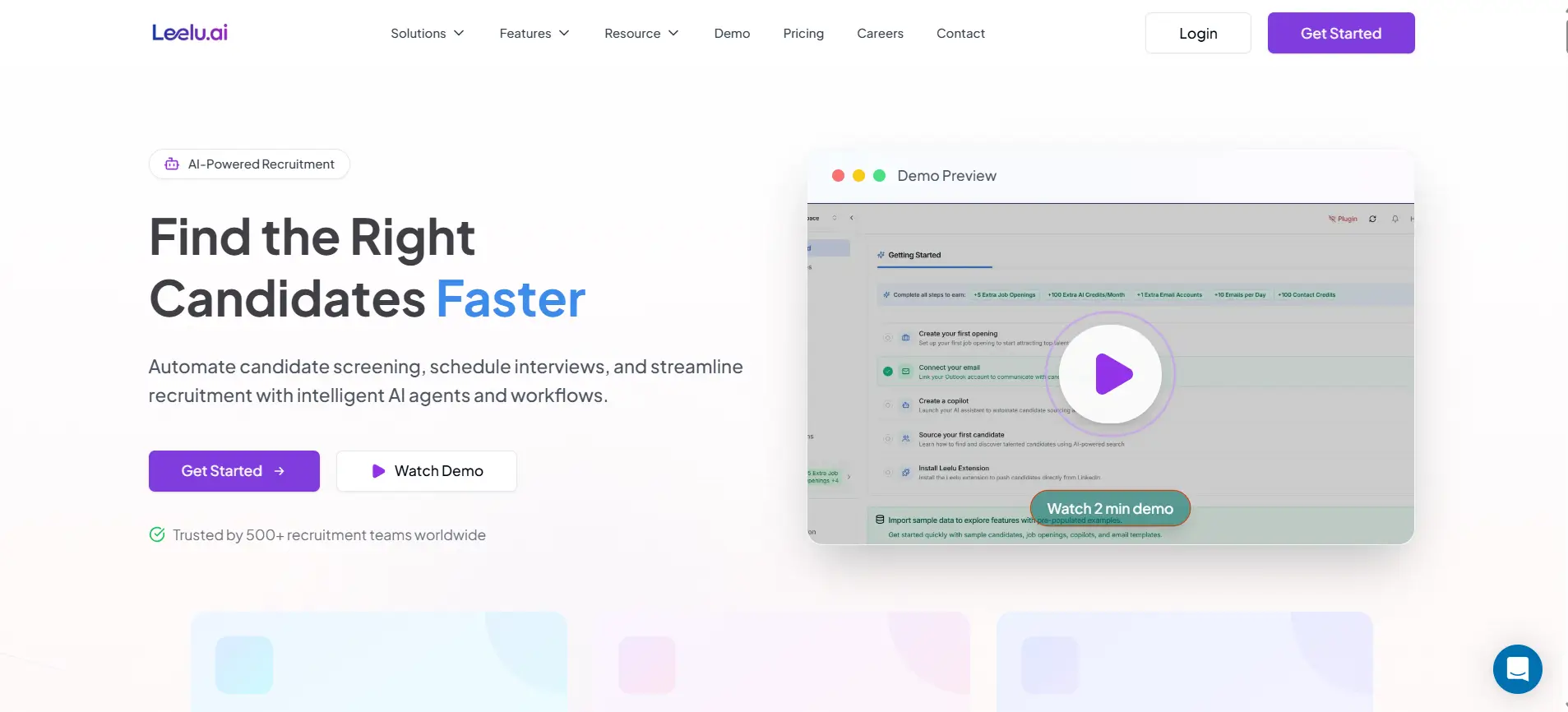
The 9 box grid helps you evaluate existing employees using performance and potential. But when you are making external hiring decisions, you need reliable candidate information before you can decide who best matches an open role.
Leelu supports this earlier part of the talent process by bringing sourcing, candidate data, AI screening, and hiring insights into one workflow.
Bring Candidate Skills and Talent Data Into One Place
When candidate information sits across different platforms, comparing talent can require significant manual work.
Leelu sources candidates from 500M+ profiles across LinkedIn, job boards, and ATS systems. It then brings candidate information together into unified profiles, giving you one place to review relevant talent data.
This helps you spend less time moving between tools and more time evaluating candidates against your hiring requirements.
Use AI to Screen and Identify Best-Fit Talent
Once you have a larger candidate pool, the next challenge is deciding who deserves your attention first.
Leelu uses AI resume parsing, scoring, and matching to screen candidates and rank them based on job fit.
You can use this process to:
- Screen large volumes of candidate profiles in minutes
- Prioritize candidates based on job requirements
- Build a more focused shortlist for further evaluation
Use Hiring Insights to Make More Informed Talent Decisions
Better hiring decisions also depend on understanding what happens throughout your recruiting funnel.
Leelu’s Hiring Insights Dashboard gives you end-to-end visibility into hiring performance and pipeline metrics.
Instead of relying only on assumptions, you can use these insights to understand your recruiting process, identify areas for improvement, and make more data-informed hiring decisions.
Conclusion
The 9 box grid gives you a practical way to look beyond performance alone and consider where employees may be ready to grow next.
But the framework works best when you use clear criteria, multiple sources of evidence, regular calibration, and meaningful development actions. Employee placement should guide better conversations, not become a permanent label.
The same evidence-based thinking matters when you bring new talent into your organization.
Leelu helps you extend that approach into hiring by bringing candidate data together, using AI to screen and rank talent, and providing hiring insights in one workflow.
If you want to make your hiring process more data-informed, explore how Leelu can support your recruiting workflow.
Frequently Asked Questions (FAQs)
Is the 9 box grid suitable for evaluating remote employees?
Yes. The framework can be used for remote, hybrid, and office-based employees. Managers should rely on measurable outcomes, documented competencies, peer feedback, and consistent evaluation criteria rather than visibility or time spent in the office, which can introduce proximity bias into performance and potential ratings.
How often should a 9 box grid assessment be updated?
Many organizations review employee placement annually or during regular talent-review cycles. However, placements can be reconsidered after significant changes such as promotions, new responsibilities, major performance improvements, or role changes. The grid should reflect current evidence rather than becoming a permanent classification of an employee.
Should employees be told where they fall on the 9 box grid?
Organizations take different approaches. Rather than simply communicating a box label, managers can focus conversations on the evidence behind the assessment, performance expectations, career goals, strengths, and development opportunities. This makes the discussion more constructive and reduces the risk of employees interpreting placement as a fixed judgment.
Can an employee move from one box to another over time?
Yes. Placement should change when an employee's performance, capabilities, readiness, or demonstrated potential changes. Development programs, coaching, new assignments, promotions, or changing responsibilities can influence future assessments. Regular reassessment prevents organizations from treating an earlier placement as a permanent description of an employee's capabilities.
Who should be involved in a 9 box grid assessment?
Typically, direct managers contribute employee assessments while HR or talent leaders facilitate the process. Senior leaders may participate during succession or leadership reviews. Using multiple perspectives and calibration discussions can help challenge individual manager assumptions and create greater consistency across teams, departments, and employee evaluations.


