
Hiring isn’t just expensive—it’s unpredictable. Many companies think posting a job and screening resumes is straightforward, but the reality is far more complex. Every unnecessary step, every unqualified applicant, and every delay in decision-making quietly drains money, productivity, and morale.
Imagine receiving hundreds of applications, spending weeks sorting through resumes, only to lose the top candidates to faster competitors. The hidden costs pile up: recruiter hours, delayed projects, lost revenue, and the real price of a bad hire.
The key to cutting hiring costs isn’t just reducing spending—it’s making the entire hiring process smarter, faster, and more efficient.
What Is Hiring Cost? (And Why Most Teams Underestimate It)
Hiring cost is the total expenditure associated with attracting, evaluating, and onboarding a new employee. Most teams focus on the obvious costs but overlook hidden ones.
Direct costs:
- Job ads
- Recruitment agency fees
- HR software or tools
Indirect costs:
- Time-to-hire
- Lost productivity
- Poor hires
Quick formula:
Cost per hire = Total hiring spend ÷ Number of hires
Many organizations optimize only for visible costs like ads or agencies—but miss the larger leaks hidden in process inefficiencies and bad hires.
The Real Reasons Your Hiring Costs Are High
Hiring costs don’t just come from posting jobs or paying recruiters—they often hide in inefficiencies and outdated practices. Many organizations face four main challenges:
- Too Many Unqualified Applicants & Poor Targeting – Companies often attract high volumes of candidates, but many don’t meet the role’s requirements. Sorting through irrelevant resumes wastes recruiter time and energy, delaying hires and increasing overall cost.
- Manual Screening & Inefficient Processes – Manually reviewing resumes, scheduling interviews, and tracking candidate progress consumes hours that could be spent on strategic hiring decisions. Inefficient workflows slow down the entire hiring cycle.
- Over-Reliance on Job Boards – While job boards expand reach, posting everywhere without targeting leads to paying for visibility rather than results. Many candidates from job boards don’t fit the role, increasing wasted spend.
- Long Hiring Cycles & Candidate Drop-Offs – Slow communication and drawn-out processes frustrate candidates, causing top talent to drop out. Extended hiring cycles also affect productivity and team performance, further inflating cost per hire.
Understanding these hidden pain points is crucial. The good news? Each of these challenges has a practical solution that can significantly reduce your hiring costs
13 Proven Ways to Reduce Hiring Cost
Hiring cost isn’t just about job ads or recruiter fees — it includes recruiter time, screening hours, interviews, lost productivity while a position is empty, and even the financial impact of making the wrong hire. Organizations that optimize their hiring strategy can save thousands per hire while still maintaining quality — but this requires smarter tactics, not cheap shortcuts.
Here are 13 actionable, real-world strategies backed by research and hiring trends.
1. Use AI-Powered Hiring Tools
AI is one of the most powerful ways to reduce hiring costs today. Traditional hiring involves multiple repetitive tasks that consume recruiter time and delay decision-making. AI eliminates much of this manual effort by automating key stages of the hiring process.
It can handle:
- Resume screening and shortlisting at scale
- Chatbots for initial candidate interaction and queries
- Automated interview scheduling without back-and-forth emails
- Skill assessments and intelligent candidate matching
Popular tools include HireVue, Pymetrics, and LinkedIn Talent Insights. These platforms help identify the most relevant candidates quickly and efficiently.
👉 Result: Faster hiring, reduced recruiter workload, and significantly lower cost per hire.
2. Improve Your Job Planning & Role Clarity
One of the most overlooked reasons for high hiring costs is poor role definition. When expectations are unclear, companies attract the wrong candidates, leading to wasted time and potential mis-hires.
Before posting a job:
- Clearly define responsibilities and expected outcomes
- Focus on must-have skills instead of long “nice-to-have” lists
- Align hiring managers and stakeholders on role expectations
Clear planning ensures that you attract the right candidates from the start, reducing screening time and avoiding costly hiring mistakes.
3. Leverage Internal Hiring First
Hiring internally is one of the most cost-effective strategies available. It eliminates the need for sourcing, advertising, and external outreach.
Benefits include:
- No external hiring costs
- Faster onboarding since employees already understand the company
- Increased employee engagement and retention
Promoting or transferring existing employees not only saves money but also boosts morale and builds a stronger internal culture.
4. Build an Employee Referral Program
Employee referrals are consistently one of the most efficient hiring channels. Candidates referred by employees tend to be more aligned with company culture and often perform better.
Key advantages:
- Lower cost per hire compared to agencies or paid channels
- Higher retention rates
- Faster hiring cycles
To make this effective, create a structured referral program with clear incentives and regularly communicate open roles within the organization.
5. Use Free & Low-Cost Hiring Channels
Not all hiring needs to be expensive. Many high-quality candidates can be found through free or low-cost platforms.
Examples include:
- LinkedIn and Indeed (free job posting options)
- Social media platforms and niche communities
- Alumni networks and professional groups
These channels allow you to reach a wide audience without significant spending, especially when combined with targeted outreach strategies.
6. Reduce Dependence on Recruitment Agencies
Recruitment agencies can be useful, but they often come with high fees—typically 15–30% of a candidate’s annual salary.
To reduce costs:
- Build strong in-house recruitment capabilities
- Use agencies only for highly specialized or hard-to-fill roles
By limiting dependency on agencies, companies can significantly reduce hiring expenses while maintaining control over the hiring process.
7. Streamline the Hiring Process
A lengthy and complicated hiring process increases both cost and candidate drop-offs. Every additional step adds time, effort, and resource consumption.
To optimize:
- Limit the number of interview rounds
- Use structured interviews for consistency
- Automate scheduling to reduce delays
A streamlined process helps you move faster, secure top talent before competitors, and reduce overall hiring costs.
8. Invest in an ATS (Applicant Tracking System)
An Applicant Tracking System (ATS) is essential for managing hiring efficiently, especially as your company scales. Tools like Workday or Greenhouse centralize and simplify the entire process.
An ATS helps:
- Organize and track candidates in one place
- Reduce manual administrative work
- Improve collaboration between hiring teams
By increasing efficiency and reducing errors, an ATS directly contributes to lowering cost per hire.
9. Hire Interns or Contract Workers
For certain roles, hiring full-time employees may not always be necessary. Interns and contract workers provide a flexible and cost-effective alternative.
Benefits include:
- Lower overall hiring and compensation costs
- Flexibility to scale workforce based on demand
- Opportunity to evaluate and convert top performers into full-time employees
This approach allows companies to manage budgets more effectively while maintaining productivity.
10. Improve Employer Branding
A strong employer brand naturally attracts high-quality candidates, reducing the need for expensive sourcing efforts.
Ways to improve branding:
- Share company culture on social platforms
- Encourage employee testimonials
- Maintain positive employer reviews on job platforms
When candidates already trust and admire your company, hiring becomes faster, easier, and more cost-efficient.
11. Reduce Employee Turnover
High turnover significantly increases hiring costs because companies must repeatedly recruit and train new employees.
To reduce turnover:
- Provide clear growth and development opportunities
- Offer competitive compensation and benefits
- Foster a positive and inclusive work environment
Retaining employees is often far cheaper than hiring new ones, making this a critical cost-saving strategy.
12. Use Data & Analytics
Data-driven hiring helps you identify inefficiencies and optimize your recruitment strategy.
Track key metrics such as:
- Cost per hire
- Time to hire
- Best-performing hiring sources
Analyzing this data allows you to focus on what works and eliminate wasteful spending, leading to smarter and more efficient hiring decisions.
13. Create a Talent Pipeline
Building a talent pipeline ensures you’re not starting from scratch every time a role opens.
Effective strategies include:
- Maintaining a database of past candidates
- Re-engaging previous applicants
- Nurturing relationships with potential hires
A ready-to-hire pool reduces sourcing time, shortens hiring cycles, and lowers overall recruitment costs.
How Leelu.ai Helps You Reduce Hiring Costs
Leelu.ai is an AI-powered hiring platform that streamlines recruitment by focusing on finding the right candidates faster and automating repetitive tasks.
Instead of spending hours manually screening resumes or chasing candidates, teams can focus on high-value hiring decisions, which directly lowers cost per hire.
Key ways Leelu.ai reduces hiring costs include:
- Smarter Candidate Targeting: AI identifies top-fit candidates, reducing time spent on irrelevant applications.
- Automated Screening & Outreach: Minimizes recruiter workload and speeds up the hiring process.
- Data-Driven Insights: Highlights the most effective sourcing channels and strategies, so you invest only where results are proven.
- Faster Time-to-Hire: Streamlined processes reduce delays, lower drop-offs, and prevent costly extended vacancies.
In short, Leelu.ai addresses hidden cost drivers like inefficient processes, long hiring cycles, and poor candidate targeting — allowing companies to hire faster, smarter, and more cost-effectively.
Cost Comparison: Traditional Hiring vs AI-Driven Hiring
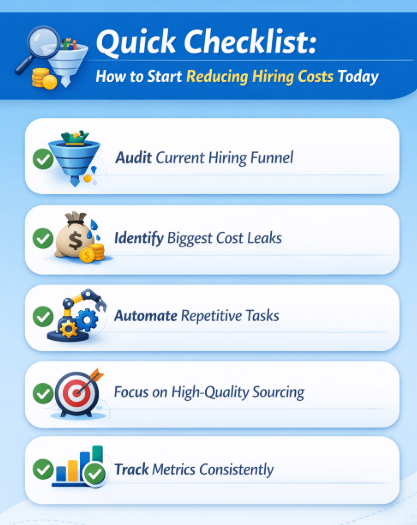
Quick Checklist: How to Start Reducing Hiring Costs
Conclusion
Reducing hiring costs is not about cutting corners — it’s about working smarter, not harder. By understanding where costs hide in your hiring process, optimizing sourcing, automating repetitive tasks, and using data-driven strategies, you can hire faster, attract better candidates, and save significant resources.
Every organization faces different pain points, but the principles remain the same: focus on quality over quantity, streamline workflows, and continuously measure performance. With the right approach, even small teams can reduce hiring expenses without compromising on talent.
Frequently Asked Questions
1. What is the fastest way to lower cost per hire?
Prioritize automation, targeted sourcing, and structured screening to reduce recruiter hours and speed up decisions — the most significant hidden costs in hiring.
2. How does time-to-hire impact hiring cost?
Every extra day a position remains unfilled increases lost productivity and recruiting expenses. Shorter cycles mean less spending on job ads, fewer drop-offs, and faster revenue contribution from new hires.
3. How can small companies reduce hiring costs?
Leverage internal talent, employee referrals, and AI-powered tools for screening and outreach. Small teams can achieve big savings by focusing on efficiency, data, and quality hires instead of volume.


