Hiring the right people has never been more challenging, especially when resumes don’t always reflect real capability.
You might be hiring based on degrees, job titles, or years of experience, yet still missing candidates who can actually do the job well.
That’s where skills based hiring shifts the focus from credentials to what truly matters—real, measurable skills.
In this guide, you’ll learn:
- What skills based hiring really means in practice
- Why traditional hiring methods fall short
- How to implement a skills-first approach in your hiring process
- Common challenges and how to overcome them
What Is Skills-Based Hiring?
Skills-based hiring is an approach where you evaluate candidates based on their actual abilities rather than just degrees, job titles, or years of experience.
Instead of asking “Where did you work?” you focus on “What can you do?” and how well those skills match the role requirements.
This method relies on practical assessments, work samples, and skill validation to identify the right fit.
By prioritizing real capabilities, you open the door to a wider, more diverse talent pool.
It also helps you make more accurate hiring decisions because you’re measuring performance potential, not just past credentials.
Key Benefits of Skills-Based Hiring
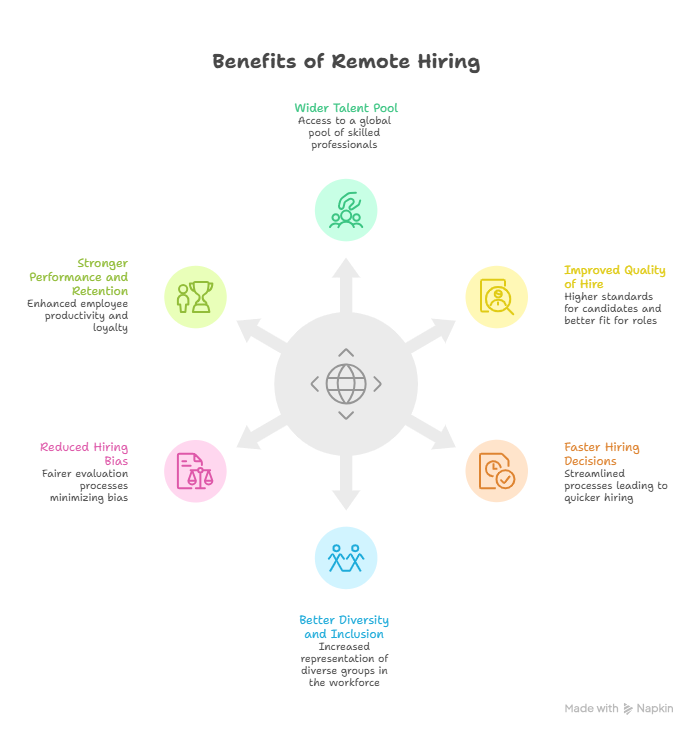
Once you shift your focus from credentials to capabilities, the impact shows up across your entire hiring process.
Skills based hiring doesn’t just improve who you hire—it improves how you hire.
1. Access to a Wider Talent Pool
When you remove strict filters like specific degrees or company backgrounds, you instantly open up your talent pool.
You start discovering candidates from non-traditional paths, including self-taught professionals and career switchers who bring valuable, job-ready skills.
This gives you more options and reduces dependency on a limited group of “perfect-looking” profiles.
2. Improved Quality of Hire
Hiring based on proven skills leads to better outcomes on the job.
Instead of guessing potential through resumes, you’re evaluating actual ability through assessments and real-world tasks.
This makes it easier to identify candidates who can contribute faster and perform more effectively in the role.
3. Faster Hiring Decisions
Traditional hiring often slows down due to resume screening and back-and-forth evaluations.
With skills based hiring, you rely on structured assessments and clear benchmarks, which helps you quickly identify top candidates.
This reduces decision fatigue and speeds up the overall hiring cycle.
4. Better Diversity and Inclusion
When you focus on skills instead of background, you create a more level playing field.
Candidates are evaluated on what they can do, not where they come from or what opportunities they had access to.
This naturally leads to a more diverse and inclusive workforce.
5. Reduced Hiring Bias
Bias often creeps in through signals like education, previous employers, or personal preferences.
Skills based hiring minimizes this by shifting attention to objective performance indicators.
When decisions are backed by measurable skills, you reduce the influence of unconscious bias.
6. Stronger Employee Performance and Retention
When someone is hired for what they can actually do, they’re more likely to succeed in the role.
This leads to better performance, higher confidence, and a stronger sense of fit.
As a result, employees stay longer, grow faster, and contribute more consistently to your team.
Common Challenges in Skills-Based Hiring
While skills based hiring offers clear advantages, implementing it isn’t always straightforward.
You’ll likely run into a few practical challenges as you move away from traditional hiring methods.
1. Identifying the Right Skills
It sounds simple, but defining the “right” skills for a role can be tricky.
Many job descriptions are still based on outdated responsibilities, not current needs.
If you don’t clearly identify must-have versus nice-to-have skills, your evaluation process can quickly become inconsistent.
2. Lack of Structured Assessment Methods
Even if you know what skills to look for, assessing them is another challenge.
Without structured tests, assignments, or benchmarks, decisions can become subjective again.
This defeats the purpose of skills based hiring and makes it harder to compare candidates fairly.
3. Resistance to Change in Hiring Teams
Hiring teams are often used to traditional methods like resume screening and pedigree-based decisions.
Shifting to a skills-first approach requires a mindset change, which can face internal resistance.
Without proper alignment and training, adoption can slow down or become inconsistent.
4. Difficulty in Evaluating Soft Skills
Technical skills are easier to measure, but soft skills require deeper evaluation.
Qualities like communication, problem-solving, and adaptability are harder to assess through standard tests.
You need thoughtful interview frameworks or real-world scenarios to evaluate these effectively.
5. Integration with Existing Hiring Processes
Most companies already have established workflows, tools, and ATS systems in place.
Introducing skills based hiring means adjusting these processes without creating friction.
If not implemented carefully, it can feel like an added layer instead of a streamlined improvement.
How to Implement Skills-Based Hiring Step by Step
Now that you understand the benefits and challenges, the next question is simple—how do you actually put skills based hiring into practice?
The key is to approach it step by step instead of trying to overhaul your entire hiring process at once.
Step 1: Identify Role-Specific Skills
Start by clearly defining what success looks like in the role.
Focus on the actual tasks the candidate will perform and break them down into measurable skills.
Separate must-have skills from those that can be learned on the job to keep your evaluation focused.
Step 2: Redesign Job Descriptions
Your job description should reflect skills, not just qualifications.
Instead of listing degrees or years of experience, describe the outcomes and responsibilities tied to the role.
This helps attract candidates who are confident in their abilities, even if their background is unconventional.
Step 3: Choose the Right Assessment Methods
Once you know what to evaluate, decide how you’ll measure those skills.
Use a mix of practical tests, assignments, or real-world scenarios that reflect the job itself.
This gives you a clearer picture of how candidates will actually perform in the role.
Step 4: Train Hiring Teams
Your hiring team needs to be aligned with this new approach.
Train them to evaluate candidates based on skills and evidence rather than resumes or intuition.
This ensures consistency and reduces bias across the hiring process.
Step 5: Use Structured Interviews
Unstructured interviews often lead to inconsistent decisions.
Create a standardized set of questions that directly relate to the skills you’re assessing.
This makes it easier to compare candidates objectively and improves decision quality.
Step 6: Evaluate and Iterate
Skills based hiring is not a one-time setup.
Continuously review your process, gather feedback, and refine your assessments based on what’s working.
Over time, this helps you build a hiring system that is both efficient and highly accurate.
Suggested Reading:
Talent Acquisition Strategy, Process & Best PracticesHow You can Use Leelu.ai for Skills-Based Hiring
Once you move toward skills based hiring, managing everything manually can quickly become overwhelming.
That is where tools like Leelu.AI helps you.
It is an AI recruiting agent that automates candidate sourcing from various job boards based on your role requirement, filters candidate, outreach and book interviews with them, so that you not only automate hiring but also fill your talent pipeline with people that have the right skills.
And here’s how Leelu.ai helps you simplify and scale the process without losing focus on real skills:
- Source candidates based on actual skills, not just resumes
You can find relevant candidates by matching role-specific skills across millions of profiles, instead of relying only on titles or degrees. - Automatically screen and rank candidates
Leelu parses and evaluates profiles against your defined skills, helping you quickly identify the best-fit candidates without manual effort. - Create a faster, more focused shortlist
Instead of reviewing hundreds of applications, you get a prioritized list based on skill relevance and job fit. - Engage candidates with personalized outreach at scale
You can send tailored messages and automate follow-ups, ensuring consistent communication without extra workload. - Eliminate scheduling delays
Interview coordination becomes seamless with automated scheduling, reducing back-and-forth communication. - Keep your hiring process aligned in one place
From sourcing to screening to scheduling, everything stays connected, making your workflow more structured and efficient. - Focus more on evaluation, less on manual tasks
By automating repetitive steps, you can spend more time assessing real capabilities and making better hiring decisions.
Suggested Reading:
AI Candidate Sourcing Tools: 10 Best Solutions for Recruiters (2026 Guide)Best Practices for Effective Skills-Based Hiring
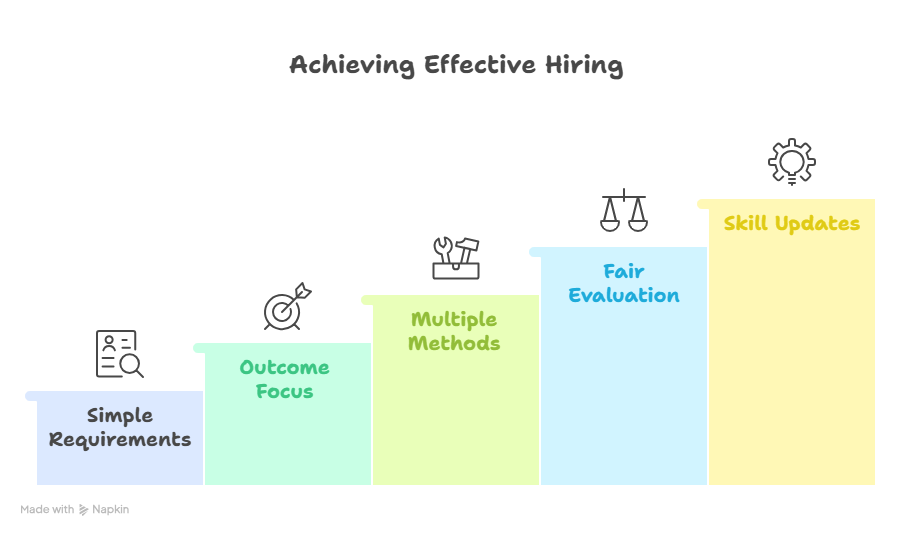
Once you’ve implemented skills based hiring, the next step is making sure it actually delivers consistent results.
A few practical best practices can help you avoid common mistakes and get the most out of this approach.
1. Keep Job Requirements Simple and Relevant
It’s easy to overload job descriptions with too many expectations.
Focus only on the skills that truly impact performance in the role instead of listing every possible requirement.
This keeps your hiring process clear and helps candidates understand what really matters.
2. Focus on Outcomes, Not Credentials
Shift your mindset from qualifications to results.
Instead of asking whether a candidate has a specific degree, look at whether they can deliver the outcomes the role demands.
This helps you identify candidates who can perform, regardless of their background.
3. Use Multiple Assessment Methods
Relying on a single test rarely gives you the full picture.
Combine different methods like practical assignments, case-based questions, and structured interviews to evaluate skills more effectively.
This reduces the risk of making decisions based on incomplete information.
4. Ensure Fair and Consistent Evaluation
Consistency is key to making skills based hiring work.
Use standardized criteria and scoring systems so every candidate is evaluated on the same parameters.
This not only improves decision-making but also reduces bias in the process.
5. Continuously Update Skill Requirements
Skills evolve as roles and industries change.
Regularly review and update your skill requirements to ensure they stay aligned with current job needs.
This keeps your hiring process relevant and helps you stay competitive in finding the right talent.
Conclusion
Hiring based on resumes alone is no longer enough to identify the right talent.
Skills based hiring helps you focus on what truly matters—real capabilities and job readiness.
By shifting your approach, you can access a wider talent pool, improve hiring quality, and make faster, more confident decisions.
While there are challenges, a structured and thoughtful implementation makes the transition smoother.
As roles continue to evolve, focusing on skills ensures your hiring stays relevant and effective.
If you want better outcomes from your hiring process, starting with skills is a practical and future-ready step.
Frequently Asked Questions
1. Does skills based hiring work for all roles?
Yes, but the approach may vary depending on the role.
Technical roles may use practical tests, while non-technical roles may rely more on case scenarios, simulations, or structured interviews.
2. How do you assess skills effectively?
You can use a mix of methods such as assignments, real-world tasks, and structured interviews.
Using multiple evaluation methods gives you a more accurate view of a candidate’s abilities.
3. Can skills based hiring reduce bias?
Yes, it helps reduce bias by focusing on objective performance instead of background factors like education or previous employers.
However, you still need structured evaluation methods to ensure fairness.
4. Is it time-consuming to implement skills based hiring?
Initially, it may take some effort to redesign your process.
But over time, it actually saves time by making screening faster and improving decision-making.