Candidates often drop off during hiring not because they lose interest, but because the process feels slow, unclear, or disconnected at different stages.
When communication delays, complex scheduling, and manual follow-ups stack up, even strong candidates quietly exit the pipeline without notice.
Implementing candidate experience automation helps remove these friction points by creating a faster, more transparent, and consistent hiring journey.
In this guide, you will learn how to identify drop-offs, automate key stages, and build a seamless experience that keeps candidates engaged until the final offer.
Where Candidate Drop-Off Happens Most
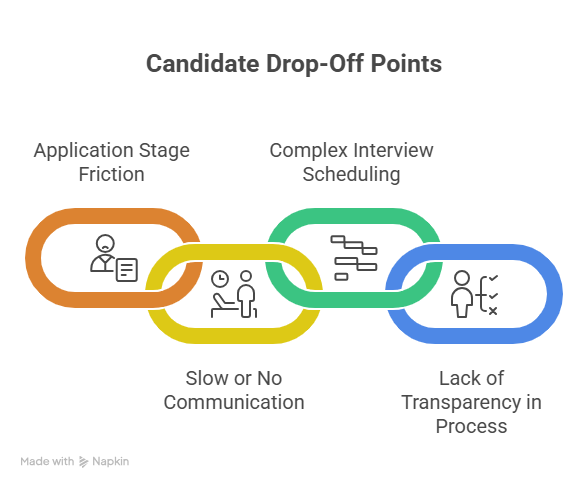
Before you think about fixing candidate drop-offs, it helps to see where they actually happen. Most hiring pipelines don’t break at one point — they leak slowly at multiple stages.
Once you map these friction points clearly, it becomes much easier to automate the right parts of the candidate journey instead of guessing.
Application Stage Friction
The first major drop-off point is right at the beginning — during the application itself.
If candidates face long forms, repetitive fields, or unclear job descriptions, they often abandon the process midway. Even small delays or unnecessary steps can quietly reduce your application completion rate.
This is where speed and simplicity matter most. When job creation and application intake are optimized, candidates are far more likely to complete the process without hesitation.
Slow or No Communication
After applying, candidates expect acknowledgment and updates — but many never hear back for days or even weeks.
This silence creates uncertainty. And uncertainty quickly turns into disengagement.
When communication is not consistent, candidates assume they are out of the running and move on to other opportunities. Even strong profiles drop off simply because they feel ignored.
Complex Interview Scheduling
Scheduling interviews sounds simple, but in reality it is one of the biggest hidden bottlenecks.
Back-and-forth emails, time zone confusion, and calendar mismatches all add friction. Each extra step increases the chance of losing a candidate who is actively interviewing elsewhere.
The longer it takes to confirm an interview, the higher the drop-off risk becomes.
Lack of Transparency in Process
Candidates don’t just want updates — they want clarity.
When hiring stages are unclear or timelines are not shared, candidates start to lose trust in the process. They are left guessing where they stand and what comes next.
That lack of visibility often leads them to prioritize other companies that communicate more openly and consistently.
Key Benefits of Automating Candidate Experience
Once you start addressing drop-off points, the next logical step is improving how candidates feel at every stage of the journey. That’s where automation really shifts the hiring experience from reactive to consistent and predictable.
Instead of relying on manual follow-ups and delayed coordination, automation helps you create a smooth flow that keeps candidates engaged without extra effort from recruiters.
1. Faster Response Times
Speed is one of the biggest expectations candidates have today.
When applications are acknowledged instantly and updates happen in real time, candidates feel valued and included in the process. Automation ensures there is no waiting gap between actions, which significantly reduces early-stage drop-offs.
This kind of responsiveness also creates a strong first impression, especially when candidates are evaluating multiple opportunities at once.
2. Higher Candidate Engagement
Engagement drops quickly when communication is inconsistent or generic.
With automation, candidates receive timely updates, personalized messages, and clear next steps throughout the process. This keeps them actively involved instead of passively waiting.
When engagement is steady, candidates are far less likely to lose interest or switch to other opportunities midway through the funnel.
3. Reduced Manual Work for Recruiters
Recruiters often spend a large portion of their time on repetitive tasks like follow-ups, scheduling, and status updates.
Automation removes this operational load by handling routine interactions in the background. This allows recruiters to focus more on meaningful activities like evaluating talent and improving hiring decisions.
Over time, this shift doesn’t just save effort — it improves overall hiring efficiency and consistency.
4. Improved Offer Acceptance Rates
A smooth and well-communicated candidate experience directly impacts final decisions.
When candidates feel informed, engaged, and respected throughout the process, they are more likely to accept offers without hesitation. Delays, confusion, or lack of communication often lead to second thoughts or competing offers.
Automation helps maintain momentum from application to offer stage, which strengthens trust and improves acceptance rates.
Suggested Reading:
Automated Hiring WorkflowsCore Elements of a Strong Automated Candidate Experience
Building a strong candidate experience isn’t just about adding automation tools. It’s about designing a connected journey where every step feels smooth, timely, and intentional.
When these elements work together, candidates don’t feel like they are “waiting in a process” — they feel guided through it.
1. Clear and Timely Communication
Communication sets the tone for the entire hiring experience.
Candidates should never feel unsure about what’s happening next. Automated updates, acknowledgments, and status messages ensure they always know where they stand.
When communication is consistent and timely, it reduces uncertainty and keeps candidates engaged even during longer hiring cycles.
2. Seamless Application Process
The application stage is often the first real test of your hiring experience.
If it feels long, repetitive, or unclear, candidates drop off quickly. A seamless process removes unnecessary steps and ensures job applications can be completed with minimal friction.
The smoother this entry point is, the higher your overall pipeline quality becomes.
3. Smart Interview Scheduling
Interview coordination is one of the most time-consuming parts of recruiting.
Automation helps eliminate back-and-forth communication by syncing calendars and suggesting available time slots instantly. This makes scheduling feel effortless for both candidates and recruiters.
A faster scheduling process also keeps candidate momentum strong throughout the hiring journey.
4. Consistent Candidate Feedback Loops
Candidates want to know how they are performing, even if they are not selected immediately.
Automated feedback loops ensure that no candidate is left in the dark. Whether it’s progression updates or rejection notifications, consistent feedback builds trust in your hiring process.
This transparency improves candidate perception of your brand, even in rejection scenarios.
5. Centralized Candidate Data Management
When candidate data is scattered across systems, it slows everything down.
A centralized system brings all candidate information into one unified view, making it easier to track interactions, feedback, and progress.
This reduces manual effort and ensures every stakeholder is working with the same updated information.
6. Automated Candidate Status Tracking
Candidates often lose interest when they don’t understand where they are in the pipeline.
Automated status tracking solves this by continuously updating candidates about their progress. Whether they are shortlisted, under review, or scheduled for an interview, the system keeps them informed.
This visibility reduces anxiety and keeps candidates engaged throughout the process.
Step-by-Step Guide to Implement Candidate Experience Automation
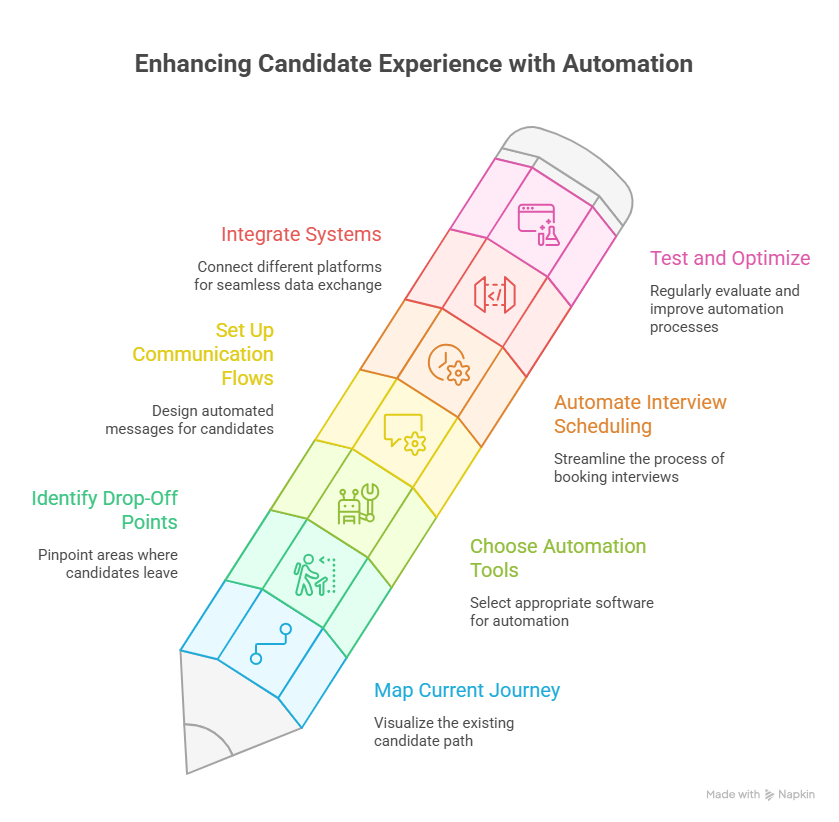
Implementing candidate experience automation works best when you don’t jump straight into tools.
Instead, you build it layer by layer—starting from understanding your current flow and ending with continuous optimization.
When done right, it transforms a fragmented hiring process into a smooth, guided journey for every candidate.
Step 1: Map Your Current Candidate Journey
Start by laying out every step a candidate goes through in your hiring process.
From application submission to final offer, document each touchpoint clearly. This helps you understand how candidates actually move through your system versus how you think they do.
Without this visibility, automation can easily miss the real problem areas.
Step 2: Identify Drop-Off Points
Once your journey is mapped, look closely at where candidates lose momentum.
This could be after applying, waiting for feedback, or during scheduling delays. These are the exact friction points that need automation first.
Focusing here ensures you’re solving real leakage instead of adding unnecessary complexity.
Step 3: Choose the Right Automation Tools
Now that you know where the gaps are, you can select tools that directly solve those problems.
Look for solutions that support sourcing, communication, scheduling, and tracking in one flow instead of multiple disconnected systems.
The goal is not more tools, but fewer steps for both recruiters and candidates.
Step 4: Set Up Automated Communication Flows
Communication is where candidate experience often breaks first.
Set up automated messages for key moments like application confirmation, interview updates, and status changes. These flows should feel timely and natural, not robotic or generic.
When done well, candidates always know what’s happening next without needing to follow up.
Step 5: Automate Interview Scheduling
Scheduling is one of the biggest time drains in recruiting.
By automating calendar syncing and availability matching, you remove back-and-forth emails completely. Candidates can book interviews instantly based on real availability.
This not only saves time but also keeps candidates engaged while interest is still high.
Step 6: Integrate Systems for Smooth Data Flow
Disconnected tools create delays, duplication, and confusion.
Integrate your ATS, communication tools, and scheduling systems so candidate data flows seamlessly across platforms. This ensures everyone is working with the same updated information at all times.
A connected system reduces manual errors and improves decision speed.
Step 7: Test and Optimize Regularly
Automation is not a one-time setup—it improves over time.
Track where candidates still drop off, how quickly they move through stages, and how they respond to communication flows. Use this data to refine and improve your automation steps.
Small adjustments here can significantly improve overall conversion rates in your hiring funnel.
Reducing Drop-Off with Smarter Engagement Strategies
Even with a well-structured hiring process, candidates still drop off if engagement feels passive or inconsistent. The difference between a filled pipeline and a leaking one often comes down to how actively you stay connected with candidates.
Smarter engagement isn’t about sending more messages—it’s about sending the right message at the right time with clarity and intent.
1. Personalized Messaging at Scale
Generic outreach is one of the fastest ways to lose candidate interest.
When messages feel irrelevant or automated in the wrong way, candidates disengage quickly. Personalization at scale solves this by tailoring communication based on role, skills, and stage in the hiring process.
This makes candidates feel seen, not just processed, which significantly improves response rates and keeps them moving forward.
2. Proactive Follow-Ups
Most drop-offs happen when candidates are left waiting without updates.
Proactive follow-ups ensure candidates never feel ignored during any stage of the process. Instead of waiting for them to ask, you stay ahead with timely nudges and status updates.
This small shift reduces uncertainty and keeps momentum strong across the entire hiring journey.
3. Transparent Timelines and Expectations
Unclear timelines create hesitation, even among highly interested candidates.
When candidates know what to expect—how long each stage takes and what comes next—they are more likely to stay engaged throughout the process. Transparency builds trust and reduces second-guessing.
It also helps candidates plan better, which makes your hiring process feel more respectful and structured.
4. Continuous Candidate Nurturing
Not every candidate will convert immediately, and that’s where nurturing becomes important.
Instead of letting strong candidates go cold, ongoing engagement keeps them connected to your pipeline. This can include updates, relevant opportunities, or simple check-ins over time.
Continuous nurturing ensures that even if a candidate isn’t selected today, they remain warm for future roles.
Suggested Reading:
Candidate Engagement StrategiesHow Leelu.ai Helps Improve Candidate Experience Automation
Candidate experience automation becomes significantly more effective when sourcing, screening, communication, and scheduling all work as one connected flow.
This is where an AI-driven recruiting copilot like Leelu.ai helps unify the entire journey—reducing manual effort while improving speed, consistency, and candidate engagement.
1. Sources Candidates from Job Boards Automatically
One of the biggest bottlenecks in hiring is fragmented sourcing across multiple platforms.
Leelu.ai removes this friction by automatically sourcing candidates from large-scale platforms like LinkedIn, job boards, and ATS systems in one unified flow. Instead of switching between tools, recruiters get access to a much wider talent pool instantly.
This improves reach while reducing the time spent on manual searching and filtering.
2. Screens and Shortlists Candidates Using AI
Manually reviewing hundreds or thousands of profiles slows down hiring and introduces inconsistency.
Leelu.ai uses AI-driven parsing and scoring to screen candidates based on job fit, experience, and relevance. It then automatically shortlists the most suitable profiles in minutes.
This ensures recruiters focus only on high-quality candidates while significantly speeding up early-stage evaluation.
3. Automates Outreach and Candidate Follow-Ups
Candidate engagement often drops when outreach is inconsistent or delayed.
Leelu.ai automates personalized messaging across channels like email and LinkedIn, ensuring every candidate receives timely and relevant communication. It also manages follow-ups automatically, keeping candidates engaged without extra recruiter effort.
This continuous engagement improves response rates and reduces mid-funnel drop-offs.
4. Handles Replies and Schedules Interviews Seamlessly
Once candidates respond, coordination can become a time-consuming back-and-forth process.
Leelu.ai handles candidate replies in real time and automates interview scheduling by syncing calendars and availability. This removes manual coordination entirely and speeds up the transition from screening to interviews.
The result is a smoother experience for candidates and a faster hiring cycle for recruiters.
Conclusion
Candidate experience automation is no longer optional because modern hiring demands speed, clarity, and consistent engagement across every single stage.
When done right, it removes friction points that silently cause drop-offs while keeping candidates informed, engaged, and moving smoothly through the funnel.
By combining smarter workflows with automation, recruiters can focus more on hiring decisions instead of manual coordination and repetitive tasks.
Platforms like Leelu.ai bring everything together by unifying sourcing, screening, outreach, and scheduling into one seamless, automated candidate experience.
Frequently Asked Questions
1. How long does it take to implement candidate experience automation?
Implementation time depends on your hiring volume and tools, but most teams can set up basic automation (like communication and scheduling) within a few weeks. More advanced workflows may take longer as you refine processes.
2. Can automation work for both high-volume and niche hiring roles?
Yes. Automation is flexible. For high-volume roles, it speeds up screening and communication. For niche roles, it helps maintain consistent engagement and reduces delays without losing personalization.
3. How do you balance automation with a human touch in hiring?
Use automation for repetitive tasks like updates, reminders, and scheduling. Keep human involvement for interviews, decision-making, and personalized conversations. The goal is to support, not replace, human interaction.
4. What type of data is important for improving candidate experience through automation?
Key data includes response times, candidate engagement rates, drop-off points, interview attendance, and feedback scores. Tracking these helps you identify where candidates lose interest.
5. Is candidate experience automation suitable for small teams?
Yes. Small teams benefit the most because automation reduces manual workload, allowing recruiters to focus on quality interactions instead of repetitive tasks.