Managing people today is not what it used to be.
You are dealing with remote teams, changing expectations, faster hiring cycles, and constant pressure to keep employees engaged and productive. What worked five years ago simply does not hold up in modern workplaces.
So the question becomes — how do you build an HR function that actually keeps up?
In this guide, you will discover:
- Practical HR strategies you can apply immediately
- Ways to improve hiring, engagement, and retention
- How to align HR with business growth in today’s work environment
What Are HR Strategies
HR strategies are structured plans you use to manage people in a way that supports business goals.
They guide how you hire, train, engage, and retain employees while adapting to changes in the workplace. Instead of reactive decisions, HR strategies help you stay proactive and consistent in managing talent.
In simple terms, they connect your people's practices with long-term growth, ensuring your workforce contributes effectively to overall business success.
Benefits of Strong HR Strategies for Modern Organizations
When your HR strategy is clear and well-structured, everything else in your organization starts to feel more aligned and predictable.
You are not just managing people anymore, you are building a system that supports growth, stability, and performance at the same time.
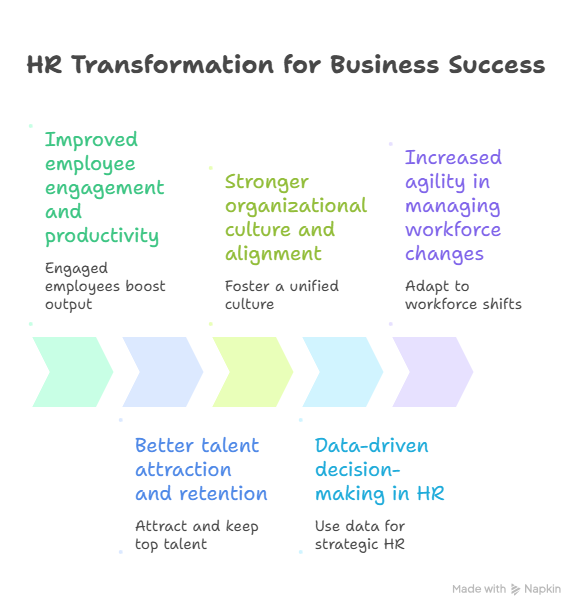
1. Improved employee engagement and productivity
When employees feel heard, supported, and valued, they naturally perform better in their roles.
Strong HR strategies help you create clear expectations, provide regular feedback, and build an environment where people stay motivated and focused on their work.
2. Better talent attraction and retention
Hiring becomes easier when your organization has a clear identity and structured processes in place.
You attract the right candidates faster and give them reasons to stay longer, reducing the constant pressure of rehiring and rebuilding teams.
3. Stronger organizational culture and alignment
A well-defined HR strategy helps you shape how people work, communicate, and collaborate every day.
It ensures that your team is aligned with company values, making decision-making smoother and more consistent across departments.
4. Data-driven decision-making in HR
Instead of relying on guesswork, you start using data to guide your hiring, performance, and retention strategies.
This allows you to identify patterns, fix issues early, and make smarter decisions that improve overall workforce performance.
5. Increased agility in managing workforce changes
Modern workplaces change quickly, and your HR approach needs to keep up with that pace.
With strong strategies in place, you can adapt to new hiring needs, remote work setups, or organizational shifts without creating disruption.
Key Pillars of Effective HR Strategies
To build an HR strategy that actually works, you need to focus on a few core areas that shape the entire employee lifecycle.
These pillars ensure that your people processes are not scattered, but connected and aligned with your business goals.
1. Talent acquisition and workforce planning
It starts with hiring the right people at the right time without delays or guesswork.
When you plan your workforce needs in advance, you avoid rushed hiring decisions and build teams that are aligned with long-term business growth.
2. Employee engagement and experience
Your employees do their best work when they feel connected to what they do and where they work.
A strong focus on engagement helps you create meaningful experiences that keep your team motivated, involved, and committed over time.
3. Learning, development, and growth
People stay longer where they see growth opportunities and continuous learning.
When you invest in skill development and career progression, you not only improve performance but also build a future-ready workforce.
4. Performance management and feedback
Clear expectations and regular feedback help employees understand where they stand and how they can improve.
A structured performance system ensures accountability while also supporting growth through constructive and timely feedback.
5. HR technology and data-driven processes
Managing HR manually slows you down and limits your ability to scale efficiently.
By using the right tools and data insights, you can automate processes, track performance, and make smarter decisions that improve overall workforce management.
Suggested Reading:
12 Proven Candidate Engagement Strategies Every Recruiter Should Use in 202612 Proven HR Strategies for Modern Workplaces
Now that you understand the core pillars, the next step is putting them into action in a way that actually drives results.
These proven HR strategies will help you build a workplace that is adaptable, people-first, and ready for modern challenges.
1. Build a strong employer brand to attract top talent
Before candidates apply, they already have an opinion about your company.
That opinion comes from your website, employee reviews, social presence, and how your hiring process feels from the outside.
A strong employer brand helps you attract the right people without chasing them constantly.
You can strengthen your employer brand by:
- Showcasing real employee stories and experiences
- Being transparent about culture, growth, and expectations
- Keeping your communication clear and human during hiring
When your brand feels authentic, candidates self-select.
That means fewer mismatched applications and better-quality hires from the start.
2. Focus on skills-based hiring instead of traditional credentials
Degrees and job titles don’t always reflect real ability anymore.
Many high-performing candidates come from non-traditional backgrounds, and strict credential filters often eliminate them too early.
Skills-based hiring shifts your focus from “what someone has done” to “what someone can actually do.”
To apply this approach:
- Use skill assessments instead of relying only on resumes
- Redefine job descriptions to focus on outcomes, not requirements
- Evaluate candidates through practical tasks or simulations
This approach expands your talent pool significantly.
It also improves hiring accuracy because you’re selecting based on capability, not assumptions.
3. Create personalized employee experiences
Employees no longer want one-size-fits-all policies.
They expect workplaces to adapt to their individual needs, preferences, and career goals.
Personalization in HR means treating employees like individuals, not headcount.
You can do this by:
- Offering flexible benefits based on life stage and priorities
- Creating customized career growth paths
- Gathering regular feedback and acting on it
When employees feel understood, engagement improves naturally.
And when engagement improves, retention becomes much easier without constant intervention.
4. Invest in continuous learning and upskilling
Skills become outdated quickly, especially in fast-moving industries.
If you’re not helping employees grow, they’ll eventually look for opportunities elsewhere.
Continuous learning is no longer optional, it’s a core part of retention.
To build a learning culture:
- Provide access to courses, certifications, and workshops
- Encourage internal knowledge sharing across teams
- Align learning programs with real business needs
Upskilling doesn’t just benefit employees.
It strengthens your organization by ensuring your workforce evolves alongside industry changes.
5. Implement flexible work policies and hybrid models
Flexibility has shifted from a perk to an expectation.
Most employees now value control over where and how they work just as much as compensation.
Rigid work structures often push talent away, even if everything else looks good.
Modern HR teams are adopting:
- Hybrid work models that balance office and remote work
- Flexible hours instead of strict schedules
- Outcome-based performance tracking instead of time-based monitoring
Flexibility builds trust between employees and employers.
And when trust increases, productivity and satisfaction usually follow.
6. Use data and analytics to drive HR decisions
HR decisions based on intuition alone are no longer enough.
With access to better tools and data, you can make more accurate and faster decisions across hiring, engagement, and retention.
Data-driven HR helps you understand what’s actually working and what needs improvement.
You can start by tracking:
- Time-to-hire and hiring funnel performance
- Employee engagement and retention trends
- Learning and performance outcomes
Modern tools even allow real-time visibility into your hiring pipeline and workforce insights.
For example, AI-driven platforms can automate sourcing, screening, and scheduling while providing actionable analytics to improve decision-making .
When you combine data with human judgment, your HR strategy becomes both efficient and effective.
And over time, that consistency leads to stronger teams and better business outcomes.
7. Strengthen employee engagement through regular feedback
Employee engagement doesn’t improve through annual surveys alone.
If feedback only happens once or twice a year, you miss the chance to fix issues when they actually matter.
Modern workplaces rely on continuous, real-time feedback to stay connected with employees.
You can strengthen engagement by:
- Running quick pulse surveys instead of long annual ones
- Encouraging managers to have regular one-on-one conversations
- Acting on feedback visibly so employees feel heard
When feedback becomes a habit, not an event, employees feel more involved in decisions.
That sense of involvement directly impacts motivation, performance, and long-term retention.
8. Align performance management with business goals
Performance management often fails because it feels disconnected from actual business outcomes.
Employees complete reviews, but they don’t always understand how their work contributes to bigger goals.
To fix this, performance systems need to be aligned with what the business is trying to achieve.
You can do this by:
- Setting clear, measurable goals linked to company objectives
- Reviewing performance more frequently instead of yearly cycles
- Shifting focus from evaluation to growth and improvement
When employees see how their work drives impact, their focus becomes sharper.
And when performance conversations feel meaningful, they stop being a formality and start driving results.
9. Foster a culture of transparency and communication
Lack of communication creates uncertainty faster than any external challenge.
When employees don’t know what’s happening or why decisions are made, trust starts to drop.
Transparency helps build that trust and keeps teams aligned.
You can create a more open culture by:
- Sharing company goals, challenges, and progress regularly
- Encouraging leaders to communicate openly, not just top-down
- Creating safe spaces where employees can ask questions freely
Transparency doesn’t mean sharing everything.
It means sharing enough to make employees feel informed, included, and respected.
Over time, this builds a stronger connection between leadership and teams.
10. Leverage AI and automation to improve HR efficiency
HR teams often spend too much time on repetitive tasks.
Sourcing candidates, screening resumes, scheduling interviews, and following up manually can slow everything down.
This is where AI and automation can make a significant difference.
Modern HR tools can:
- Automate candidate sourcing across multiple platforms
- Screen and rank profiles based on job fit in minutes
- Handle outreach, follow-ups, and interview scheduling automatically
This doesn’t replace recruiters.
It removes the manual workload so they can focus on high-impact decisions and candidate relationships.
For instance, AI recruiting copilots can manage end-to-end hiring workflows, from sourcing to scheduling, while also providing real-time insights to improve hiring outcomes .
The result is faster hiring, better candidate experience, and significantly reduced effort for HR teams.
11. Prioritize diversity, equity, and inclusion initiatives
Diversity, equity, and inclusion are no longer optional initiatives.
They are essential for building strong, innovative, and resilient teams.
A diverse workplace brings different perspectives, which leads to better problem-solving and decision-making.
To prioritize DEI effectively:
- Remove bias from hiring processes using structured evaluations
- Create inclusive policies that support different backgrounds and needs
- Measure and track diversity metrics consistently
DEI is not just about hiring.
It’s about creating an environment where everyone feels valued and has equal opportunities to grow.
When done right, it strengthens both culture and business performance.
12. Build leadership development and succession planning programs
Strong organizations don’t rely on external hiring for every leadership role.
They build leaders from within and prepare for future transitions in advance.
Without a clear plan, leadership gaps can disrupt teams and slow down growth.
You can build effective leadership pipelines by:
- Identifying high-potential employees early
- Providing mentorship and leadership training programs
- Creating clear succession plans for critical roles
Leadership development is a long-term investment.
It ensures continuity, stability, and growth even during periods of change.
And when employees see clear growth paths, they are more likely to stay and contribute at a higher level.
How to Choose the Right HR Strategy for Your Organization
Not every HR strategy will work the same way for every organization.
The right approach depends on your current challenges, growth stage, and what you are trying to improve first, so it is important to focus on what matters most right now.
1. If your focus is improving employee retention
When employees are leaving frequently, the issue is often deeper than just compensation.
You need to focus on engagement, career growth, feedback systems, and workplace culture to understand why people leave and create reasons for them to stay longer.
2. If you are scaling hiring and workforce planning
Rapid growth brings pressure to hire faster without compromising on quality.
In this case, your strategy should prioritize structured hiring processes, clear workforce planning, and tools that help you source and screen candidates efficiently.
3. If employee engagement is your biggest challenge
Low engagement usually shows up as reduced productivity and lack of motivation.
You should focus on communication, personalized experiences, recognition, and regular feedback to rebuild connection and involvement within your team.
4. If you want to modernize HR with technology
Outdated processes slow everything down and create unnecessary manual work.
Your strategy should include adopting HR technology, automation, and data-driven systems to improve efficiency and make smarter, faster decisions.
How Leelu Helps You Execute Modern HR Strategies More Effectively
Even with the right HR strategies in place, execution is where most teams struggle.
You often deal with multiple tools, manual processes, and slow hiring cycles that make everything harder than it should be.
That’s where Leelu.ai helps you simplify and scale your hiring without adding complexity.
Instead of managing scattered workflows, you get one system that handles sourcing, screening, outreach, and scheduling in a structured way.
It allows you to focus more on decision-making and people strategy while the operational work runs in the background.
Here’s how Leelu supports your HR strategy execution:
- Source candidates from 500M+ profiles across platforms without switching tools
- Automatically screen and rank candidates based on job fit in minutes
- Reach out to candidates with personalized messages at scale
- Keep candidates engaged with automated follow-ups and responses
- Schedule interviews instantly with smart calendar integration
- View all candidate data in one unified profile for better decisions
- Integrate seamlessly with your existing ATS without manual updates
- Track hiring performance with real-time insights and analytics
By reducing manual effort and improving speed, Leelu.ai helps you move from reactive hiring to a more structured and efficient approach.
The result is not just faster hiring, but better-quality decisions and a smoother experience for both recruiters and candidates.
Common Mistakes When Implementing HR Strategies
Even the best HR strategies can fail if they are not implemented the right way.
Often, the problem is not the strategy itself, but how consistently and thoughtfully it is applied across the organization.
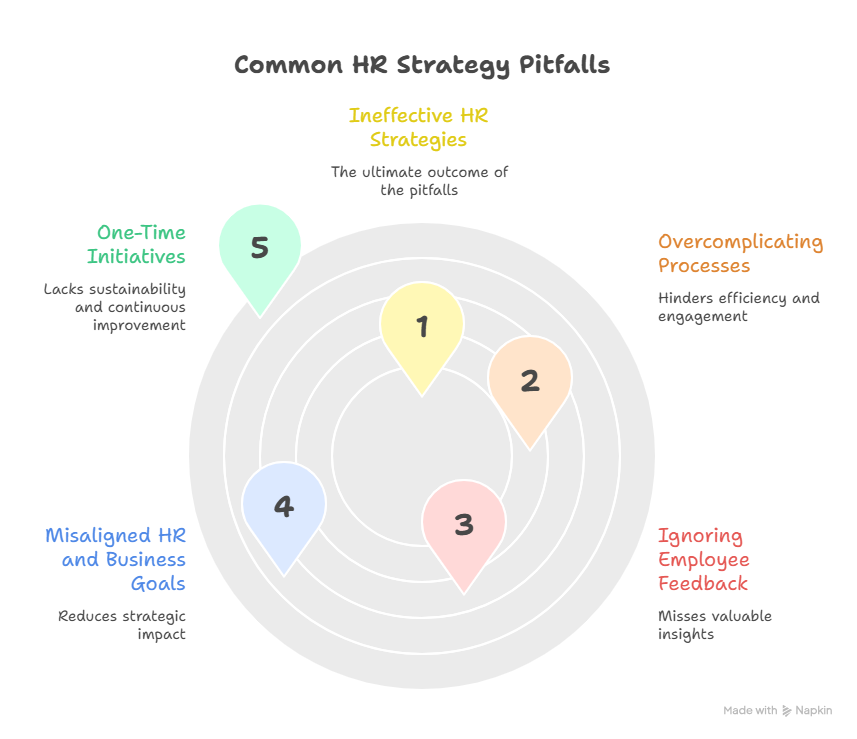
1. Treating HR strategies as one-time initiatives
HR strategies are not something you set once and forget.
Workplaces evolve constantly, so your approach needs regular updates and adjustments to stay relevant and effective.
2. Not aligning HR goals with business objectives
When HR operates in isolation, it creates disconnects across teams.
Your HR initiatives should directly support business priorities, ensuring that people strategies contribute to overall growth and performance.
3. Ignoring employee feedback and data insights
Decisions made without listening to employees or reviewing data often miss the real issues.
By actively using feedback and insights, you can identify gaps early and improve your strategies with confidence.
4. Overcomplicating processes instead of simplifying them
Complex processes slow down teams and create unnecessary friction.
The goal of HR strategies should be to make workflows smoother, not harder, so simplicity should always be a priority.
5. Not leveraging technology and automation effectively
Relying too much on manual work limits efficiency and scalability.
When you use the right tools and automation, you reduce repetitive effort and create space to focus on more strategic HR initiatives.
Suggested Reading:
Modern Onboarding Process Steps for HR ProfessionalsConclusion
Building effective HR strategies is no longer optional if you want to keep up with modern workplace demands.
When you focus on the right pillars, avoid common mistakes, and choose strategies based on your current challenges, you create a system that supports both people and business growth.
The key is to stay adaptable, keep improving, and use the right tools where needed so your HR function evolves with your organization instead of falling behind.
Frequently Asked Questions
1. Why are HR strategies important for modern workplaces?
Workplaces today are constantly evolving with remote work, changing expectations, and faster hiring needs.
Strong HR strategies help you stay adaptable, improve employee experience, and ensure your team remains productive and aligned with business growth.
2. How do you create an effective HR strategy?
You start by identifying your biggest challenges, whether it is hiring, retention, or engagement.
Then you build a plan around clear goals, use data to guide decisions, and continuously improve your approach based on feedback and results.
3. What is the biggest mistake companies make with HR strategies?
One of the most common mistakes is treating HR strategies as one-time efforts instead of ongoing processes.
Without regular updates and alignment with business goals, even well-designed strategies can quickly become ineffective.
4. How can technology improve HR strategies?
Technology helps you automate repetitive tasks, streamline hiring, and track employee data more effectively.
This allows you to make faster decisions, reduce manual effort, and focus more on strategic initiatives that drive long-term impact.