Hiring great developers sounds simple until your startup starts growing faster than your team can keep up.
Suddenly, you're trying to fill multiple technical roles while also managing product development, customer demands, and day-to-day operations.
Without an internal recruiting team, the hiring process can quickly become overwhelming and slow down growth.
The good news is that many startups successfully scale tech hiring without building large recruitment departments.
Instead, they rely on smarter processes, automation, external support, and modern hiring tools.
In this guide, you'll learn:
- Why tech hiring becomes a major bottleneck for startups
- The strategies startups use to scale hiring efficiently
- How to build a faster and more predictable hiring process
- How AI-powered recruiting solutions can reduce hiring workload
Why Tech Hiring Becomes a Bottleneck for Startups
As startups grow, hiring shifts from an occasional task to a continuous business priority.
What initially feels manageable can quickly become a major obstacle to scaling.
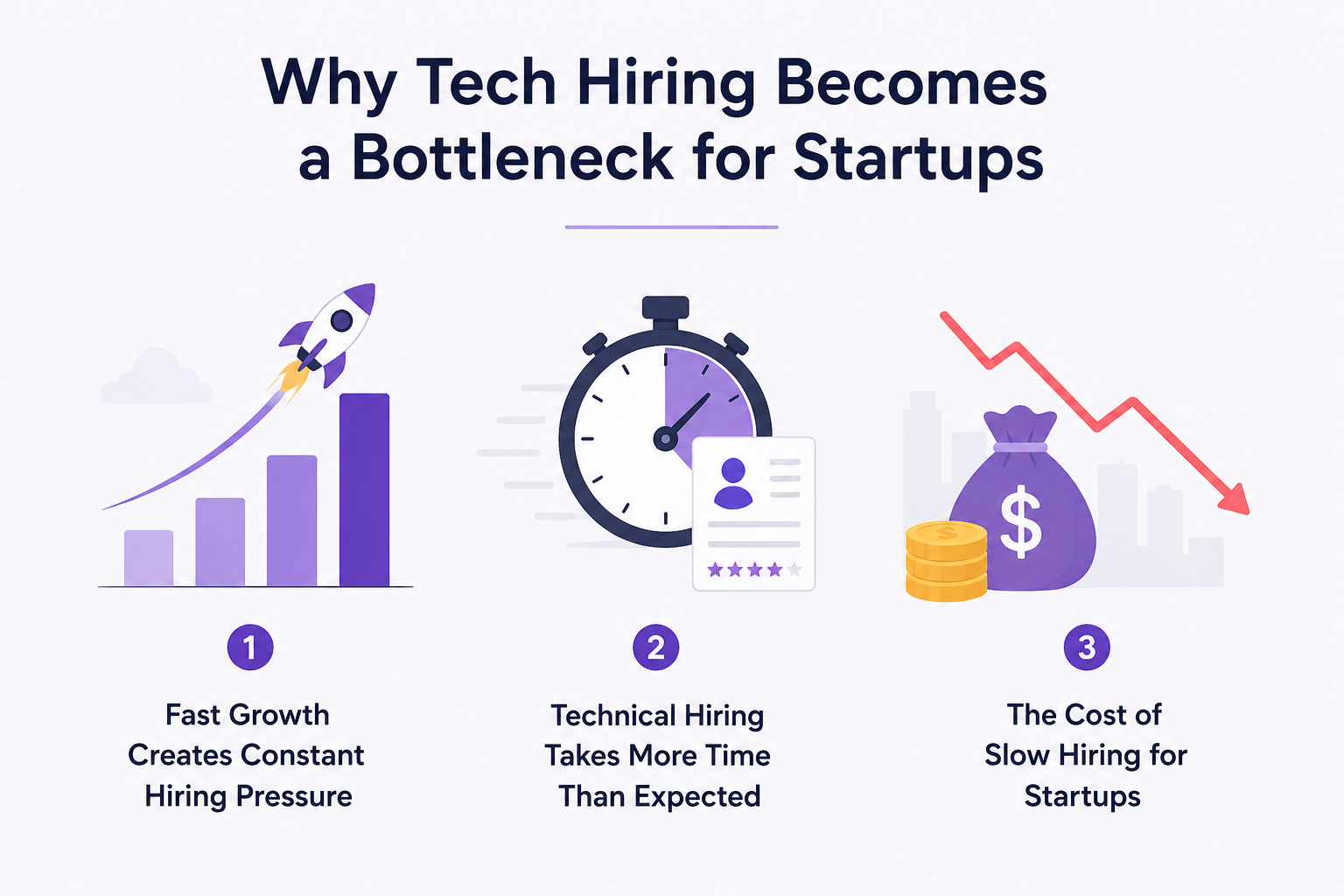
Fast Growth Creates Constant Hiring Pressure
New product launches, expanding customer demands, and business growth often create an immediate need for more developers.
Many startups find themselves hiring for multiple technical roles simultaneously while working with limited time and resources.
As hiring needs increase, maintaining a steady flow of qualified candidates becomes increasingly difficult.
Technical Hiring Takes More Time Than Expected
Finding qualified technical talent is rarely a quick process.
Teams must source candidates, review resumes, conduct technical assessments, coordinate interviews, and manage follow-ups.
Each stage requires careful evaluation to ensure candidates have the right technical skills and experience.
For founders and engineering leaders, these responsibilities often compete with critical business and product priorities.
The Cost of Slow Hiring for Startups
When hiring slows down, business growth often slows with it.
Open positions can delay product development, increase workloads for existing team members, and create missed opportunities.
Extended hiring timelines can also lead to candidate drop-offs as top talent accepts offers elsewhere.
Over time, prolonged vacancies can affect productivity, team morale, and the startup's ability to stay competitive.
Tactics Used by Startups to Scale Tech Hiring
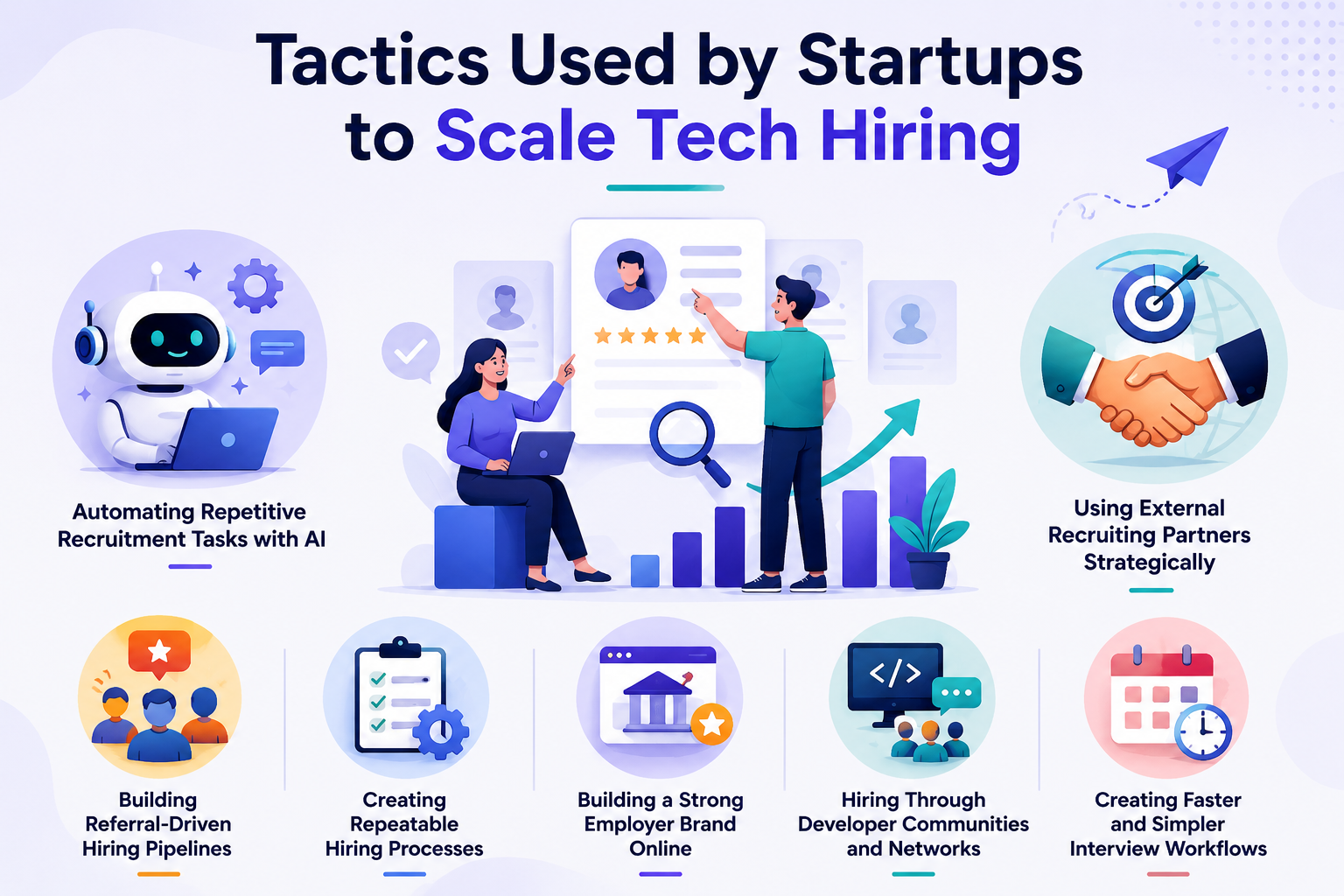
Once startups understand where hiring bottlenecks come from, the next step is removing them with systems that can scale.
Instead of expanding recruiting teams immediately, many startups focus on strategies that help them hire faster while keeping costs under control.
1. Automating Repetitive Recruitment Tasks with AI
A large portion of recruitment involves repetitive tasks that consume valuable time.
This often includes:
- Candidate sourcing
- Resume screening
- Outreach and follow-ups
- Interview scheduling
- Candidate pipeline tracking
According to industry estimates, recruiters can spend more than 50% of their time on administrative activities rather than evaluating candidates.
AI helps automate these processes and allows startups to:
- Source candidates faster
- Screen applications at scale
- Prioritize qualified talent automatically
- Reduce manual coordination
As a result, hiring teams can focus more on making decisions and less on managing workflows.
Suggested Reading:
How Recruitment Automation Is Transforming Hiring in USAUsing External Recruiting Partners Strategically
Hiring demand can increase quickly after funding rounds, product launches, or expansion into new markets.
During these periods, external recruiting partners can provide additional support without requiring startups to build an in-house recruiting function.
The most successful startups typically use recruiting partners for:
- Specialized technical roles
- Leadership positions
- High-volume hiring periods
- Hard-to-find skill sets
This approach gives startups access to larger talent networks and recruiting expertise while maintaining flexibility.
Rather than replacing internal hiring efforts, external partners often act as an extension of the existing team.
Building Referral-Driven Hiring Pipelines
Employee referrals continue to be one of the most effective hiring channels for technical talent.
Developers often have strong professional networks, making referrals a reliable source of qualified candidates.
A referral-driven hiring strategy can help startups:
- Reduce sourcing costs
- Improve candidate quality
- Shorten hiring timelines
- Increase offer acceptance rates
Many growing companies encourage referrals by creating structured programs and rewarding successful recommendations.
Over time, referrals can become a consistent talent pipeline that supports hiring growth without requiring significant recruiting resources.
For startups looking to scale efficiently, referrals often deliver both speed and quality at the same time.
Creating Repeatable Hiring Processes
Many startups struggle with hiring because every open role is handled differently.
Without a structured process, teams often spend time rebuilding workflows, redefining evaluation criteria, and coordinating interviews from scratch.
Creating a repeatable hiring process helps eliminate this inconsistency.
A scalable hiring framework typically includes:
- Standardized job descriptions
- Consistent screening criteria
- Defined interview stages
- Structured candidate evaluations
- Clear decision-making workflows
When every stakeholder follows the same process, hiring becomes faster and more predictable.
It also improves the candidate experience by reducing delays and communication gaps throughout the recruitment journey.
Building a Strong Employer Brand Online
Even the best hiring process struggles if candidates know little about your company.
Before applying, most developers research potential employers through websites, social media platforms, review sites, and employee content.
A strong employer brand helps startups attract talent without relying entirely on outbound recruiting.
Startups can strengthen their employer brand by:
- Sharing company culture and values
- Highlighting employee experiences
- Showcasing product innovation
- Publishing engineering and technical content
- Maintaining an active presence on professional platforms
When candidates already understand what your company stands for, they are more likely to engage with opportunities and respond to outreach.
Over time, this creates a steady stream of inbound interest from qualified talent.
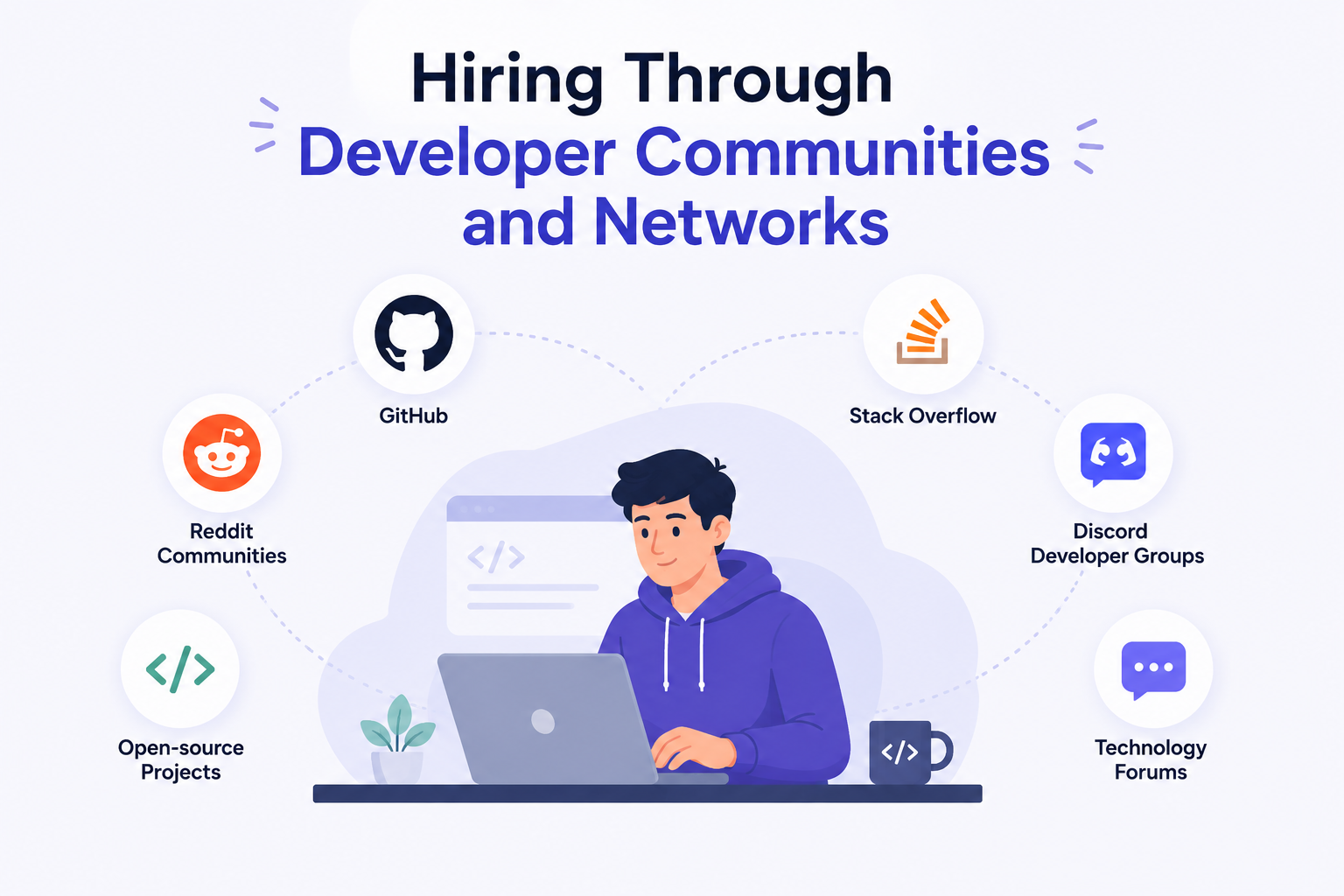
Hiring Through Developer Communities and Networks
Many highly skilled developers are not actively searching job boards.
Instead, they spend time in professional communities where they learn, collaborate, and share knowledge with peers.
This is why successful startups often expand their hiring efforts beyond traditional recruitment channels.
Popular talent communities include:
- GitHub
- Stack Overflow
- Discord developer groups
- Reddit communities
- Open-source projects
- Technology-specific forums
These communities provide access to both active and passive candidates.
Participating in discussions, contributing value, and building relationships can help startups connect with talent that may not respond to conventional recruiting methods.
This approach often leads to stronger candidate engagement and better long-term hiring outcomes.
Creating Faster and Simpler Interview Workflows
Even when startups attract qualified candidates, lengthy interview processes can become a major obstacle.
Top technical talent often receives multiple opportunities simultaneously and may leave the process if interviews move too slowly.
To reduce candidate drop-offs, many startups focus on simplifying their interview workflows.
Common improvements include:
- Reducing unnecessary interview rounds
- Standardizing technical assessments
- Automating interview scheduling
- Improving interviewer coordination
- Providing faster feedback to candidates
A streamlined process helps candidates move through the hiring funnel more efficiently.
It also allows hiring teams to evaluate talent faster and secure strong candidates before competitors make an offer.
For growing startups, interview speed is often a competitive advantage that directly impacts hiring success.
Suggested Reading:
How to Hire Faster: 12 Proven Ways to Cut Time-to-HireHow Leelu Helps Startups Scale Tech Hiring Efficiently
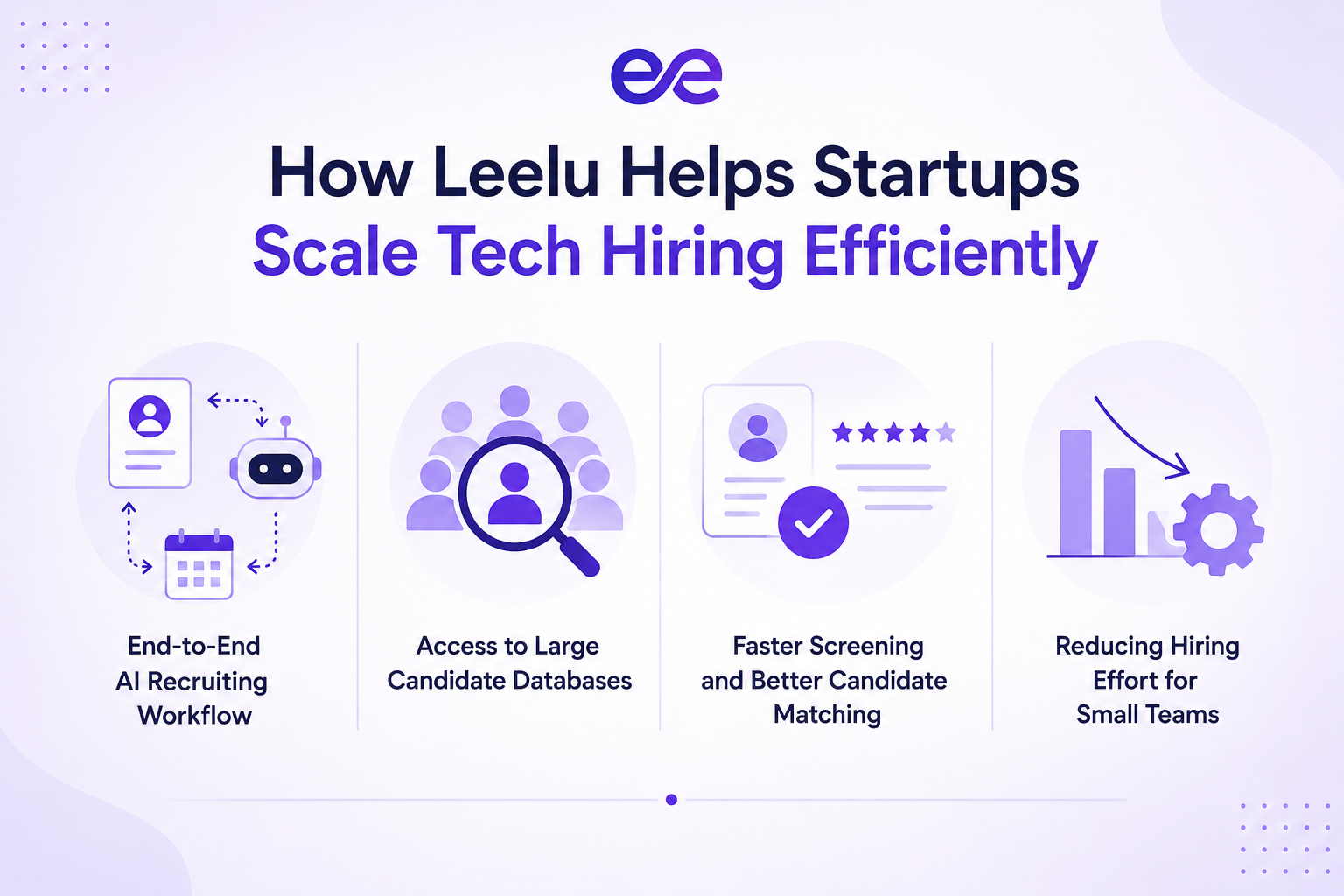
As startups grow, hiring becomes difficult not because candidates are unavailable, but because managing the entire recruitment process requires significant time and coordination.
This is where Leelu helps startups build a scalable hiring system without relying on a large internal recruiting team.
End-to-End AI Recruiting Workflow
Most startups use separate tools for sourcing, screening, outreach, and interview scheduling.
Managing these disconnected workflows often creates delays and additional manual work.
Leelu brings the entire recruiting process into one platform and automates key hiring activities from start to finish.
The workflow includes:
- Candidate sourcing
- Resume screening
- AI candidate matching
- Personalized outreach
- Follow-ups and engagement
- Interview scheduling
Instead of managing every step manually, startups can run a more consistent hiring process with significantly less effort.
Access to Large Candidate Databases
One of the biggest hiring challenges for startups is finding enough qualified candidates quickly.
Leelu helps solve this by giving access to a large talent pool across multiple sourcing channels.
The platform searches candidates from:
- Indeed
- Monster
- CareerBuilder
- ATS systems
- Internal talent databases
With access to more than 500 million candidate profiles, startups can expand their hiring reach without switching between multiple recruiting tools.
Faster Screening and Better Candidate Matching
Reviewing hundreds of resumes manually can slow hiring and make it harder to identify strong candidates quickly.
Leelu uses AI-powered screening and matching to evaluate candidate profiles based on job requirements.
This helps teams:
- Prioritize qualified candidates faster
- Reduce manual resume reviews
- Improve shortlist quality
- Identify stronger matches earlier
Instead of spending hours filtering applications, hiring teams can focus on evaluating the most relevant candidates first.
Reducing Hiring Effort for Small Teams
Many startups do not have dedicated recruiters handling hiring full-time.
Founders, engineering managers, and team leads often manage recruitment alongside their existing responsibilities.
Leelu reduces this workload by automating repetitive recruiting tasks that typically consume the most time.
This includes:
- Candidate sourcing
- Outreach campaigns
- Follow-ups
- Screening workflows
- Interview coordination
By automating these activities, startups can reduce hiring effort by up to 70–95% while maintaining hiring speed and candidate engagement.
This allows small teams to scale recruitment efficiently without expanding internal recruiting operations.
Conclusion
Scaling tech hiring without an internal recruiting team is challenging, but it is far from impossible.
By combining AI automation, referral programs, external recruiting support, strong employer branding, and streamlined hiring processes, startups can build a predictable and scalable talent pipeline.
The key is to reduce manual work and create systems that support growth as hiring demands increase.
Solutions like Leelu help startups achieve this by automating sourcing, screening, outreach, and scheduling, allowing lean teams to hire faster without expanding their recruiting operations.
Frequently Asked Questions
1. Can startups scale tech hiring without an internal recruiter?
Yes. Many startups use AI tools, referrals, external recruiting partners, and structured hiring processes to scale hiring without building a dedicated recruiting team.
2. What is the biggest challenge in startup tech hiring?
The biggest challenge is balancing hiring with other business priorities while finding qualified technical talent quickly.
3. How can AI improve the tech hiring process?
AI can automate sourcing, resume screening, candidate outreach, follow-ups, and interview scheduling, reducing manual effort and speeding up hiring.
4. Are employee referrals effective for hiring developers?
Yes. Referral candidates are often higher quality, move through the hiring process faster, and tend to have higher offer acceptance rates.
5. How does Leelu help startups hire faster?
Leelu automates sourcing, screening, outreach, candidate engagement, and interview scheduling, helping startups reduce recruiting effort and accelerate hiring.


