Most recruiters post a job, share it once, and wait.
Then they wonder why the same few mediocre résumés trickle in for weeks.
The real challenge is that the candidates you actually want aren't actively browsing job boards.
They're already employed, casually exploring opportunities, and often invisible to a simple "we're hiring" post.
That's why doubling your applicants isn't about posting louder or on more platforms.
It's about reaching qualified candidates where they already spend time and giving them a reason to respond before a competitor gets there first.
In this guide, you'll learn:
- The foundations that make candidate lead generation work
- 13 proven strategies to build a stronger applicant pipeline
- How to attract both active and passive candidates
- Ways to turn sourcing into a repeatable recruitment system
- Common mistakes that quietly limit applicant growth
Get These Candidate Lead Generation Foundations Right First
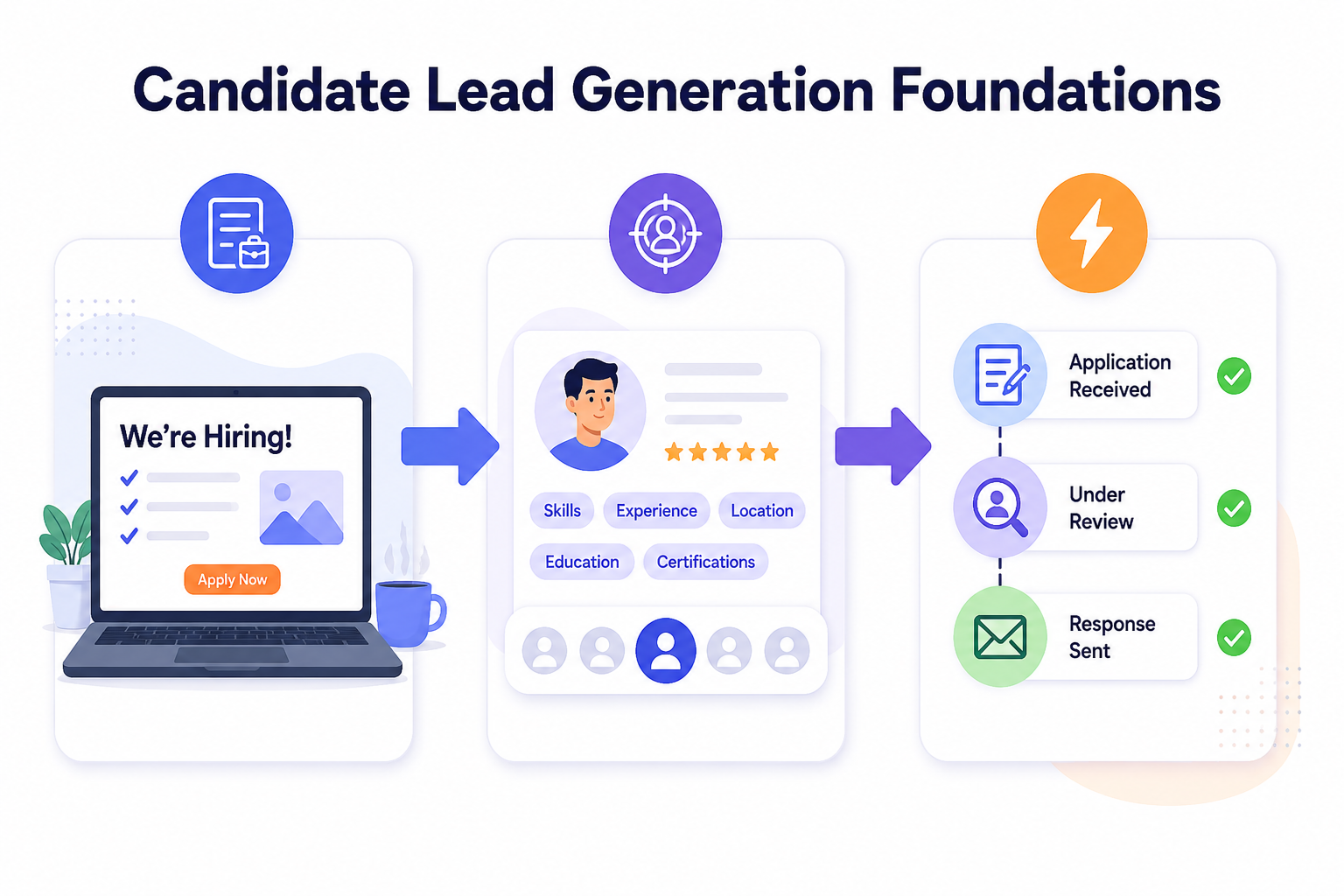
The strategies below can bring more candidates into your pipeline.
But they only work if your job and hiring process can hold the attention they earn.
Think of these as the foundations that support every candidate lead generation effort, not strategies on their own.
A Job Description That Sells, Not Just Lists
Your job description is often the first interaction a candidate has with your company.
If it reads like a long checklist of requirements, many qualified people will leave before applying.
Instead, start by explaining what the role offers, the impact the person will make, and who is most likely to thrive in the position.
When candidates can picture themselves succeeding in the role, they're more likely to engage.
A strong job description improves applicant quality before you source a single candidate.
A Clear Picture of Who You're Actually After
Many hiring teams make sourcing harder by searching for broad job titles.
The problem is that "developer" could describe thousands of very different professionals.
A specific candidate profile gives your sourcing efforts direction.
For instance, "senior backend engineer with fintech experience who prefers remote work" is far more useful than a generic title.
The clearer your ideal candidate profile is, the easier it becomes to find the right people and create outreach that feels relevant.
Specificity helps your messages land instead of getting ignored.
A Response Process That Doesn't Stall
Even the best sourcing strategy can fail if interested candidates wait too long for a response.
Top candidates often explore multiple opportunities at the same time.
If your team takes several days to reply, schedule a call, or answer a question, another employer may move faster.
That's why speed matters throughout the hiring process.
Automated acknowledgments, timely follow-ups, and clear next steps help maintain momentum after a candidate shows interest.
When your process responds quickly, you keep warm candidates engaged and reduce the chances of losing them before the conversation even begins.
13 Candidate Lead Generation Strategies to Fill Your Pipeline
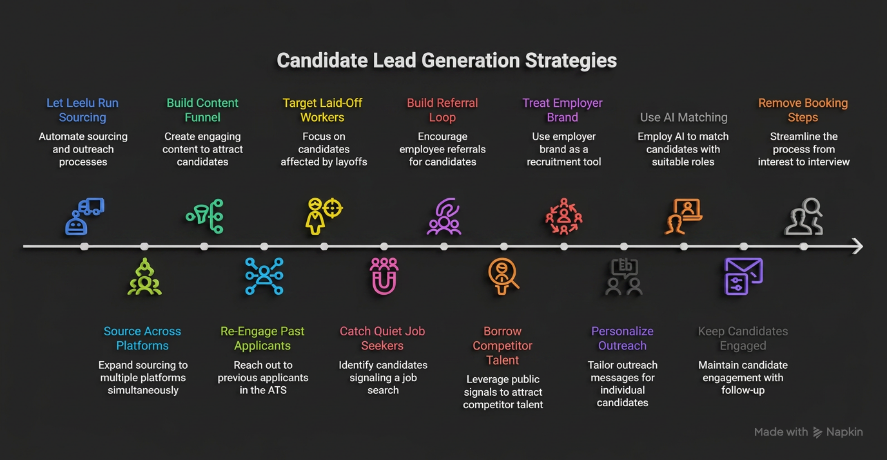
Now that the foundation is in place, it's time to focus on where the real sourcing happens.
The strategies below help you find candidates who are already showing signals of interest or availability, rather than relying on random cold outreach.
We'll start with the strategy that makes every other tactic easier to execute.
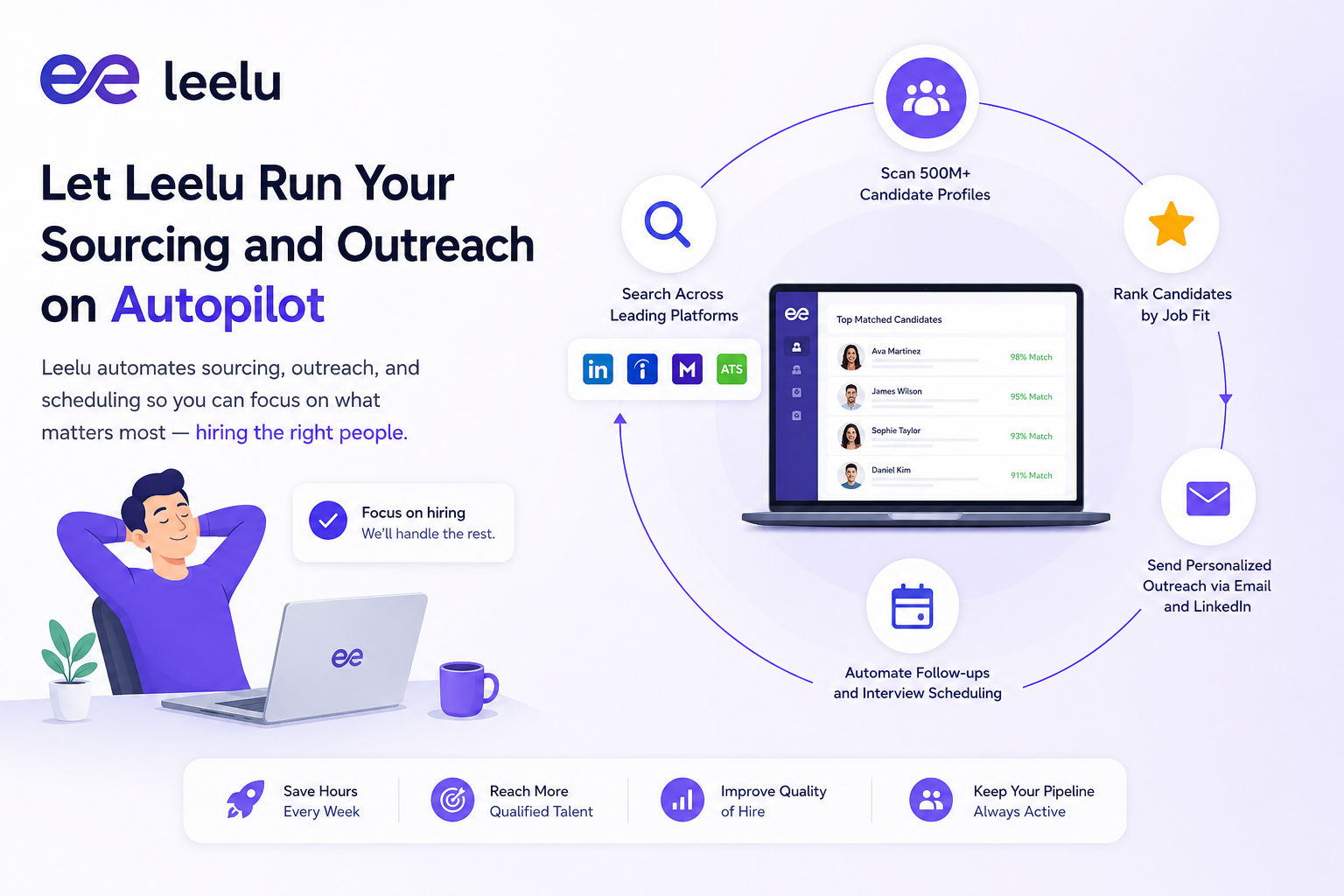
Strategy 1 — Let Leelu Run Your Sourcing and Outreach on Autopilot
Every strategy in this guide can work.
The challenge is that running them manually consumes hours that could be spent interviewing and evaluating candidates.
Instead of searching, screening, messaging, and scheduling one step at a time, automation can handle much of the heavy lifting.
Leelu helps streamline the entire process by:
- Scanning 500M+ candidate profiles
- Searching across LinkedIn, Indeed, Monster, and ATS systems
- Ranking candidates based on job fit
- Sending personalized outreach through email and LinkedIn
- Automating follow-ups and interview scheduling
Rather than sourcing candidates only when you have time, the process keeps moving while you focus on hiring decisions.
Strategy 2 — Source Across Every Platform at Once, Not One at a Time
Many recruiters spend hours searching LinkedIn and assume they've covered the market.
The reality is that candidates behave differently across platforms.
Someone who rarely updates LinkedIn may be highly active on Indeed or another job board.
Limiting sourcing to a single platform immediately shrinks your talent pool.
Multi-platform sourcing helps you:
- Reach a larger audience faster
- Discover candidates your competitors miss
- Increase applicant volume without increasing effort
- Build a more diverse pipeline
The wider your search coverage, the more qualified candidates enter your funnel.
Strategy 3 — Build a Content Funnel on LinkedIn That Makes Candidates Come to You
Not every candidate will respond to outreach.
Some prefer to research companies quietly before expressing interest.
That's where LinkedIn content becomes a lead generation channel.
Regularly sharing content about:
- Team culture
- Employee success stories
- Hiring insights
- Industry trends
- Open opportunities
helps potential candidates become familiar with your company long before they apply.
Over time, your content creates trust and attracts people who already understand what your organization offers.
Instead of starting every conversation cold, candidates begin coming to you already interested.
Strategy 4 — Re-Engage Past Applicants Sitting Dead in Your ATS
Most companies already have hundreds or even thousands of candidate records sitting inside their ATS.
Many of those applicants were rejected because timing wasn't right, not because they lacked qualifications.
A new opening creates a perfect reason to reconnect.
These candidates already:
- Know your company
- Applied previously
- Showed interest in working with you
That makes them significantly warmer than completely new prospects.
Before spending weeks sourcing fresh candidates, review the talent you've already collected.
You may discover strong applicants who can move through the hiring process much faster.
Strategy 5 — Target People Who Just Announced a Layoff or Company Closure
Layoffs create concentrated pools of available talent.
When a company announces workforce reductions, qualified professionals often begin exploring opportunities immediately.
The timing matters.
Recruiters who reach out within days of a layoff announcement usually face less competition than those who wait weeks.
Monitor:
- Company layoff announcements
- Funding shutdowns
- Office closures
- Restructuring news
- Industry workforce reductions
A single layoff event can place dozens or even hundreds of qualified candidates into the market at the same time.
By acting quickly, you connect with talent while interest and availability are at their highest.
More importantly, these candidates often have highly relevant experience because they come from organizations already operating within your industry or niche.
Strategy 6 — Catch Candidates Signaling a Quiet Job Hunt
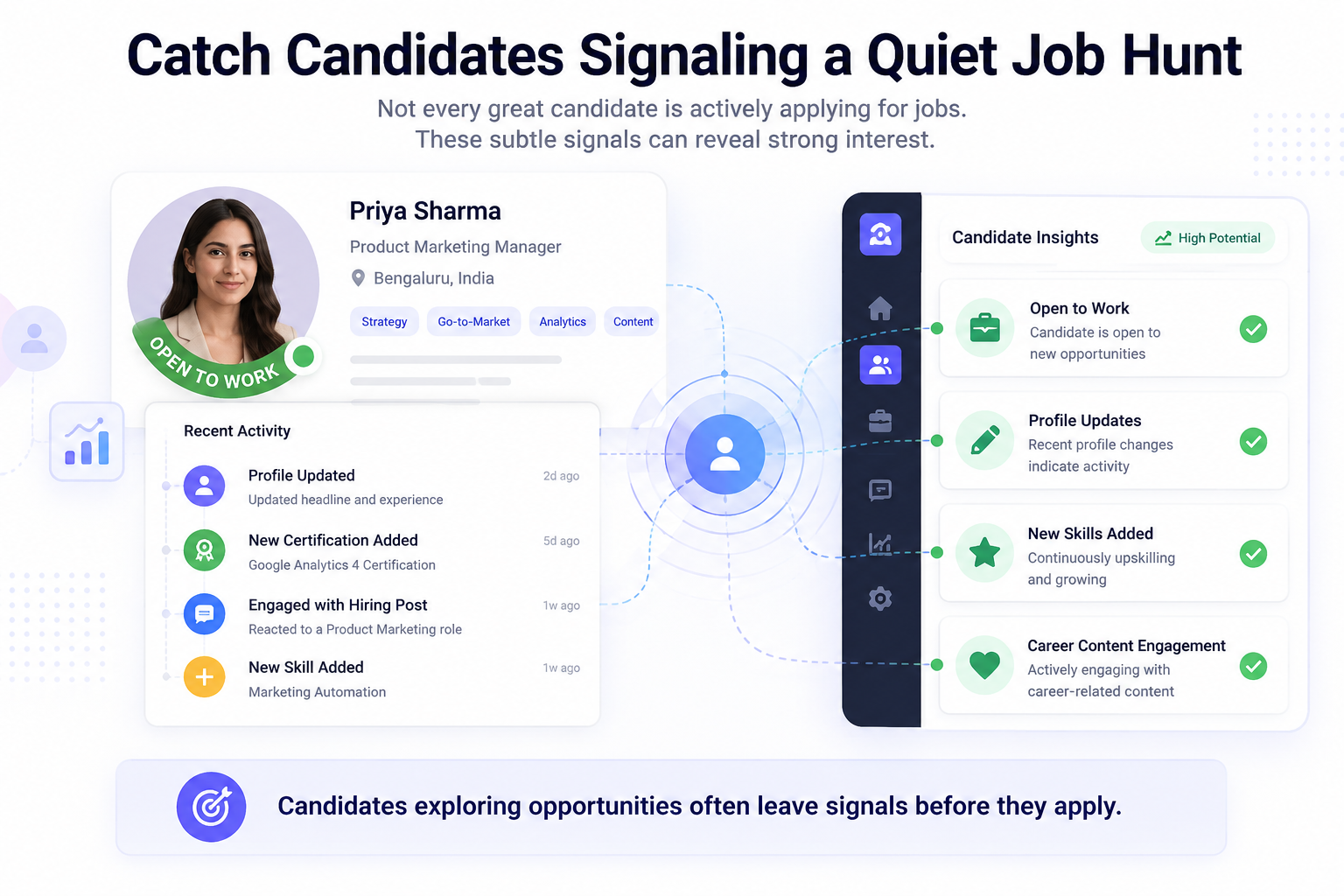
Not every great candidate is actively applying for jobs.
Many are simply testing the market before making a move.
The good news is that these candidates often leave signals behind.
Look for indicators such as:
- "Open to Work" profile settings
- Recent profile updates
- Increased activity on hiring posts
- New skills or certifications being added
- Engagement with career-related content
These actions usually suggest someone is exploring opportunities.
Because they're already considering a change, they're often more responsive than completely passive candidates.
Suggested Reading:
Passive Candidates: How to Source & Hire Top TalentStrategy 7 — Build a Referral Loop Your Current Employees Actually Use
Your employees are connected to talented professionals who already understand the industry.
That's what makes referrals one of the most effective candidate lead generation channels.
The problem is that many referral programs create unnecessary friction.
Long forms and complicated submission processes reduce participation.
Instead, make referrals quick and simple.
A strong referral program should:
- Require minimal effort to submit
- Offer clear incentives
- Keep employees updated on referral status
- Make sharing opportunities easy
When referrals become part of everyday hiring rather than an occasional initiative, candidate quality and application volume both improve.
Strategy 8 — Borrow a Competitor's Talent Pool Through Public Signals
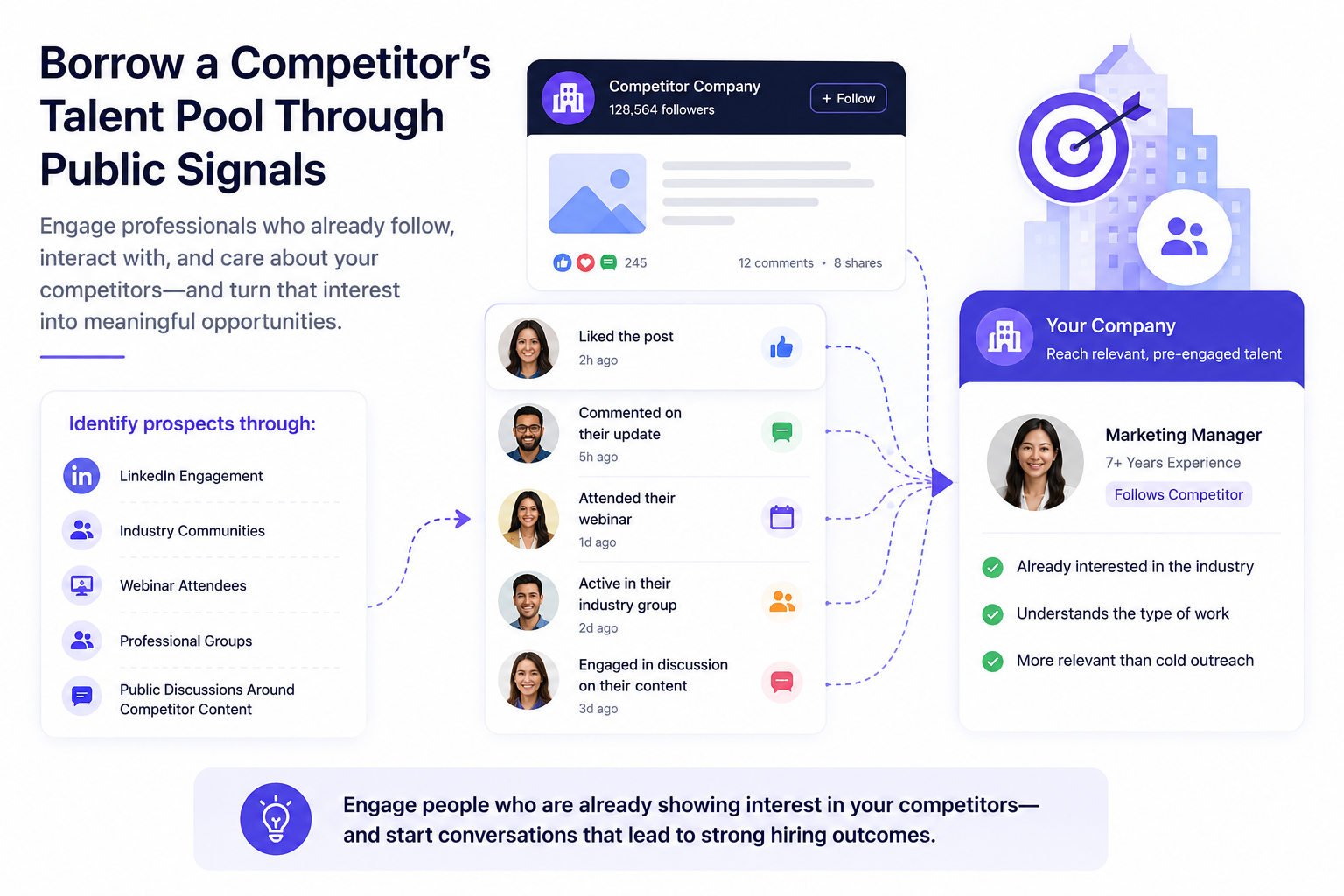
Some of your best future hires may already be paying attention to your competitors.
People who follow, comment on, or engage with competitor content have already shown interest in that industry and type of work.
That signal matters.
Instead of starting with a completely cold audience, you're engaging professionals who already understand the space.
You can identify these prospects through:
- LinkedIn engagement
- Industry communities
- Webinar attendees
- Professional groups
- Public discussions around competitor content
This approach helps you reach relevant candidates without relying entirely on job applications.
Strategy 9 — Treat Your Employer Brand as Your Best Recruiter
Before applying, candidates often research your company from multiple angles.
They read reviews, browse social media, talk to peers, and look for signals about what it's actually like to work there.
Platforms like:
- Glassdoor
- Industry communities
- Employee networks
often influence application decisions more than the job post itself.
That's why employer branding isn't just a marketing activity.
It's a recruiting advantage.
A strong employer brand helps candidates trust your company before the first conversation even happens.
The impact extends beyond awareness.
According to LinkedIn research, companies with strong employer brands can reduce cost per hire by up to 50%.
When candidates already view your company positively, attracting talent becomes easier, outreach performs better, and applications increase naturally.
In many cases, your employer brand is working long before your recruiters ever send a message.
Strategy 10 — Personalize Outreach at Scale So It Doesn't Read Like a Blast
Candidates can spot a mass message within seconds.
Most generic outreach gets ignored because it feels like it could have been sent to anyone.
The difference is relevance.
When your message references a candidate's experience, recent work, skills, or career progression, it immediately feels more personal.
You don't need a completely custom email for every prospect.
Instead, focus on details that show you've done your homework.
Effective outreach often includes:
- A reference to their current role
- Relevant experience or achievements
- Why they're a good fit for the opportunity
- A clear reason for reaching out now
This approach works across both email and LinkedIn.
In fact, personalized outreach campaigns can generate response rates between 40% and 60%, significantly outperforming generic templates.
Strategy 11 — Use AI Matching to Stop Chasing the Wrong People
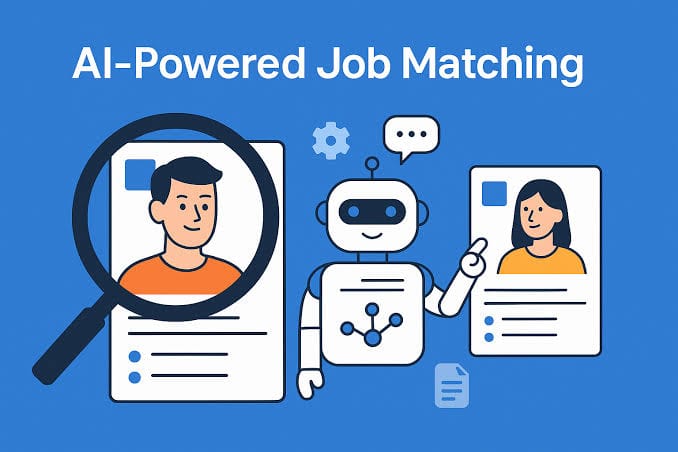
More candidates don't automatically lead to more hires.
The real goal is finding the right candidates.
Many recruiters spend hours reviewing profiles that were never a strong fit in the first place.
AI matching helps solve that problem by evaluating candidates against your role requirements before outreach begins.
Instead of sorting through hundreds of profiles manually, you can prioritize the people most likely to succeed in the role.
Strong matching systems typically analyze:
- Skills and qualifications
- Industry experience
- Job history
- Location preferences
- Role alignment
This improves efficiency while reducing wasted outreach.
When candidates are pre-qualified before engagement, your hiring team spends more time talking to the right people and less time filtering out the wrong ones.
Strategy 12 — Keep Candidates Engaged With Always-On Follow-Up
One of the biggest reasons pipelines go cold is simple.
Nobody follows up.
Candidates express interest, respond to outreach, or submit an application, then hear nothing for days.
Eventually, they move on.
Consistent follow-up keeps momentum alive throughout the hiring process.
That doesn't mean recruiters need to spend every hour checking their inbox.
Automated engagement can handle many routine interactions, including:
- Application confirmations
- Follow-up reminders
- Status updates
- Interview preparation messages
- Candidate questions
With 24/7 engagement running in the background, candidates stay informed and connected even when recruiters are busy.
Strategy 13 — Remove Every Booking Step Between Interest and Interview
A surprising number of candidates disappear after saying they're interested.
The reason is often friction.
Every additional email, scheduling request, or coordination step creates another opportunity for someone to drop off.
The fastest hiring teams reduce that friction as much as possible.
Instead of lengthy back-and-forth scheduling conversations, candidates should be able to book time immediately.
Features like:
- Calendar synchronization
- Self-service booking links
- Automated reminders
- Instant confirmations
help move candidates from interest to interview in minutes.
The shorter the gap between "I'd like to learn more" and a scheduled conversation, the more applicants stay engaged.
When scheduling becomes effortless, your pipeline keeps moving and fewer qualified candidates slip away before the interview stage.
How to Wire It All Into One Candidate Funnel
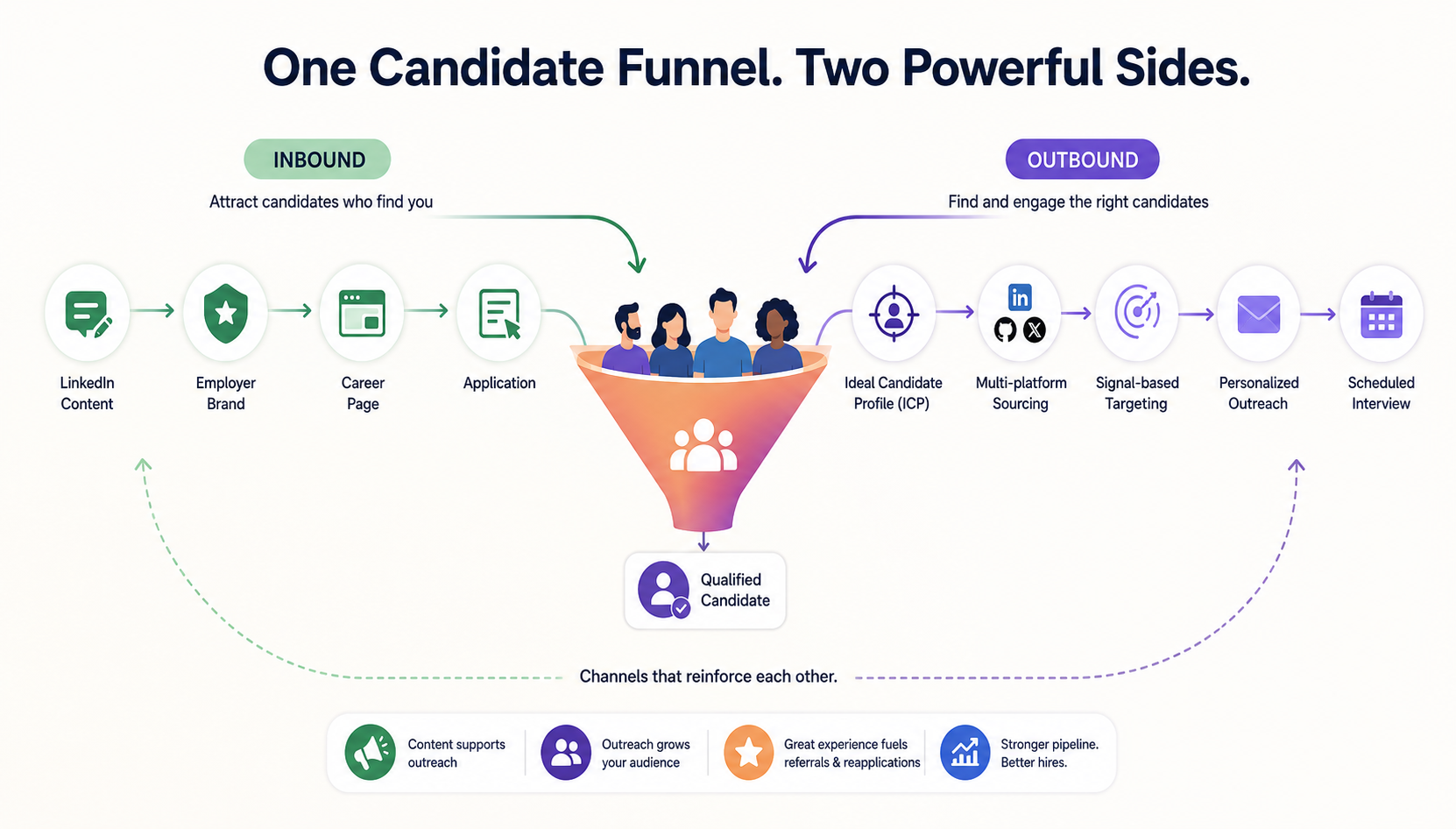
Each strategy on its own can help you attract more applicants.
But the real impact happens when those strategies work together inside a single recruiting system.
Think of your candidate funnel as having two sides: inbound and outbound.
The inbound side focuses on attracting candidates who discover your company naturally.
A simple inbound flow looks like this:
LinkedIn content → Employer brand → Career page → Application
Your content creates visibility.
Your employer brand builds trust.
Your career page turns interest into action.
As candidates move through that journey, they become qualified applicants without direct outreach.
The outbound side works differently.
Instead of waiting for candidates to find you, you actively find them.
A typical outbound process looks like this:
Ideal Candidate Profile (ICP) → Multi-platform sourcing → Signal-based targeting → Personalized outreach → Scheduled interview
This approach helps you engage qualified candidates who may never apply on their own.
The strongest hiring pipelines don't choose one side over the other.
They combine both.
That's where the funnel starts to compound.
Someone who regularly engages with your LinkedIn content can become an outbound prospect later.
Likewise, a candidate you source today may begin following your company, engaging with future content, and even referring others down the line.
Over time, these channels reinforce each other.
Your content supports outreach.
Your outreach grows your audience.
Your candidate experience fuels referrals and reapplications.
As a result, the pipeline becomes more predictable and less dependent on a single sourcing tactic.
Just remember that activity alone isn't the goal.
What matters is conversion.
Track metrics such as:
- Source-to-hire rate
- Interview-to-offer rate
- Offer acceptance rate
- Quality of hire by source
These numbers reveal which channels actually produce successful hires.
Once you know what's working, you can invest more resources into the strategies that deliver results.
This end-to-end approach is also why many teams are moving toward automation.
Rather than managing sourcing, matching, outreach, follow-ups, and scheduling across multiple tools, platforms like Leelu bring the entire workflow together in one place, making it easier to run a consistent candidate funnel at scale.
Suggested Reading:
Talent Acquisition Strategy, Process & Best PracticesMistakes That Keep Your Applicant Pool Empty
The strategies we've covered can significantly increase your applicant volume.
But even the best candidate lead generation efforts struggle when a few common mistakes remain in the process.
Here are the habits that quietly drain your pipeline.
Posting the Job and Waiting to Be Found
Many recruiters still rely on a simple formula.
Post the job, share the link, and wait for applications.
The problem is that most qualified candidates aren't actively searching every day.
They're busy working elsewhere.
Without proactive sourcing, you're only reaching a small portion of the available talent market.
Visibility helps.
But visibility without outreach is hope, not a hiring strategy.
Reaching Out to Everyone the Same Way
Candidates receive recruiting messages constantly.
Most of them sound exactly the same.
A generic message sent to hundreds of people rarely creates meaningful engagement.
Different candidates have different motivations, experiences, and career goals.
That's why personalization matters.
Even a small reference to someone's background, achievements, or experience can make your outreach feel relevant instead of automated.
When every message looks identical, response rates usually suffer.
Letting Interested Candidates Sit Unanswered
Candidate interest has a short shelf life.
Someone who responds today may accept another opportunity by the end of the week.
Unfortunately, many hiring teams create delays between application, outreach, and follow-up.
Every day of silence creates room for competitors to move first.
Fast communication keeps momentum alive.
Even a simple acknowledgment can prevent candidates from losing interest while they wait.
Ignoring the Talent Already in Your ATS
Recruiters often spend weeks searching for new candidates while overlooking people they've already identified.
Your ATS likely contains former applicants who were qualified but unavailable at the time.
Some may have gained additional experience since then.
Others may now be actively looking for a new opportunity.
Re-engaging past applicants is often one of the fastest and most cost-effective ways to rebuild a pipeline.
Yet many teams never revisit those records.
Doing It All Manually Until You Burn Out
Manual sourcing works when hiring demand is low.
The challenge appears when multiple roles open at once.
Searching profiles, screening resumes, sending outreach, following up, and scheduling interviews quickly becomes overwhelming.
As workloads increase, sourcing is often the first activity to slow down.
Unfortunately, that's usually when the pipeline is needed most.
Building repeatable processes and using automation where appropriate helps maintain consistency, even during periods of heavy hiring.
A pipeline should continue running whether you're busy or not.
Conclusion
Doubling your applicants isn't about posting more jobs or sharing them more often.
It's about reaching the right candidates at the right moment and responding before they move on to another opportunity.
The good news is that you don't need to overhaul your entire hiring process this week.
Start with one action.
Re-open your ATS and reconnect with ten qualified past applicants, or run a search across multiple sourcing platforms instead of just one.
Small changes compound quickly.
And when manual sourcing starts taking more time than hiring itself, that's usually the sign to let automation handle the repetitive work so you can focus on what matters most: choosing the right people.
Frequently Asked Questions
1. What is candidate lead generation?
Candidate lead generation is the process of identifying, attracting, and engaging potential candidates before they actively apply for a job.
Instead of waiting for applications, you proactively build a pipeline of qualified talent through sourcing, outreach, referrals, content, and employer branding.
2. How can I generate more job applicants quickly?
The fastest ways to increase applicants include sourcing across multiple platforms, re-engaging past applicants from your ATS, leveraging employee referrals, and reaching out to candidates who are already showing job-seeking signals.
Combining inbound and outbound recruiting typically delivers the best results.
3. What are the best sources for finding passive candidates?
Passive candidates can be found through LinkedIn, employee referral networks, industry communities, professional groups, past applicant databases, and engagement with competitor content.
These candidates may not be actively applying but are often open to the right opportunity.
4. Why are candidates not responding to my outreach?
Low response rates are usually caused by generic messaging, poor candidate targeting, or delayed follow-up.
Personalized outreach that references a candidate's experience and clearly explains the opportunity is far more likely to generate engagement.
5. How can AI improve candidate lead generation?
AI can automate candidate sourcing, profile screening, outreach, follow-ups, and interview scheduling.
It also helps match candidates to roles more accurately, allowing recruiters to spend less time on manual tasks and more time building relationships with qualified talent.