You’re constantly juggling sourcing, screening, follow-ups, and interview scheduling, all while trying to move faster without compromising on quality or candidate experience.
As hiring demands grow, this pressure only increases, and that’s where most HR teams start to feel overwhelmed and stretched too thin.
The real challenge isn’t just volume, it’s managing every step manually.
That’s where AI agents are starting to change the game. They take over repetitive, time-consuming tasks and keep your pipeline moving, so you can focus on making better hiring decisions and building stronger candidate relationships.
Key Features to Look for in AI Agents for HR
Once you start exploring AI agents, everything can look impressive on the surface.
But not every tool actually reduces your workload or helps you scale hiring in a meaningful way. The difference comes down to the features that truly automate and simplify your process.
Here’s what you should pay close attention to before making a choice.
1. End-to-end recruitment automation capabilities
The biggest shift AI brings is not just speed, but ownership of repetitive tasks.
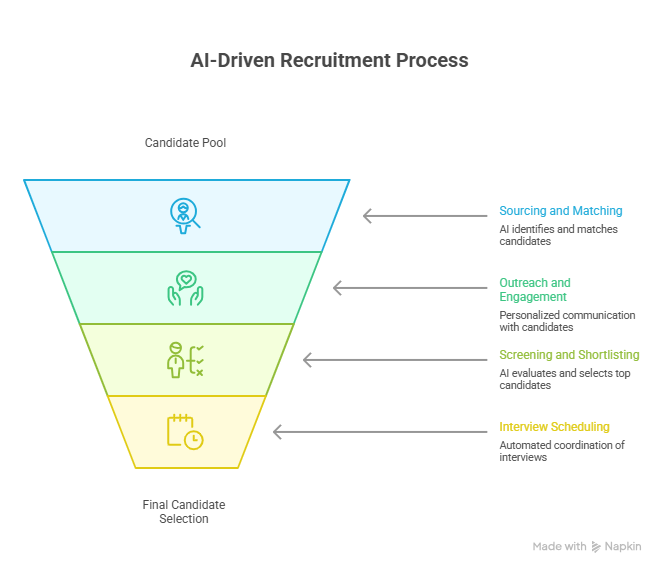
You want an AI agent that doesn’t just assist but actually handles the workflow from sourcing to scheduling without constant manual input.
That means it should be able to:
- Create or refine job descriptions
- Source candidates across multiple platforms
- Manage outreach and follow-ups
- Move candidates through different hiring stages
If you want to understand how automation is evolving, check out this guide on recruitment automation.
When your hiring process runs without you chasing every step, that’s when you start seeing real relief from burnout.
2. AI-driven candidate sourcing and matching
Finding candidates is no longer the problem. Finding the right ones quickly is.
A strong AI agent should go beyond keyword matching and actually understand role requirements, experience depth, and relevance.
Look for tools that:
- Scan multiple platforms simultaneously
- Rank candidates based on real fit, not just resumes screening
- Continuously improve matching using data
This ensures you spend less time filtering and more time speaking with high-quality candidates.
3. Personalized outreach and engagement at scale
Reaching out to candidates manually limits how fast you can hire.
But generic bulk messages don’t work either, and they often hurt your response rates.
The right AI agent helps you strike that balance by:
- Sending tailored messages based on candidate profiles
- Managing follow-ups automatically
- Keeping conversations active without manual effort
So even when you scale outreach, it still feels personal and relevant to each candidate.
4. Automated screening and shortlisting
Screening is one of the most time-consuming parts of hiring.
Going through hundreds of resumes manually slows everything down and increases the chances of missing strong candidates.
AI agents should be able to:
- Parse resumes instantly
- Score candidates based on job fit
- Create a shortlist within minutes
This helps you move from a large applicant pool to a focused, high-quality pipeline much faster.
5. Interview scheduling and workflow integration
Even after shortlisting, coordination can become a bottleneck.
Back-and-forth emails, calendar conflicts, and manual updates across tools can eat up hours every week.
A reliable AI agent should:
- Automatically schedule interviews with calendar sync
- Integrate with your existing ATS or HR tools
- Keep all candidate data updated in one place
When scheduling and systems run smoothly in the background, your entire hiring process feels more controlled and efficient.
9 Best AI Agents for HR Teams to Scale Hiring Without Burnout
Now that you know what features actually matter, let’s look at the tools that bring those capabilities to life.
Not all AI agents are built the same, and some are designed specifically to take real pressure off HR teams rather than just adding another layer of software.
1. Leelu.AI
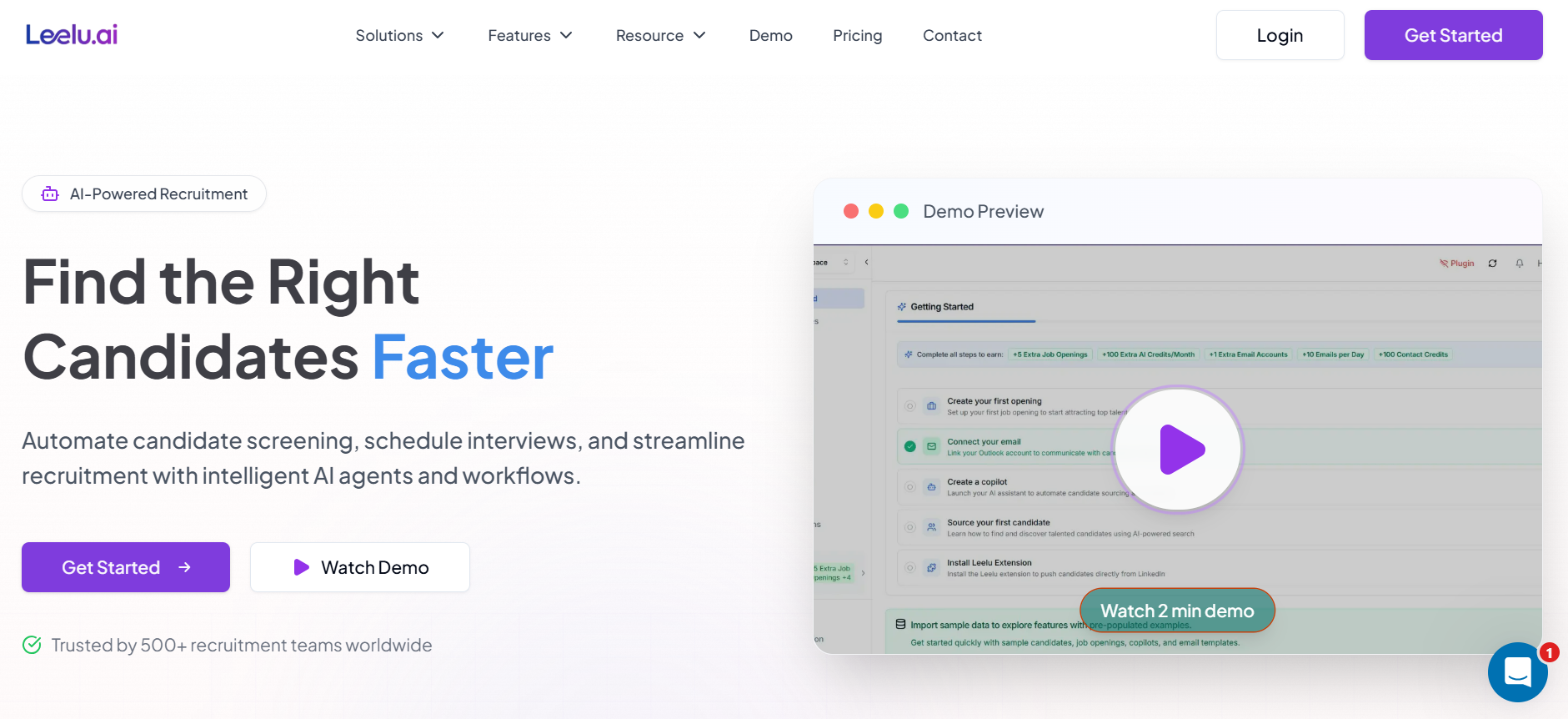
If your goal is to reduce manual effort while still hiring faster and better, Leelu AI is built exactly for that use case.
Instead of acting like a tool you have to manage, it works more like an AI recruiting copilot that handles the entire hiring workflow for you.
From the moment you create a job to the point where interviews are scheduled, most of the heavy lifting is automated in the background.
Here’s how it fits into your hiring process:
- Instantly generates optimized job descriptions
- Sources candidates from 500M+ profiles across platforms
- Screens and ranks candidates based on real job fit
- Sends personalized outreach and follow-ups automatically
- Schedules interviews with minimal coordination
- Syncs everything with your ATS and hiring workflows
This means you’re not jumping between tools or manually pushing candidates through each stage. The system keeps everything moving for you.
Pros
- Automates sourcing, screening, outreach, and scheduling end-to-end
- Significantly reduces recruiter workload and repetitive tasks
- Helps you reach and engage a much larger talent pool
- Improves speed, with hiring cycles potentially shrinking to days
- Keeps candidate engagement active with 24/7 follow-ups
Cons
- May feel like a big shift if you’re used to manual workflows
- Requires initial setup and alignment with your hiring process
- Less control over micro-level tasks if you prefer doing everything manually
If your team is struggling with volume, speed, or coordination, Leelu AI is less about adding another tool and more about removing the operational burden from your hiring process.
2. HireVue
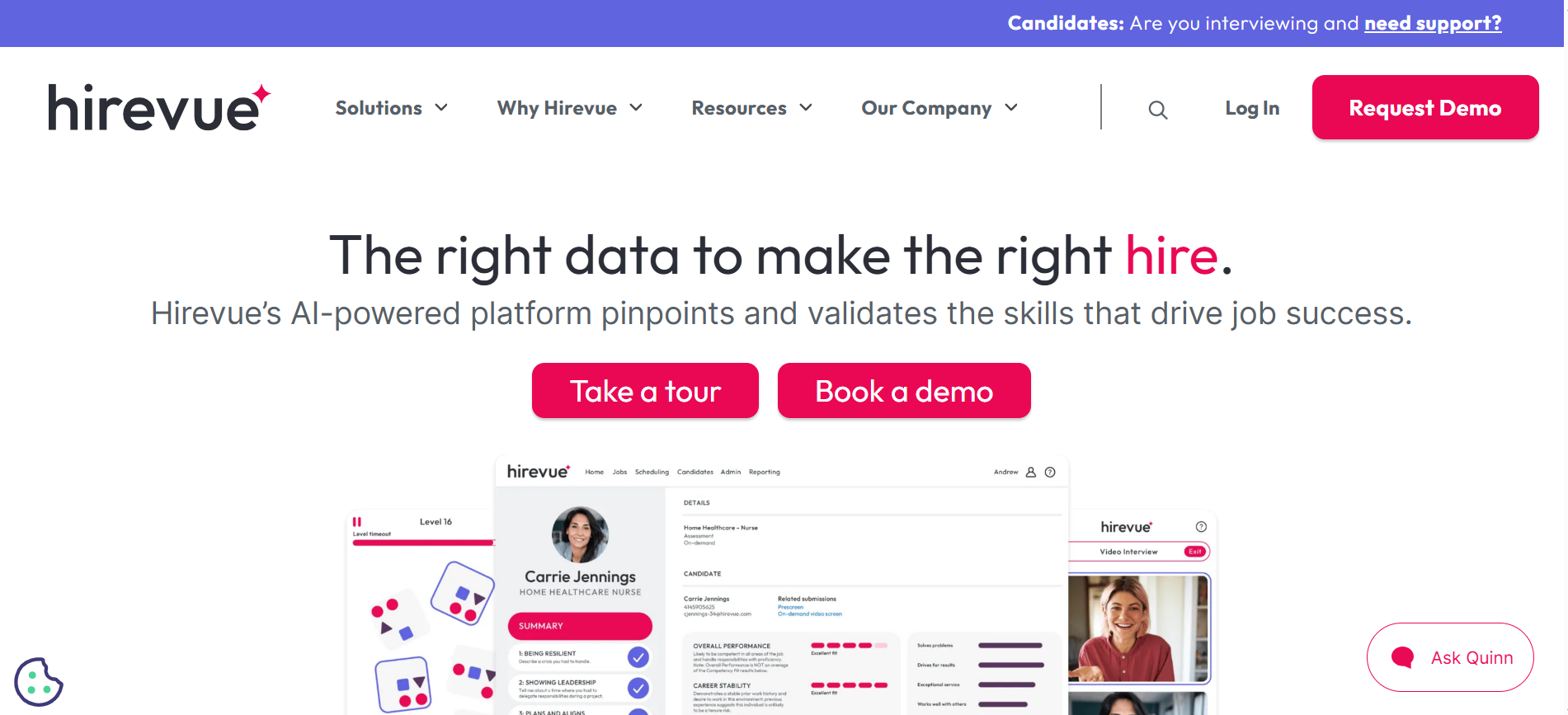
When hiring at scale, especially for enterprise roles, interviews themselves become a bottleneck.
HireVue focuses on solving that by using AI-powered video interviews and assessments to evaluate candidates early in the process.
It allows you to assess skills, communication, and role fit without needing live interview rounds initially.
Pros
- Asynchronous video interviews save significant time
- AI-based assessments help standardize evaluations
- Useful for high-volume hiring and campus recruitment
- Reduces scheduling dependency in early stages
Cons
- Can feel impersonal to candidates
- AI evaluation transparency can be a concern
- Not focused on sourcing or outreach
3. Tezi
If your hiring process involves a lot of repetitive screening conversations, Tezi focuses on automating that early interaction.
It acts as an AI recruiting assistant that engages candidates, asks pre-screening questions, and helps you qualify talent before you step in.
This allows you to filter candidates faster without spending hours on initial calls.
Pros
- Automates early-stage candidate screening conversations
- Saves time on repetitive recruiter interactions
- Helps qualify candidates before manual review
- Improves response speed and engagement
Cons
- Limited capabilities beyond screening
- Does not handle sourcing at scale
- May require fine-tuning for different roles
4. Eightfold AI
Eightfold AI is designed for teams that want a more data-driven, talent intelligence approach to hiring.
It uses deep learning to understand skills, career paths, and potential, helping you match candidates more accurately.
It also extends into talent management beyond hiring.
Pros
- Advanced AI matching and talent insights
- Strong internal mobility and workforce planning features
- Scales well for large organizations
- Continuous learning from hiring data
Cons
- Can be complex to implement
- Higher cost compared to simpler tools
- May be more than what small teams need
5. Paradox (Olivia)
Paradox, powered by its AI assistant Olivia, focuses heavily on automating conversations.
It acts like a recruiting chatbot that engages candidates, answers questions, and schedules interviews in real time.
This is especially useful when speed and responsiveness matter.
Pros
- Excellent for conversational engagement
- Automates interview scheduling efficiently
- Improves candidate experience with quick responses
- Works well for hourly and high-volume roles
Cons
- Limited sourcing capabilities
- Focused more on engagement than full-cycle hiring
- Customization may require setup effort
6. SeekOut
If sourcing is your biggest challenge, SeekOut is built to solve that.
It helps you discover candidates across platforms, including hard-to-find and passive talent pools.
The platform also provides strong filtering and diversity insights.
Pros
- Powerful sourcing capabilities across multiple channels
- Great for finding niche and passive candidates
- Strong diversity filters and insights
- Detailed candidate profiles
Cons
- Limited automation beyond sourcing
- Outreach and engagement features are basic
- Requires manual effort for later hiring stages
7. Fetcher
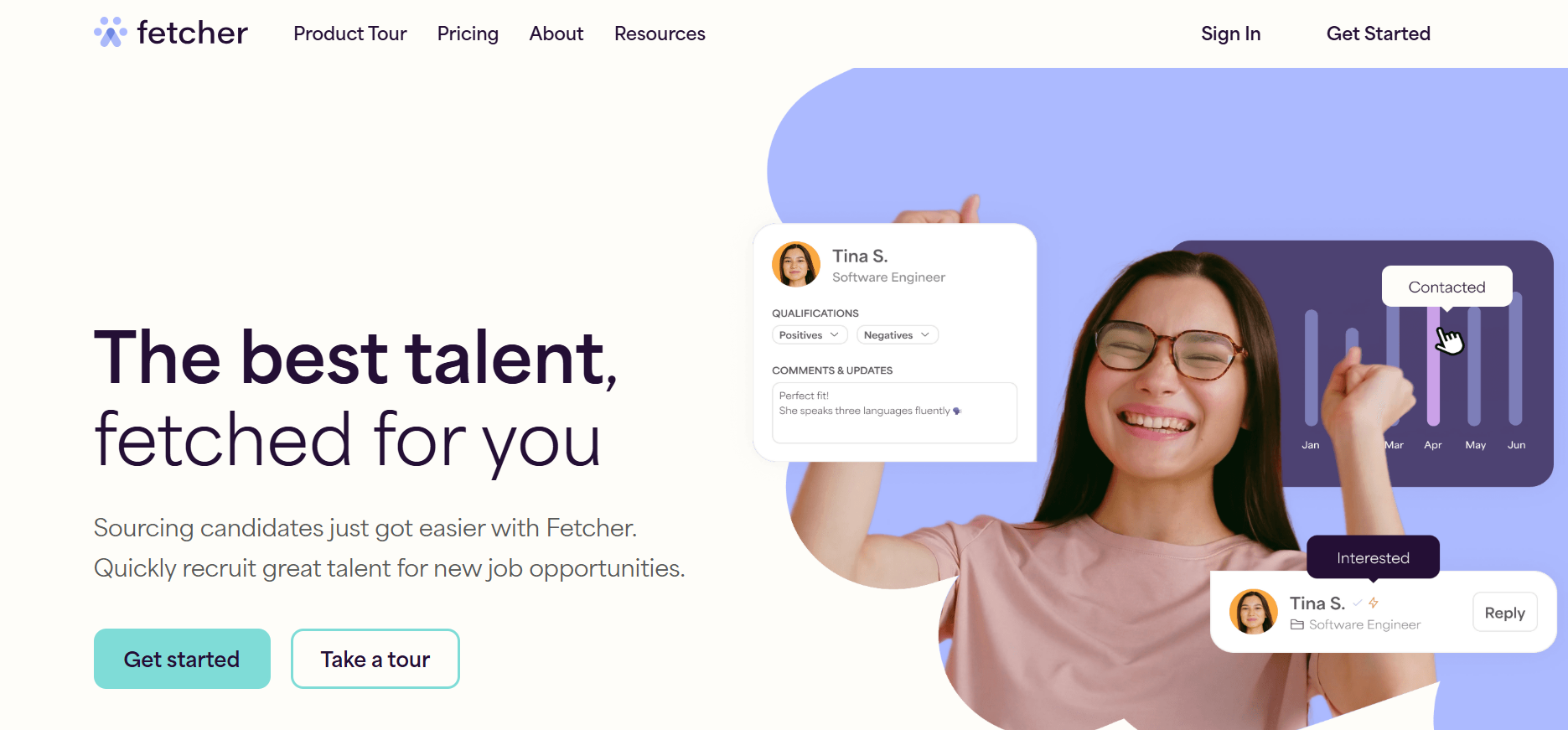
Fetcher focuses on automating candidate sourcing and initial outreach.
It combines AI with human-assisted sourcing to deliver curated candidate lists directly to your pipeline.
This reduces the time spent searching for candidates manually.
Pros
- Automates sourcing and outreach workflows
- Delivers pre-vetted candidate pipelines
- Easy to use and quick to get started
- Saves time on top-of-funnel activities
Cons
- Limited beyond sourcing and outreach
- Less control over sourcing strategy
- Not a full end-to-end hiring solution
8. hireEZ
hireEZ is a sourcing and outbound recruiting platform designed to help you scale candidate discovery and engagement.
It brings together AI sourcing, CRM capabilities, and outreach automation in one place.
This makes it useful for proactive recruiting strategies.
Pros
- Strong AI sourcing across multiple platforms
- Built-in CRM for managing candidate relationships
- Outreach automation improves response rates
- Good integration capabilities
Cons
- Can feel feature-heavy for smaller teams
- Requires learning curve to use effectively
- Limited automation in later hiring stages
9. Humanly
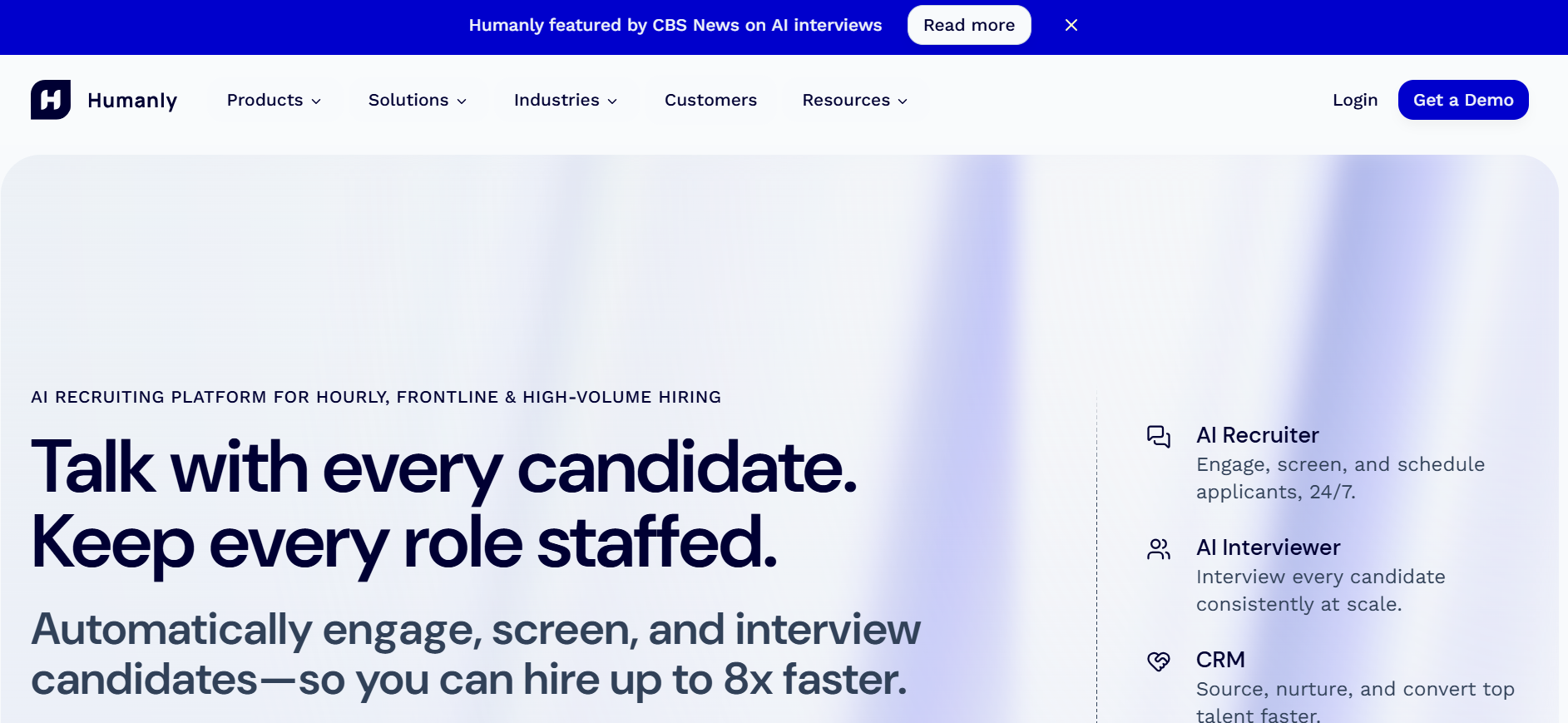
Humanly focuses on automating candidate screening and engagement through conversational AI.
It conducts chat-based screening interviews and helps shortlist candidates before human interaction.
This reduces repetitive screening calls for recruiters.
Pros
- Automates initial screening conversations
- Saves time on repetitive recruiter tasks
- Improves candidate experience with instant responses
- Helps create structured shortlists
Cons
- Limited sourcing capabilities
- Best suited for early-stage screening only
- May not fully replace human interaction for complex roles
How to Choose the Right AI Agent for Your HR Team
Choosing the right AI agent isn’t about picking the most advanced tool.
It’s about aligning the tool with where your hiring process actually breaks or slows down today.
If you're building a structured approach, this talent acquisition strategy process guide can help.
1. If you want full hiring automation vs partial assistance
Start by deciding how much of your workflow you want AI to handle.
Some tools only assist with sourcing or screening, while others take over the entire hiring cycle from start to finish.
If you’re dealing with high volume and limited bandwidth, full automation gives you the biggest relief.
2. If reducing recruiter workload is your top priority
Not every AI tool reduces effort in a meaningful way.
Look for solutions that eliminate repetitive tasks like follow-ups, scheduling, and manual data entry instead of just making them faster.
The goal is to free up your time, not just optimize busy work.
3. If you need better candidate matching accuracy
Speed means nothing if the quality isn’t there.
Choose AI agents that go beyond keyword matching and actually understand role fit, experience, and candidate intent.
This helps you spend more time with the right candidates, not just more candidates.
4. If you are scaling hiring across multiple roles or regions
As hiring expands, complexity increases quickly.
You need an AI agent that can handle multiple roles, geographies, and pipelines without breaking your workflow or creating chaos.
How Leelu Helps You Scale Hiring Without Recruiter Burnout
Leelu takes over sourcing, screening, outreach, and scheduling so you don’t have to manage every step manually.
You move faster, reduce repetitive work, and keep your hiring pipeline active without stretching your team thin.
Suggested Reading:
How to Reduce Hiring CostCommon Mistakes When Using AI Agents in HR
AI agents can significantly improve your hiring process, but only if they’re used the right way.
Many teams adopt them expecting instant results, only to realize later that poor implementation creates new problems instead of solving old ones.
Here are the most common mistakes you should avoid.
1. Over-relying on automation without human oversight
Automation is powerful, but it shouldn’t replace judgment.
If you let AI handle everything without review, you risk missing context, culture fit, or nuances that only humans can catch.
The best results come when AI handles execution and you guide decisions.
2. Ignoring candidate experience during automation
Speed should never come at the cost of experience.
If your outreach feels robotic or your communication lacks clarity, candidates can lose interest quickly.
Even with automation, every interaction should feel relevant, timely, and human.
3. Choosing tools without end-to-end capabilities
Many teams pick tools that solve just one part of hiring.
This leads to fragmented workflows, constant tool switching, and more manual effort than expected.
It’s often better to choose a solution that connects multiple stages of hiring seamlessly.
4. Not integrating AI agents into existing workflows
AI works best when it fits into your current system, not when it disrupts it.
If your tools don’t integrate with your ATS or internal processes, you end up duplicating work instead of saving time.
Smooth integration is what turns AI into a real productivity driver.
5. Failing to measure impact on hiring performance
Without tracking results, you won’t know what’s actually improving.
You should monitor metrics like time-to-hire, response rates, and quality of hires to understand the real impact of AI on your process.
Suggested Reading:
Modern Onboarding Process Steps for HR ProfessionalsConclusion
Scaling hiring doesn’t have to mean stretching your team to the limit.
With the right AI agents, you can automate repetitive tasks, improve candidate quality, and keep your pipeline moving without constant manual effort.
The key is choosing tools that align with your hiring needs and using them thoughtfully.
When done right, AI doesn’t replace recruiters—it gives you the space to focus on decisions, relationships, and building stronger teams.
Frequently Asked Questions
1. Do AI agents replace recruiters completely?
No, AI agents are designed to support you, not replace you.
They handle repetitive and time-consuming tasks so you can focus on decision-making, candidate relationships, and strategic hiring.
2. How quickly can you see results with AI hiring tools?
Most teams start seeing improvements in speed and workload within a few weeks.
However, the exact impact depends on how well the tool is integrated into your existing hiring process.
3. Are AI agents suitable for small HR teams?
Yes, in fact, small teams benefit the most.
AI helps you do more with fewer resources by automating tasks that would otherwise require additional hires.
4. How do AI agents improve candidate quality?
They use data-driven matching instead of just keywords.
This helps you identify candidates who actually fit the role, reducing time spent on irrelevant profiles.
5. Is candidate experience affected by automation?
It depends on how you use it.
When done right, AI improves response time and consistency, which creates a better experience. Poorly implemented automation, however, can feel impersonal.


