
Hiring today isn’t just about filling roles — it’s about building relationships that actually last.
If your hiring process ends once an offer is accepted, you’re likely losing great talent sooner than expected. Strong talent relationship management helps you attract, engage, and retain the right people long-term.
In this guide, you’ll learn:
- What talent relationship management really means
- Why it matters for both hiring and retention
- 12 practical strategies you can start using right away
Key Elements of an Effective Talent Relationship Strategy
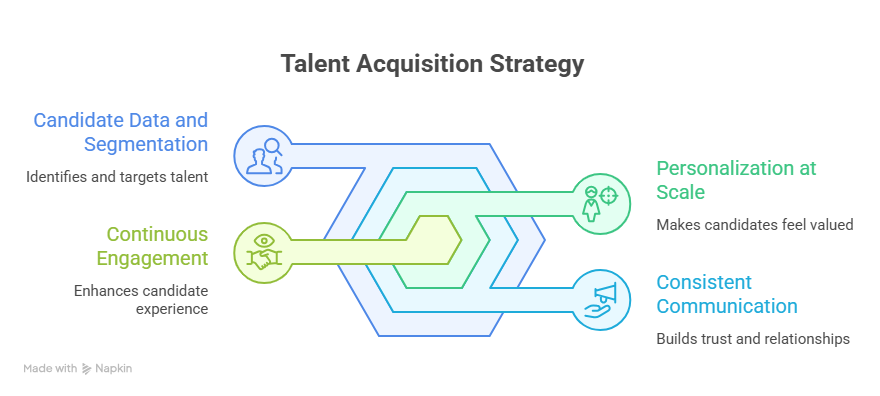
If you want talent relationship management to actually work, you need more than just good intent.
It comes down to building a system that helps you understand candidates, stay connected, and engage them in a way that feels relevant at every stage.
Here are the core elements that make that happen.
1. Candidate Data and Segmentation
Everything starts with how well you understand your candidates.
If all profiles sit in one generic pool, your communication will always feel disconnected and ineffective.
You need to organize candidates based on meaningful criteria like:
- Skills and experience level
- Job preferences and career goals
- Engagement history (applied, responded, interviewed)
- Location, industry, or role type
This allows you to segment your talent pool and approach each group differently instead of sending the same message to everyone.
When your data is structured, your hiring decisions also become faster and more accurate.
2. Consistent Communication
Once you have the right data, consistency becomes your biggest advantage.
Most companies lose candidates simply because they go silent for too long.
You should stay in touch across the entire journey — not just when you have an open role.
This includes:
- Application updates and follow-ups
- Regular check-ins with shortlisted candidates
- Sharing relevant opportunities or company updates
When candidates hear from you consistently, they are far more likely to stay engaged and respond when the right role comes up.
3. Personalization at Scale
Candidates can easily tell when they are receiving generic outreach.
And in most cases, they simply ignore it.
The challenge is not personalization — it is doing it at scale without increasing manual effort.
You can personalize communication by:
- Referencing candidate skills or past experience
- Aligning roles with their career goals
- Tailoring messages based on where they are in the hiring funnel
This creates a much stronger connection while still allowing you to manage large candidate volumes efficiently.
4. Continuous Engagement
Talent relationship management does not stop after one interaction.
It is an ongoing process of building familiarity and trust over time.
Even if candidates are not ready to switch today, staying engaged ensures you are the first option they consider later.
Ways to maintain continuous engagement include:
- Sharing industry insights or career content
- Keeping passive candidates warm with occasional updates
- Re-engaging past applicants for new roles
When you treat candidates like long-term relationships instead of one-time transactions, your hiring pipeline becomes stronger and more predictable.
12 Talent Relationship Management Strategies for Hiring & Retention
Now that you understand the core elements, the next step is putting them into action.
A strong talent relationship strategy is not built on one tactic — it is the result of consistent, structured efforts across the entire candidate lifecycle.
Here are practical strategies you can start applying to improve both hiring outcomes and long-term retention.
1. Build and Maintain a Centralized Talent Database
If your candidate data is scattered across emails, spreadsheets, and different tools, you are already losing efficiency.
A centralized talent database gives you a single, clear view of every candidate interaction.
Instead of searching multiple sources, you can:
- Access candidate profiles instantly
- Track communication history in one place
- Revisit past applicants for new roles
This not only saves time but also helps you build long-term relationships because no candidate context gets lost.
Over time, your database becomes a valuable asset that continuously supports future hiring needs.
2. Segment Candidates Based on Skills and Intent
Once you have a centralized database, segmentation becomes much easier and more powerful.
Not every candidate is the same, and treating them as one group reduces engagement significantly.
You should segment candidates based on:
- Skill sets and job roles
- Seniority level
- Job search intent (actively looking vs passive)
- Past interaction behavior
This allows you to send relevant opportunities and messages that actually resonate.
When candidates feel understood, they are far more likely to respond and stay connected with your brand.
3. Personalize Candidate Communication
After segmentation, personalization is what turns basic outreach into meaningful interaction.
Generic messages rarely work because candidates receive them every day.
You should aim to tailor communication in a way that reflects:
- Their experience and achievements
- Their career direction
- Their previous interactions with your company
Even small touches like mentioning a relevant project or skill can significantly improve response rates.
The goal is to make candidates feel like you are speaking directly to them, not broadcasting to a list.
4. Use Multi-Channel Engagement
Relying on a single communication channel limits your reach and reduces response chances.
Candidates today are active across multiple platforms, and your strategy should reflect that.
You can engage candidates through:
- Email outreach
- Professional platforms like LinkedIn
- Messaging tools or SMS (where appropriate)
Using multiple channels increases visibility and ensures your message reaches candidates where they are most comfortable.
It also helps create multiple touchpoints, which strengthens recall and trust over time.
5. Automate Outreach and Follow-Ups
Manual follow-ups are one of the biggest bottlenecks in recruitment workflows.
Delays in communication often result in losing high-quality candidates to faster-moving companies.
Automation helps you stay consistent without increasing workload.
You can automate:
- Initial outreach messages
- Follow-ups for non-responses
- Interview reminders and updates
This ensures no candidate is left waiting while maintaining a steady flow of communication.
When done right, automation feels timely and helpful rather than robotic.
6. Engage Passive Candidates Continuously
Not every great candidate is actively looking for a job right now.
In fact, many of the best hires come from passive talent pools.
Instead of waiting for them to apply, you should build relationships early and stay connected.
You can do this by:
- Sharing relevant opportunities occasionally
- Sending industry insights or updates
- Checking in without always pushing a role
This keeps your brand top-of-mind so when they are ready to make a move, you are the first option they consider.
Continuous engagement turns passive candidates into future hires without starting from scratch each time.
7. Use AI to Scale Talent Relationship Management
As your hiring needs grow, manual processes start breaking down quickly.
This is where AI helps you scale without losing quality or consistency in candidate engagement.
Instead of spending hours on repetitive tasks, AI can handle:
- Sourcing candidates from multiple platforms simultaneously
- Screening and ranking profiles based on job fit
- Sending personalized outreach at scale
- Managing follow-ups and responses automatically
This allows you to focus more on decision-making and less on execution.
With the right setup, you can move from reactive hiring to a system that runs continuously in the background.
8. Use Data to Improve Candidate Engagement
If you are not tracking what is working, you are guessing your way through hiring.
Data helps you understand how candidates interact with your process and where improvements are needed.
You should regularly monitor:
- Response rates to outreach messages
- Drop-off points in the hiring funnel
- Time taken at each stage of recruitment
- Candidate feedback and satisfaction
These insights help you refine your approach and remove friction from the candidate experience.
Over time, small improvements driven by data can significantly increase both hiring speed and quality.
9. Align TRM with Employer Branding
Your talent relationship strategy should reflect how your company is perceived by candidates.
If your communication feels disconnected from your brand, it creates confusion and reduces trust.
You should ensure consistency across:
- Messaging tone and style
- Career page content and outreach communication
- Candidate experience during interviews
When your employer brand and TRM strategy are aligned, candidates get a clear and consistent impression of your company.
This makes them more confident in choosing you over other opportunities.
10. Integrate TRM with Your Hiring Workflow
Talent relationship management should not operate as a separate activity.
It needs to be embedded into your existing hiring process to be truly effective.
This means:
- Connecting your talent database with your ATS
- Ensuring smooth handoffs between sourcing, screening, and interviewing
- Keeping all candidate interactions visible across teams
When everything is connected, your hiring process becomes faster and more collaborative.
It also reduces duplication of effort and prevents candidates from slipping through the cracks.
11. Re-Engage Past Candidates
Many companies overlook one of their most valuable talent sources — past candidates.
Just because someone was not selected earlier does not mean they are not a good fit now.
You should actively revisit:
- Previously shortlisted candidates
- Candidates who declined offers
- Applicants who were a close match but not selected
Re-engaging these candidates is often faster and more effective than starting from scratch.
They already know your company, which makes future interactions smoother and more productive.
12. Continue Relationship-Building After Hiring
Talent relationship management does not end once a candidate joins your company.
In fact, retention depends heavily on how those relationships continue to evolve internally.
You can strengthen post-hiring relationships by:
- Maintaining regular check-ins and feedback loops
- Supporting career growth and internal mobility
- Keeping communication open and transparent
When employees feel supported and connected, they are more likely to stay longer and perform better.
This closes the loop — turning great hiring into long-term retention and a stronger overall workforce.
Suggested Reading:
Candidate Engagement StrategiesHow Leelu.AI Helps You Manage Talent Relationships from Hiring to Retention
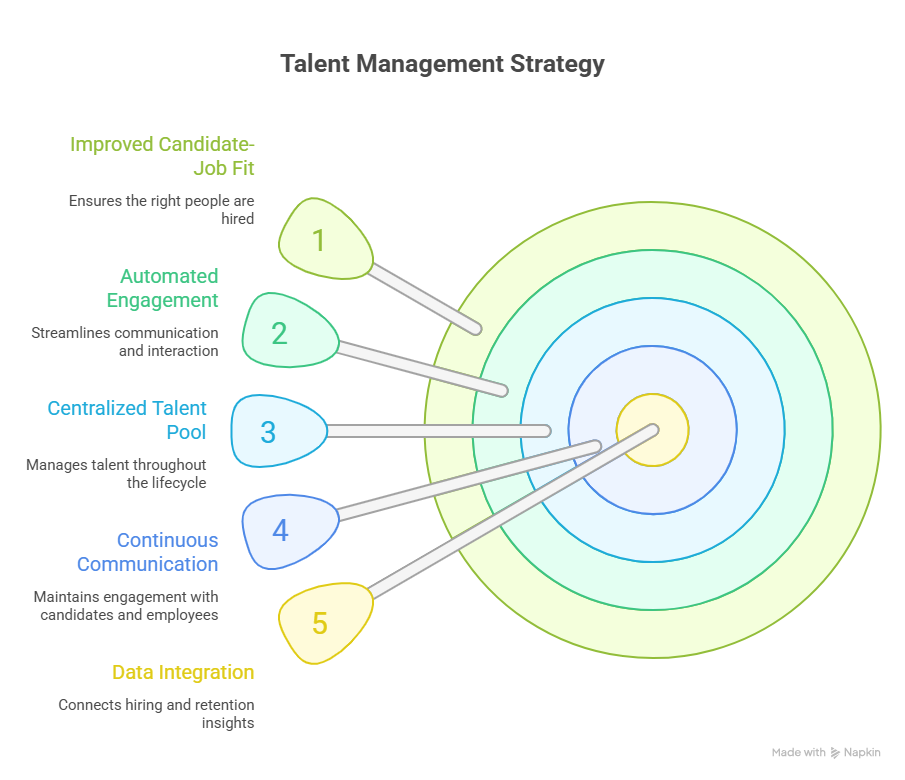
So far, we’ve looked at strategies you can implement to build stronger talent relationships.
But execution is where most teams struggle — especially when managing large candidate volumes while trying to keep communication personal and consistent.
This is where a system like Leelu.ai brings everything together in a way that actually works in real workflows.
1. Build and manage a centralized talent pool across the lifecycle
Instead of scattered candidate data across tools, Leelu.ai gives you one unified view of your entire talent pool.
You can track every candidate from first interaction to post-hiring without losing context at any stage.
This helps you:
- Access complete candidate profiles in one place
- Track interaction history across sourcing, resume screening, and hiring
- Easily revisit and re-engage candidates when needed
Over time, your talent pool becomes a long-term asset instead of a one-time pipeline.
2. Automate personalized engagement from sourcing to post-hiring
Staying consistent with communication is hard when everything is manual.
Leelu.ai automates outreach, follow-ups, and candidate interactions while still keeping communication relevant and personalized.
You can:
- Send tailored messages based on candidate data
- Automate follow-ups without missing responses
- Keep candidates engaged throughout the hiring journey
This ensures no candidate feels ignored, even at scale.
3. Improve candidate-job fit with AI-driven matching
Finding the right candidate is not just about speed — it is about accuracy.
Leelu.ai uses AI to analyze and match candidates based on job requirements, helping you identify the best-fit talent faster.
This allows you to:
- Rank candidates instantly based on relevance
- Reduce time spent on manual screening
- Improve shortlist quality with better matching
As a result, you spend less time filtering and more time engaging the right people.
4. Keep candidates and employees engaged with continuous communication
Engagement should not stop after the first interaction or even after hiring.
Leelu.ai helps you maintain continuous communication with both candidates and employees across the lifecycle.
You can:
- Automate follow-ups and updates
- Stay connected with passive candidates
- Keep new hires engaged beyond onboarding
This creates stronger relationships that extend beyond a single hiring cycle.
5. Connect hiring data with retention insights
Most hiring and retention data sit in separate systems, making it hard to see the full picture.
Leelu.ai connects these data points so you can understand what actually leads to long-term success.
This helps you:
- Track hiring performance and outcomes
- Identify patterns in successful hires
- Improve future hiring decisions using real insights
When your data is connected, your strategy becomes more predictable and effective.
6. Reduce manual effort while strengthening human relationships
The goal of automation is not to remove the human element — it is to enhance it.
Leelu.ai reduces repetitive work so you can focus on building real relationships with candidates and employees.
With less time spent on manual tasks, you can:
- Have more meaningful conversations
- Make faster, more informed decisions
- Create a better overall candidate experience
This balance between automation and human connection is what makes talent relationship management truly effective.
Common Mistakes in Talent Relationship Management
Even with the right strategies in place, small mistakes can weaken your entire talent relationship approach.
Most of these issues are not about lack of effort, but about inconsistency and missed opportunities across the candidate journey.
Here are some common mistakes you should avoid.
1. Treating Candidates as One-Time Applicants
If you only interact with candidates during an active hiring cycle, you lose long-term value.
Strong talent relationships are built over time, not in a single hiring moment.
You should treat every candidate as part of an ongoing pipeline rather than a one-time interaction.
2. Lack of Personalization in Outreach
Generic outreach is easy to ignore, especially when candidates receive similar messages daily.
When your communication lacks relevance, it reduces response rates and damages your employer perception.
Even small personalization based on skills or intent can make a noticeable difference.
3. Inconsistent Communication
Long gaps in communication often lead to candidate drop-offs.
When candidates are left waiting without updates, they quickly move on to other opportunities.
Consistency builds trust and keeps candidates engaged throughout the process.
4. Ignoring Data and Insights
Without tracking performance, it becomes difficult to improve your hiring strategy.
Many teams rely on assumptions instead of actual data, which leads to repeated mistakes.
You should regularly review engagement metrics and adjust your approach accordingly.
5. Over-Reliance on Manual Processes
Manual workflows slow down hiring and create unnecessary bottlenecks.
They also make it harder to maintain consistency, especially when handling large candidate volumes.
Balancing automation with human interaction helps you stay efficient without losing the personal touch.
Suggested Reading:
How to Retain Gen Z Employees: 11 Proven Strategies That WorkConclusion
Building strong talent relationships is no longer optional if you want to hire and retain the right people.
When you focus on consistent engagement, personalization, and data-driven decisions, your hiring process becomes more predictable and effective over time.
The key is to treat candidates and employees as long-term relationships, not short-term transactions.
If managing all of this feels complex, tools like Leelu.ai help you bring everything together — from sourcing to retention — without losing the human touch that truly makes the difference.
Frequently Asked Questions
1. How long does it take to see results from talent relationship management?
Results can start appearing within a few weeks, especially in engagement metrics like open and response rates. However, meaningful improvements in hiring speed and retention usually take a few months of consistent effort.
2. Is talent relationship management only useful for large companies?
No, it works for companies of all sizes. Smaller teams can benefit even more by building strong candidate relationships early instead of relying only on active applicants.
3. How often should you engage with candidates in your talent pool?
It depends on the role and industry, but a good approach is to stay in touch every few weeks or at least once a month with relevant updates or opportunities.
4. What type of content should you share with candidates?
You can share job opportunities, industry insights, company updates, employee stories, and helpful resources that add value instead of just asking for applications.
5. Can talent relationship management replace traditional recruiting?
No, it doesn’t replace it—it strengthens it. TRM works alongside recruiting by creating a steady pipeline of engaged candidates, making hiring faster and more efficient.