
Hiring often feels slower than it should, even when your team is actively working to fill roles.
You post jobs, review resumes, and schedule interviews, yet the process still drags on and delays decisions.
The issue is not always effort.
It is often hidden inefficiencies that slow down your hiring pipeline.
In this guide, you will learn:
- The key recruitment challenges affecting hiring speed
- Why these issues happen in modern hiring
- Practical fixes that actually improve results
Key Factors Driving Recruitment Challenges Today
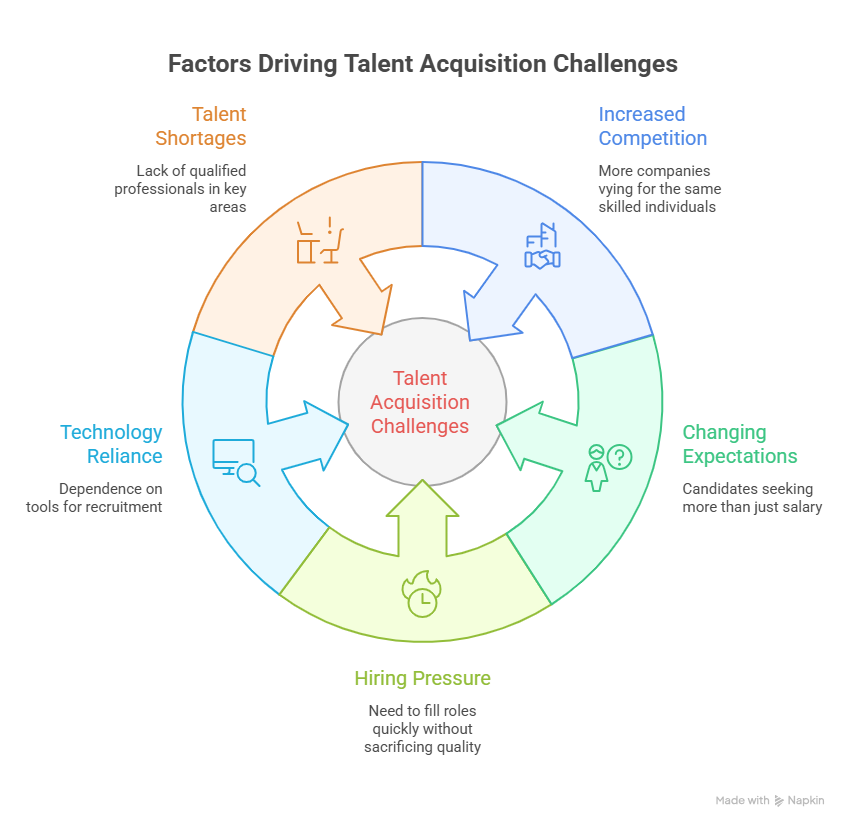
Modern recruitment challenges are driven by evolving talent markets, shifting candidate expectations, increasing hiring pressure, and growing complexity in processes and tools.
1. Increased competition for top talent
You are competing with more companies than ever, including global and remote-first organizations.
Top candidates receive multiple opportunities quickly, often within days.
This makes speed and relevance critical.
Even small delays in your hiring process can result in losing strong candidates to competitors who move faster and engage more effectively.
2. Changing candidate expectations and behavior
Candidates today expect fast communication, personalized interactions, and a smooth hiring experience.
They evaluate your company based on how you engage with them.
If your process feels slow, generic, or unclear, they disengage quickly.
This shift requires you to rethink how you communicate and maintain consistent engagement throughout the hiring journey.
3. Pressure to hire faster without compromising quality
Hiring speed directly affects business performance, increasing pressure to close roles quickly.
However, rushing decisions can lead to poor hiring outcomes.
You need to balance speed with careful evaluation.
This challenge often creates tension between moving fast and ensuring candidates truly meet role expectations and long-term business needs.
4. Growing reliance on technology and automation
Recruitment today depends on multiple tools for sourcing, screening, and communication.
While these tools aim to improve efficiency, they often create fragmented workflows.
Switching between systems and managing disconnected data slows you down.
Without integration, technology can add complexity instead of simplifying your hiring process.
5. Talent shortages in critical roles
Many roles, especially technical and specialized ones, have limited talent availability.
Finding qualified candidates takes more time and targeted effort.
Traditional sourcing methods often fall short, making it harder to build strong pipelines.
This shortage increases hiring timelines and intensifies competition for the same small pool of skilled professionals.
12 Recruitment Challenges (And Fixes That Work)
Now that you understand what’s driving hiring friction, it becomes easier to spot where things are breaking inside your process.
These challenges usually don’t appear all at once.
They show up as small inefficiencies that slowly compound into long hiring cycles and missed opportunities.
Let’s break down the most common ones and how you can fix them in a practical way.
1. Attracting qualified candidates
You may be getting applications, but not the right ones.
This usually happens when your job descriptions are too generic, your reach is limited, or your roles are not positioned clearly in the market.
Candidates who are a strong fit often never even see your job post.
What you can do instead:
- Write clear, outcome-focused job descriptions that show impact, not just responsibilities
- Expand sourcing beyond a single platform to reach diverse talent pools
- Align job titles and requirements with what candidates actually search for
When you improve clarity and reach, candidate quality improves naturally.
2. Long and inefficient hiring processes
A slow hiring process is one of the biggest silent killers of good hires.
Too many steps, delayed feedback, and unstructured workflows create unnecessary lag.
By the time you are ready to make an offer, your top candidates have already moved on.
What you can do instead:
- Audit your hiring stages and remove unnecessary steps
- Set clear timelines for feedback and decision-making
- Standardize interview workflows to avoid repeated evaluations
Speed does not mean rushing.
It means removing friction that should not exist in the first place.
3. Low candidate response rates
You send outreach messages, but most of them go unanswered.
This is often not about volume.
It is about relevance and timing.
Generic messages feel automated, even when they are not.
What you can do instead:
- Personalize outreach based on candidate experience and background
- Keep messages short, clear, and role-focused
- Follow up consistently instead of sending one-off messages
Better engagement starts with communication that feels human and relevant.
4. High candidate drop-off during hiring
Candidates who start strong suddenly disappear mid-process.
This usually signals confusion, delays, or loss of interest.
When communication slows down, candidates assume the process is stalled.
What you can do instead:
- Keep candidates informed at every stage of the process
- Reduce gaps between interviews and feedback loops
- Clearly communicate next steps after every interaction
Consistency builds trust, and trust keeps candidates engaged.
5. Poor candidate experience
Your hiring process is also your brand experience.
If candidates feel ignored, confused, or overwhelmed, it reflects directly on your company.
Even rejected candidates walk away with an impression that spreads.
What you can do instead:
- Simplify application and interview steps
- Communicate timelines clearly from the beginning
- Provide timely updates, even if there is no final decision yet
A better experience does not require more effort.
It requires more clarity and consistency.
6. Difficulty in screening and shortlisting candidates
Manually reviewing resumes is time-consuming and often inconsistent.
You may spend hours filtering profiles and still miss strong candidates.
This slows down your pipeline before it even begins.
What you can do instead:
- Define clear evaluation criteria before screening
- Use structured scoring to reduce bias and inconsistency
- Prioritize candidates based on role-fit, not just keywords
When screening becomes structured, decision-making becomes faster and more accurate.
7. Hiring bias and inconsistent evaluations
Even with the best intentions, bias can quietly influence hiring decisions.
Use structured interview frameworks with predefined questions aligned with skills-based hiring.
This makes it harder to compare candidates fairly and confidently.
What you can do instead:
- Use structured interview frameworks with predefined questions
- Create clear scoring criteria for every role
- Train interviewers to evaluate based on skills, not assumptions
Consistency in evaluation leads to better and more defensible hiring decisions.
8. Lack of alignment between hiring teams
When recruiters, hiring managers, and interviewers are not aligned, everything slows down.
You may see conflicting feedback, unclear role expectations, or repeated interview rounds.
This creates confusion not just internally, but also for candidates.
What you can do instead:
- Align on role requirements before starting the hiring process
- Define what “ideal candidate” actually means in measurable terms
- Keep communication centralized and transparent across the team
Alignment early on prevents delays later in the process.
9. Ineffective employer branding
Candidates are constantly evaluating where they want to work.
If your company presence is unclear, outdated, or inconsistent, it becomes harder to attract strong talent.
Even interested candidates may hesitate if they cannot understand your culture or value.
What you can do instead:
- Clearly communicate your company culture, mission, and growth opportunities as part of a strong talent acquisition strategy process.
- Share real employee stories and experiences
- Maintain consistency across your careers page and external platforms
Strong employer branding builds trust before the first interaction even happens.
10. Managing high-volume hiring
When you are hiring at scale, manual processes quickly break down.
Screening hundreds or thousands of applications becomes overwhelming and error-prone.
Important candidates can easily get missed in the noise.
What you can do instead:
- Automate repetitive tasks like Resume screening and initial communication
- Use structured filters to prioritize high-fit candidates
- Build repeatable workflows that can scale with hiring demand
Efficiency becomes critical when volume increases.
11. Difficulty in hiring for niche or technical roles
Some roles require highly specific skills that are not easy to find.
Traditional sourcing methods often fall short in these cases.
You may spend weeks searching without meaningful progress.
What you can do instead:
- Use targeted sourcing strategies instead of broad outreach
- Tap into specialized communities and networks
- Focus on skills-based hiring rather than rigid experience requirements
A focused approach improves your chances of finding the right fit.
12. Low offer acceptance rates
Reaching the offer stage does not guarantee a successful hire.
Candidates may decline due to better offers, unclear expectations, or a weak hiring experience.
This forces you to restart the process, adding more delays.
What you can do instead:
- Set clear expectations about role, compensation, and growth early
- Maintain strong engagement throughout the hiring journey
- Move quickly once you identify the right candidate
Offer acceptance improves when candidates feel confident and valued throughout the process.
How to Choose the Right Recruitment Fix for Your Hiring Needs
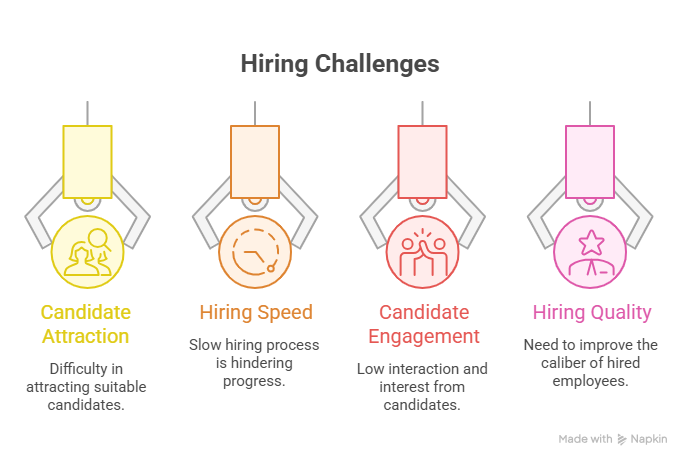
Choosing the right recruitment fix depends on identifying your biggest hiring bottleneck and applying targeted solutions that improve speed, quality, and overall efficiency.
1. If your biggest challenge is attracting candidates
When the top of your funnel is weak, everything downstream suffers.
You end up with fewer applicants, lower quality profiles, and longer hiring timelines.
This is usually a visibility and positioning problem, not just a sourcing issue.
What you should focus on:
- Improve job descriptions to clearly communicate impact and expectations
- Expand sourcing across multiple platforms instead of relying on one channel
- Strengthen your employer brand so candidates understand why they should choose you
If you fix attraction, you naturally improve both quality and volume.
2. If hiring speed is your main bottleneck
If roles stay open for too long, it creates pressure across the business.
Delays often come from too many manual steps, unclear ownership, or slow decision-making.
Speed is rarely about working harder.
It is about removing friction from your workflow.
What you should focus on:
- Reduce unnecessary interview rounds and approval layers
- Set clear timelines for feedback and stick to them
- Automate repetitive tasks like sourcing, screening, and scheduling
When your process becomes streamlined, faster hiring follows naturally.
3. If candidate engagement is low
If candidates are not responding or dropping off, your communication needs attention.
Low engagement is often a signal that your outreach or experience is not resonating.
Candidates today expect relevance, clarity, and consistency.
What you should focus on:
- Personalize outreach instead of sending generic messages
- Maintain regular follow-ups and updates throughout the process
- Make every interaction clear, simple, and respectful of candidate time
Better engagement leads to stronger pipelines and fewer drop-offs.
4. If hiring quality needs improvement
If hires are not meeting expectations, the issue usually starts early in the process.
It often comes down to unclear evaluation criteria, rushed decisions, or inconsistent screening.
Improving quality requires more structure, not more effort.
What you should focus on:
- Define what success looks like for the role before hiring starts
- Use structured interviews and standardized scoring systems
- Focus on skills, outcomes, and role-fit instead of surface-level signals
When your evaluation becomes consistent, your hiring outcomes improve significantly.
Suggested Reading:
Candidate Sourcing ChannelsHow Leelu.AI Helps You Solve Recruitment Challenges End-to-End
Leelu.ai helps you streamline hiring by connecting sourcing, screening, outreach, and decision-making into one efficient, automated, and data-driven workflow.
1. Automate sourcing and reach the right candidates faster
Sourcing is often where delays begin.
Manually searching across platforms limits both speed and reach, which directly impacts the quality of your pipeline.
With an AI-driven sourcing engine, you can scan hundreds of millions of profiles across platforms like LinkedIn, job boards, and ATS systems in one go.
This allows you to:
- Reach a much larger talent pool instantly
- Identify relevant candidates faster based on role requirements
- Reduce dependency on manual sourcing efforts
Instead of searching longer, you start reaching better candidates earlier in the process.
2. Improve candidate matching and screening accuracy
Screening is one of the most time-consuming parts of hiring.
Going through resumes manually not only slows you down but also introduces inconsistency.
With AI-powered parsing and matching, candidates are automatically evaluated based on job fit.
This helps you:
- Screen thousands of profiles in minutes instead of hours
- Rank candidates based on relevance and match accuracy
- Build stronger shortlists without missing high-potential talent
When screening becomes faster and more accurate, your entire pipeline moves more efficiently.
3. Increase engagement with personalized outreach
Even the best candidates will not respond if your outreach feels generic.
Personalization at scale is difficult to achieve manually, especially when you are handling multiple roles.
With AI-driven outreach, you can send tailored messages across channels while maintaining relevance.
This enables you to:
- Personalize communication based on candidate profiles
- Reach out across email and LinkedIn simultaneously
- Maintain consistent follow-ups without manual effort
As a result, response rates improve and your pipeline stays active.
4. Reduce manual work with end-to-end automation
One of the biggest challenges in recruitment is the amount of repetitive work.
From sourcing to follow-ups to scheduling, these tasks consume a significant portion of your time.
With end-to-end automation, your workflow becomes significantly lighter.
You can:
- Automate candidate conversations and follow-ups 24/7
- Schedule interviews instantly with calendar syncing
- Eliminate repetitive coordination and manual tracking
This reduces effort by a large margin while keeping your hiring process always active.
5. Optimize hiring decisions with real-time data insights
Without clear visibility, it becomes difficult to improve your hiring process.
You may not know where candidates drop off or which stages are slowing things down.
With real-time insights and analytics, you gain full visibility into your hiring funnel.
This helps you:
- Track performance across every stage of hiring
- Identify bottlenecks and optimize quickly
- Make data-driven decisions instead of relying on guesswork
Better insights lead to better decisions, and better decisions lead to stronger hiring outcomes.
Suggested Reading:
Candidate Engagement StrategiesCommon Mistakes When Solving Recruitment Challenges
Many hiring teams make critical mistakes by addressing surface issues, relying on outdated processes, and ignoring data, which leads to slower and inefficient hiring outcomes.
1. Fixing symptoms instead of root causes
You may try to fix visible hiring problems without understanding what is actually causing them.
Low response rates or slow hiring often have deeper issues like poor targeting or unclear roles.
When you focus only on symptoms, the same problems keep repeating and your hiring process never truly improves over time.
2. Over-relying on manual processes
Manual recruitment tasks may feel manageable at first, but they quickly become overwhelming as hiring needs grow.
Screening resumes, sending follow-ups, and scheduling interviews take significant time.
This slows down your process, increases errors, and prevents your team from focusing on strategic hiring decisions that actually improve outcomes.
3. Using disconnected tools and workflows
When your recruitment tools are not connected, your workflow becomes fragmented and inefficient.
You switch between systems, duplicate data, and lose visibility into your hiring pipeline.
This creates confusion, delays decision-making, and makes it harder to manage candidates effectively across different stages of the hiring process.
4. Ignoring candidate experience
Candidates judge your company based on how smooth and transparent your hiring process feels.
If communication is slow, unclear, or inconsistent, candidates lose interest quickly.
A poor experience leads to higher drop-offs and declined offers, making it harder for you to attract and retain strong talent.
5. Not measuring and optimizing hiring performance
Without tracking hiring metrics, you rely on assumptions instead of actual insights.
You may not know where candidates drop off or which stages slow you down.
This prevents continuous improvement, making it difficult to optimize your process, reduce inefficiencies, and consistently achieve better hiring results over time.
Conclusion
Recruitment challenges are rarely about effort.
They are usually about gaps in process, speed, and alignment that slow you down over time.
When you focus on fixing the right bottlenecks, your entire hiring system becomes more efficient and predictable.
The goal is not to add more steps, but to simplify how hiring actually works.
This is where platforms like Leelu.AI help you bring sourcing, screening, and engagement into one seamless workflow without adding complexity.
Frequently Asked Questions
1. How can recruitment teams reduce hiring delays without adding more recruiters?
Recruitment teams can automate sourcing, screening, and follow-ups using tools like Leelu.ai to reduce manual effort and speed hiring.
2. What role does technology play in improving hiring speed?
Technology centralizes hiring workflows, automates communication, and provides real-time insights, helping teams make faster decisions and reduce delays across stages.
3. How does poor communication impact the hiring process?
Poor communication causes confusion, missed updates, and candidate frustration, leading to higher drop-offs and slower hiring outcomes across recruitment stages.
4. Can improving candidate experience really speed up hiring?
Improving candidate experience keeps applicants engaged, reduces drop-offs, and ensures smoother transitions between stages, ultimately leading to faster hiring results.
5. What is the first step to fixing a slow recruitment process?
The first step is identifying bottlenecks in the hiring process, then applying targeted improvements and automation to remove delays efficiently.