
Hiring at scale sounds exciting until your recruiters start drowning in applications, interview coordination delays begin piling up, and qualified candidates start dropping out before you can even reach them.
That’s why high volume hiring today is no longer just about filling roles faster. You need systems, workflows, and automation that help you maintain hiring speed without losing candidate quality or recruiter efficiency.
In this guide, you’ll learn:
- Why high volume hiring becomes difficult to scale
- Core fundamentals that improve hiring success
- 9 proven high volume hiring strategies
- Common mistakes companies should avoid
- How AI recruiting platforms like Leelu simplify bulk hiring workflows
Why High Volume Hiring Becomes Difficult to Scale
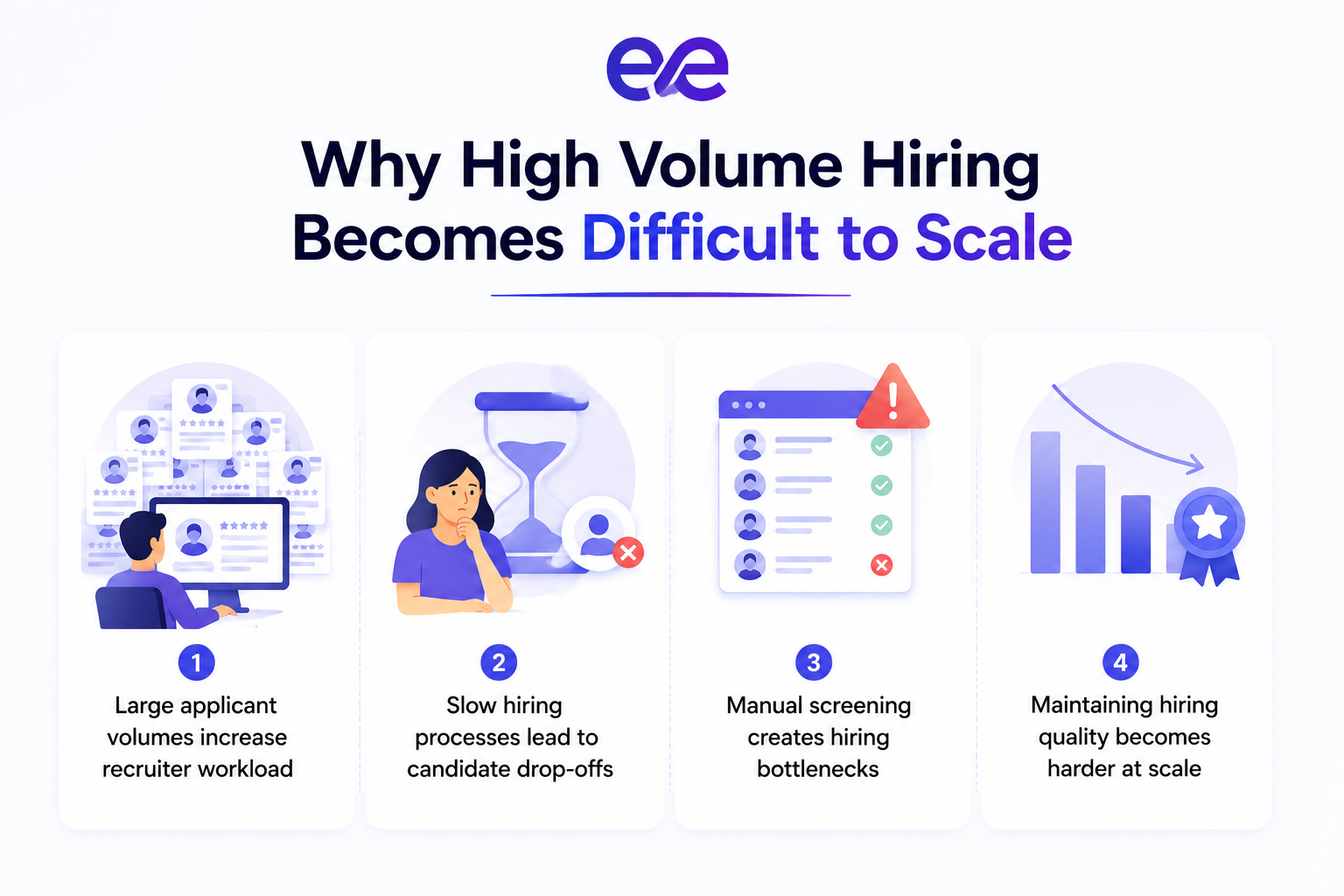
High volume hiring looks manageable in the early stages.
But once companies start hiring across multiple roles, locations, or departments simultaneously, the recruitment process quickly becomes difficult to control.
What initially feels like “more applications” often turns into operational overload for recruiters and hiring teams.
Large applicant volumes increase recruiter workload
When hundreds or thousands of applications enter the pipeline every week, recruiters spend most of their time manually reviewing resumes, coordinating interviews, and sending follow-ups.
This creates:
- Delayed response times
- Recruiter burnout
- Slower candidate movement across stages
- Reduced focus on quality hiring decisions
Slow hiring processes lead to candidate drop-offs
In high volume hiring, speed directly affects candidate conversion.
Top candidates rarely stay available for long. If interview scheduling, screening, or communication takes too much time, candidates often lose interest or accept competing offers before your process moves forward.
Suggested Reading:
Smart Ways to Reduce Time to Hire Without Sacrificing QualityManual screening creates hiring bottlenecks
Many companies still rely heavily on manual resume reviews and disconnected hiring workflows.
As hiring demand increases, these manual processes make it harder to:
- Identify qualified candidates quickly
- Prioritize top-fit applicants
- Maintain consistent screening standards
- Scale recruitment operations efficiently
Maintaining hiring quality becomes harder at scale
As application volume grows, hiring teams often focus more on speed than fit.
Without structured evaluation criteria and streamlined workflows, companies risk making rushed hiring decisions that increase turnover, affect productivity, and create long-term recruitment inefficiencies.
Core Fundamentals That Improve High Volume Hiring Success
Once hiring demand starts increasing, adding more recruiters alone rarely solves the problem.
Companies that scale hiring successfully usually focus on building structured and repeatable recruitment processes first.
That foundation helps teams move faster without losing hiring quality.
Standardizing hiring workflows across teams
When every recruiter or hiring manager follows a different process, hiring becomes inconsistent and difficult to scale.
Standardized workflows help teams:
- Move candidates through stages faster
- Reduce communication gaps
- Improve collaboration across departments
- Maintain consistency in hiring decisions
Clear workflows also make it easier to manage bulk hiring across multiple roles and locations.
Defining clear screening and evaluation criteria
High volume hiring becomes chaotic when recruiters lack clear qualification benchmarks.
Creating structured screening criteria helps recruiters quickly identify candidates based on:
- Required skills
- Experience level
- Role fit
- Availability
- Location or compliance requirements
This reduces bias, improves shortlist quality, and speeds up decision-making.
Creating a faster and more engaging candidate experience
Candidates expect quick communication and smooth hiring experiences, especially in competitive industries.
A faster process with timely updates, simplified scheduling, and consistent engagement helps companies:
- Reduce candidate drop-offs
- Improve offer acceptance rates
- Build a stronger employer brand
Using automation and data to improve hiring efficiency
Manual recruiting processes slow down hiring at scale.
Automation tools and recruitment analytics help teams:
- Screen applications faster
- Automate follow-ups
- Track hiring bottlenecks
- Improve sourcing performance
- Optimize recruiter productivity
With better data visibility, companies can continuously improve hiring efficiency as recruitment demand grows.
Suggested Reading:
How Recruitment Automation Is Transforming Hiring in USA9 High Volume Hiring Strategy Ideas to Fill Roles at Scale
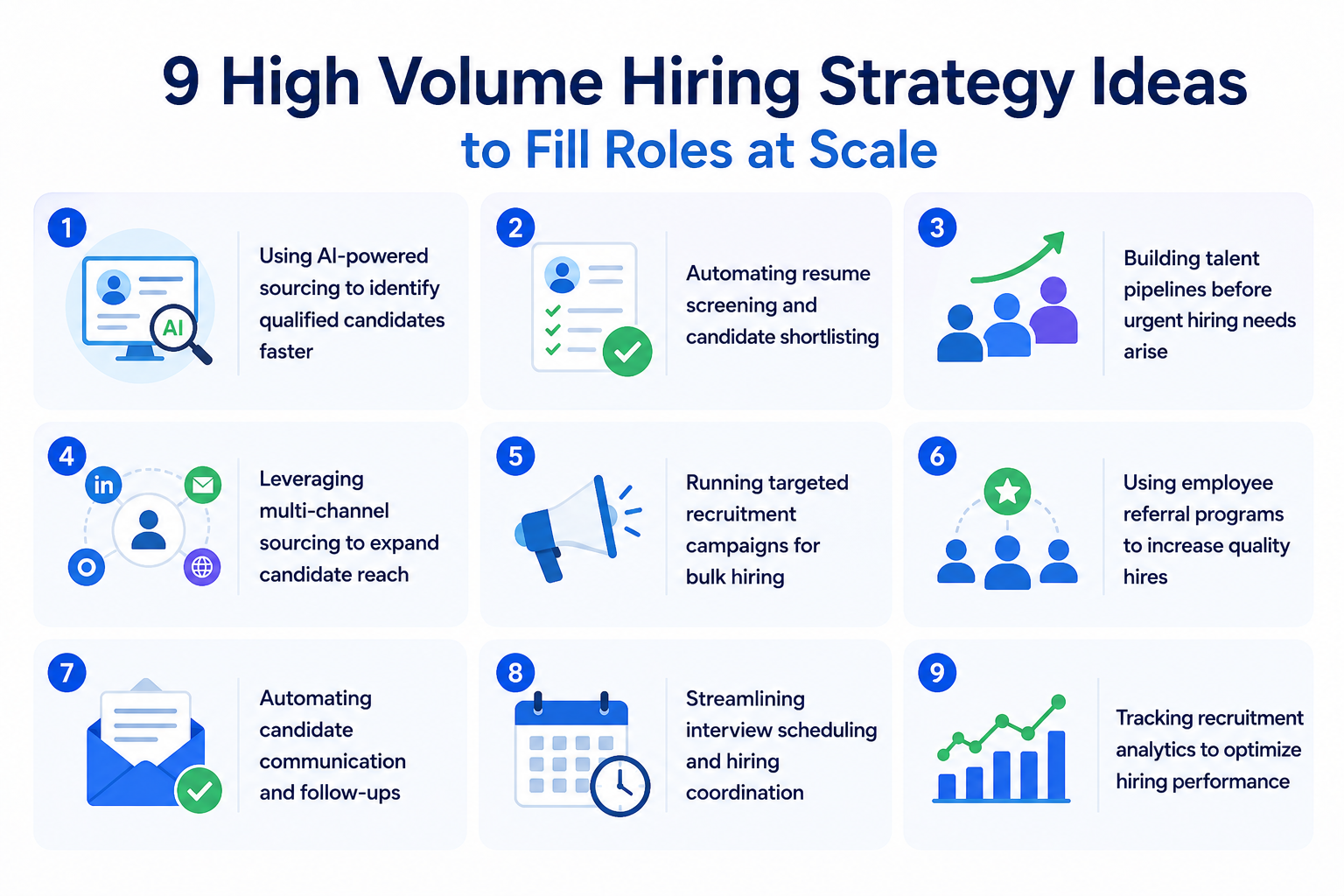
Once your hiring volume starts increasing, traditional recruiting methods become difficult to sustain.
Recruiters spend more time managing tasks manually, while candidates expect faster communication and shorter hiring cycles.
That’s why companies scaling recruitment successfully usually rely on structured, automation-driven hiring strategies.
1. Using AI-powered sourcing to identify qualified candidates faster
Finding qualified candidates manually across multiple platforms takes enormous recruiter effort, especially during bulk hiring.
AI-powered sourcing helps companies identify relevant candidates much faster by automatically scanning large talent databases and matching profiles against job requirements.
Instead of spending hours searching across different platforms, recruiters can instantly discover candidates based on:
- Skills and experience
- Industry background
- Location preferences
- Hiring intent signals
- Role compatibility
Platforms like Leelu simplify this process by helping companies source candidates from 500M+ profiles across LinkedIn, job boards, and ATS systems through one unified workflow.
This allows recruiters to:
- Reduce sourcing time significantly
- Reach passive candidates faster
- Expand talent reach across channels
- Focus more on candidate engagement instead of manual searching
For companies handling large-scale recruitment, AI sourcing becomes one of the biggest drivers of hiring speed and efficiency.
2. Automating resume screening and candidate shortlisting
Resume screening becomes one of the biggest bottlenecks in high volume hiring.
When recruiters manually review hundreds of applications daily, it becomes difficult to maintain both speed and consistency.
Automated screening tools help solve this by instantly evaluating resumes based on predefined hiring criteria such as:
- Skills match
- Experience level
- Education requirements
- Certifications
- Role-specific keywords
This helps recruiters quickly identify top-fit candidates without manually filtering every application.
The biggest advantage is not just speed. Automation also improves hiring consistency by ensuring every candidate is evaluated against the same criteria.
Companies using automated screening often see:
- Faster shortlisting cycles
- Reduced recruiter workload
- Better hiring accuracy
- Improved candidate response times
As hiring demand grows, automated screening becomes essential for maintaining recruitment efficiency.
3. Building talent pipelines before urgent hiring needs arise
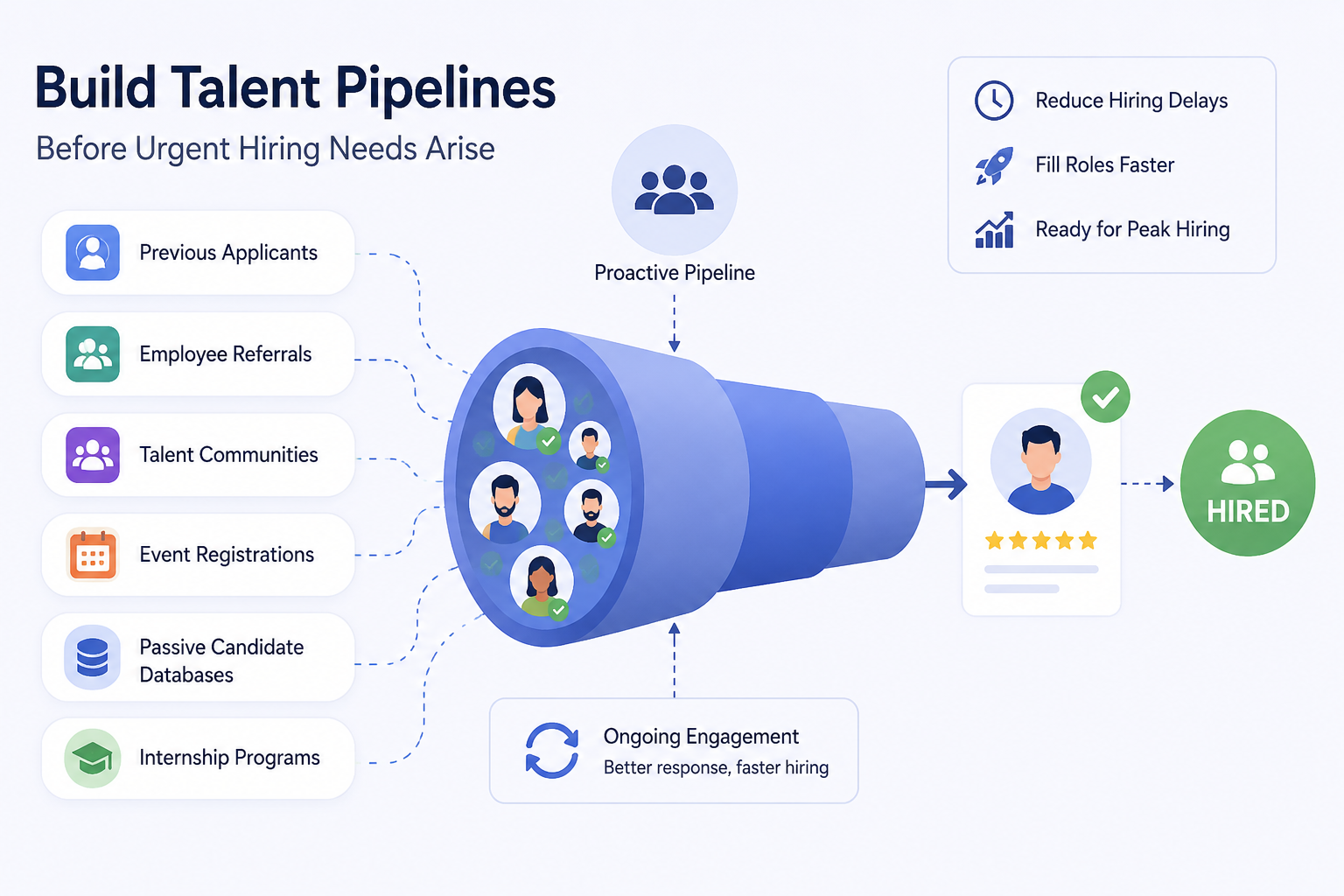
One of the biggest mistakes companies make is starting sourcing only after positions open.
High volume hiring works far better when companies build talent pipelines proactively.
A strong talent pipeline gives recruiters access to pre-qualified candidates before urgent hiring needs appear. This reduces hiring delays and helps teams fill positions faster during peak recruitment periods.
Companies can build talent pipelines through:
- Previous applicants
- Employee referrals
- Talent communities
- Event registrations
- Passive candidate databases
- Internship programs
Maintaining ongoing engagement with these candidates also improves future response rates.
Instead of restarting the hiring process every time a role opens, recruiters can quickly reactivate existing talent pools and accelerate hiring timelines.
4. Leveraging multi-channel sourcing to expand candidate reach
Relying on a single sourcing channel limits candidate availability, especially when hiring at scale.
Different candidates prefer different platforms. Some actively apply through job boards, while others respond better through LinkedIn outreach, referrals, or niche communities.
Multi-channel sourcing helps companies reach a broader and more diverse talent pool.
Effective sourcing channels often include:
- Indeed
- Monster
- CareerBuilder
- Employee referral networks
- Industry-specific communities
- Social recruiting platforms
- ATS databases
Using multiple sourcing channels also improves hiring resilience. If one channel slows down, recruiters still maintain candidate flow from other sources.
For high volume hiring, wider reach usually translates directly into:
- Faster pipeline generation
- Better candidate quality
- Reduced hiring gaps
- Improved hiring scalability
5. Running targeted recruitment campaigns for bulk hiring
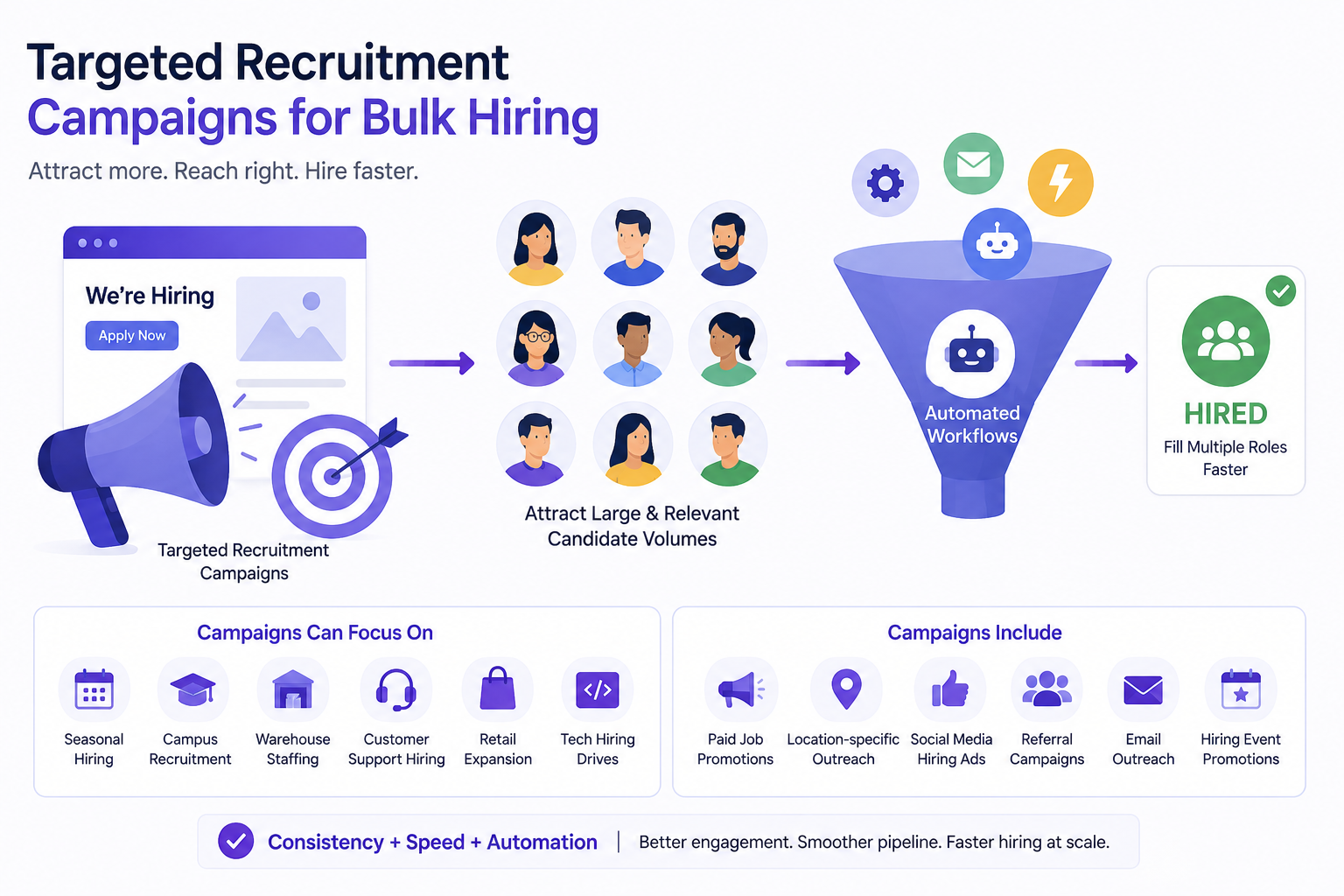
Bulk hiring becomes much more effective when companies treat recruitment like a targeted marketing campaign instead of a reactive process.
Recruitment campaigns help companies attract larger applicant volumes while improving candidate relevance.
These campaigns can focus on:
- Seasonal hiring
- Campus recruitment
- Warehouse staffing
- Customer support hiring
- Retail expansion
- Tech hiring drives
Targeted campaigns often include:
- Paid job promotions
- Location-specific outreach
- Social media hiring ads
- Referral campaigns
- Email outreach sequences
- Hiring event promotions
The key is consistency and speed.
When campaigns are supported by automated workflows, recruiters can engage large candidate volumes without overwhelming hiring teams.
This creates a smoother recruitment pipeline and helps companies fill multiple positions faster while maintaining candidate engagement throughout the process.
6. Using employee referral programs to increase quality hires
When companies need to fill roles quickly, employee referrals often become one of the most reliable sourcing channels.
Referred candidates usually move through the hiring process faster because they already have some understanding of the company culture, work environment, and role expectations.
Compared to traditional sourcing methods, referral hiring often leads to:
- Higher candidate quality
- Faster hiring cycles
- Better retention rates
- Lower recruitment costs
- Improved employee trust in hiring
But referral programs only work well when the process is simple and structured.
Companies scaling high volume hiring should:
- Make referrals easy to submit
- Offer clear referral incentives
- Keep employees updated on referral status
- Prioritize quick screening for referred candidates
Referral programs become even more effective when combined with automation tools that help recruiters track referrals, manage communication, and speed up evaluation workflows.
7. Automating candidate communication and follow-ups
One of the fastest ways to lose candidates during high volume hiring is poor communication.
When recruiters manage hundreds of applicants manually, delays in follow-ups become unavoidable. Candidates often feel ignored, lose interest, or accept offers from competitors before hearing back.
Automating communication helps companies maintain consistent engagement throughout the hiring process.
Recruitment automation tools can handle:
- Application confirmations
- Interview reminders
- Status updates
- Follow-up emails
- Candidate nurturing sequences
- Re-engagement campaigns
This creates a much smoother candidate experience while reducing recruiter workload significantly.
Consistent communication also improves employer branding. Even candidates who are not selected are more likely to leave with a positive impression when they receive timely updates and professional engagement.
For high volume recruitment, automation ensures no candidate gets overlooked because of process delays.
8. Streamlining interview scheduling and hiring coordination
Interview scheduling becomes extremely complex when companies are hiring for multiple positions simultaneously.
Recruiters often spend hours coordinating calendars, managing reschedules, and following up with hiring managers. As hiring volume grows, these small delays create major operational bottlenecks.
Streamlined scheduling systems help automate much of this coordination process.
Instead of relying on endless email exchanges, companies can use scheduling tools that:
- Sync interviewer calendars automatically
- Allow candidates to select available slots
- Send automated reminders
- Handle rescheduling instantly
- Reduce scheduling conflicts
This improves both recruiter productivity and candidate experience.
Faster interview coordination also helps companies reduce time-to-hire, which is critical in competitive hiring markets where top candidates are often evaluating multiple opportunities simultaneously.
For large-scale hiring, simplified scheduling workflows can save recruiters dozens of hours every week.
9. Tracking recruitment analytics to optimize hiring performance
High volume hiring becomes difficult to improve when companies lack visibility into recruitment performance.
Without proper analytics, hiring teams struggle to identify:
- Where candidates drop off
- Which sourcing channels perform best
- Why hiring delays occur
- Which recruiters are overloaded
- How long hiring stages actually take
Recruitment analytics help companies make data-driven hiring decisions instead of relying on assumptions.
Key metrics companies should monitor include:
- Time-to-hire
- Cost-per-hire
- Source-to-hire performance
- Candidate conversion rates
- Interview-to-offer ratio
- Offer acceptance rates
- Recruiter productivity
These insights help hiring teams identify bottlenecks early and continuously optimize recruitment workflows.
Analytics also improve workforce planning by helping companies predict hiring demand and allocate recruiter resources more effectively.
As hiring scales, companies that consistently track and optimize recruitment performance usually gain a major advantage in both hiring speed and candidate quality.
How Leelu Helps Companies Manage High Volume Hiring Efficiently
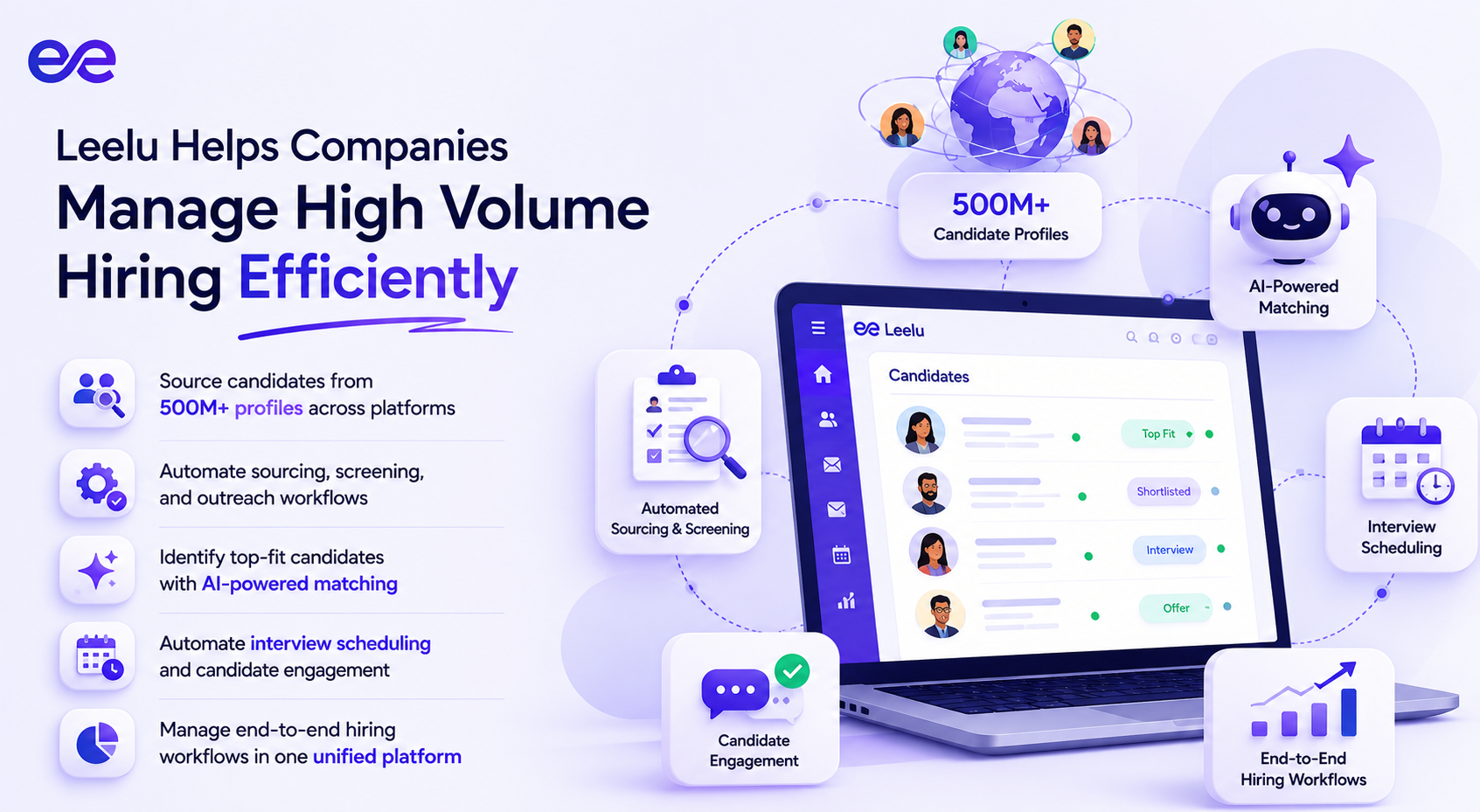
Managing high volume hiring manually becomes difficult once recruiters start handling hundreds of applications, interviews, and follow-ups simultaneously.
That’s where AI-driven recruitment platforms like Leelu help companies simplify and scale hiring operations without overwhelming recruiting teams.
Source candidates from 500M+ profiles across platforms
Leelu helps recruiters discover qualified candidates from 500M+ profiles across LinkedIn, job boards, and ATS systems through one centralized platform.
Instead of switching between multiple sourcing tools, recruiters can identify relevant candidates faster while expanding their talent reach significantly.
Automate sourcing, screening, and outreach workflows
Leelu automates repetitive recruiting tasks that usually consume most recruiter time.
Teams can automate:
- Candidate sourcing
- Resume screening
- Candidate shortlisting
- Outreach campaigns
- Follow-up communication
This helps recruiters reduce manual effort while improving hiring speed and consistency.
Identify top-fit candidates with AI-powered matching
Leelu’s AI-powered matching system helps recruiters prioritize candidates based on role fit, skills, experience, and hiring requirements.
This allows hiring teams to focus on the most relevant applicants instead of manually reviewing every profile individually.
Automate interview scheduling and candidate engagement
Coordinating interviews at scale often creates major delays.
Leelu simplifies scheduling with automated calendar coordination, interview reminders, and continuous candidate engagement workflows that keep applicants informed throughout the hiring process.
Manage end-to-end hiring workflows in one unified platform
From sourcing and screening to outreach and scheduling, Leelu centralizes the entire recruitment workflow in one platform.
This reduces tool fragmentation, improves team collaboration, and helps companies scale hiring operations more efficiently.
Common Mistakes to Avoid in High Volume Hiring
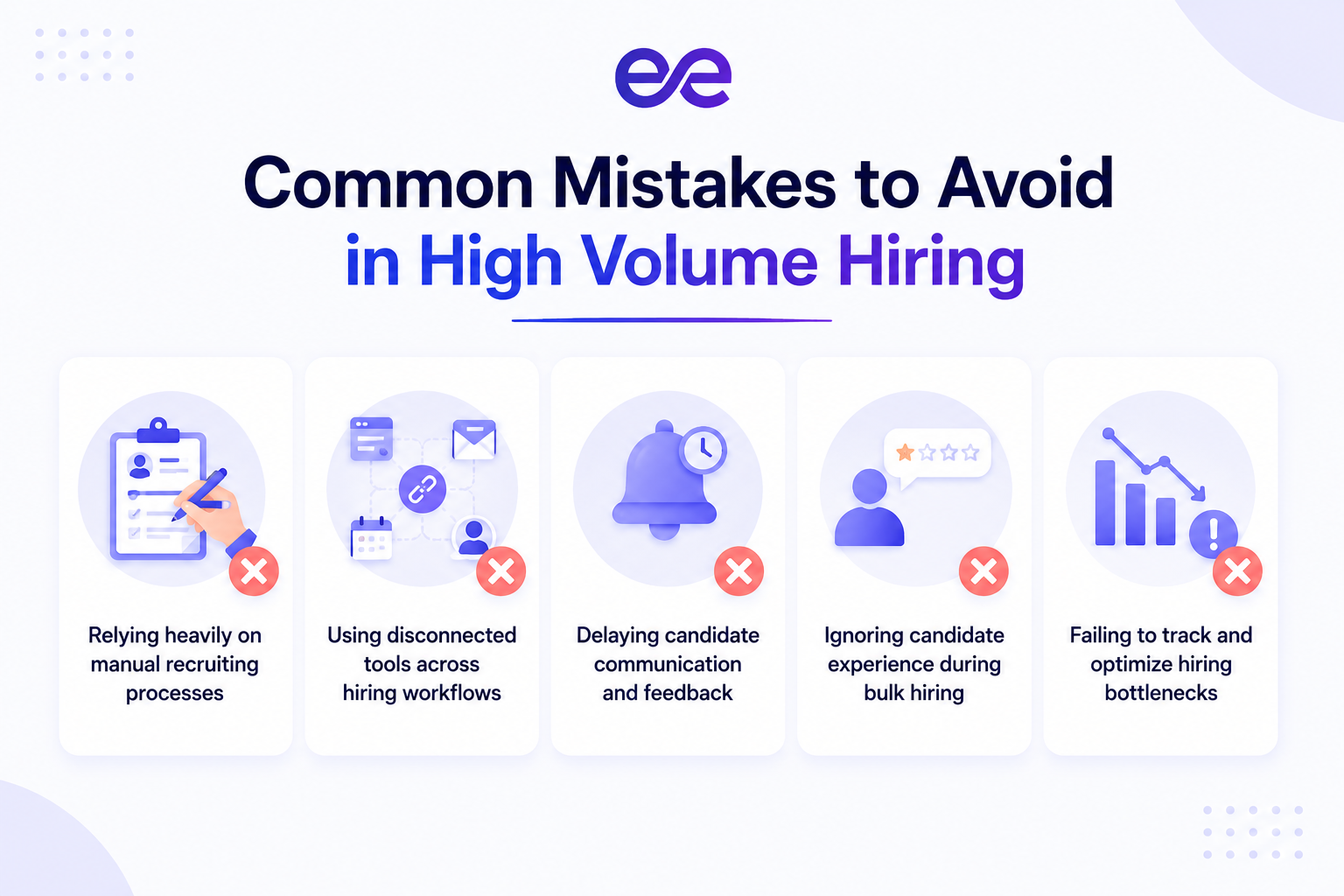
High volume hiring becomes far more difficult when companies rely on outdated processes or fail to optimize recruitment workflows as hiring demand grows.
Avoiding a few common mistakes can significantly improve hiring speed, recruiter efficiency, and candidate quality.
Relying heavily on manual recruiting processes
Manual sourcing, screening, and scheduling slow down recruitment operations quickly.
As application volume increases, recruiters struggle to keep up with repetitive tasks, which often leads to:
- Delayed hiring decisions
- Recruiter burnout
- Missed candidate opportunities
- Inconsistent screening processes
Using disconnected tools across hiring workflows
Many companies use separate tools for sourcing, communication, scheduling, and applicant tracking.
This creates fragmented workflows, duplicate work, and poor visibility across the hiring pipeline.
Unified hiring systems help teams collaborate more efficiently while reducing operational confusion.
Delaying candidate communication and feedback
Slow communication is one of the biggest reasons candidates drop out during high volume hiring.
Candidates expect regular updates throughout the hiring process. Delayed responses often damage candidate experience and reduce offer acceptance rates.
Ignoring candidate experience during bulk hiring
Companies sometimes prioritize speed so heavily that candidate experience gets overlooked.
Complicated application processes, poor communication, and slow interview coordination can negatively affect employer branding and future hiring efforts.
Failing to track and optimize hiring bottlenecks
Without recruitment analytics, companies struggle to identify where hiring delays actually occur.
Tracking hiring metrics helps teams:
- Identify slow stages
- Improve recruiter productivity
- Optimize sourcing channels
- Reduce time-to-hire
- Improve overall hiring efficiency
Continuous optimization becomes essential as recruitment operations scale.
Conclusion
High volume hiring becomes challenging when companies rely on slow, manual, and disconnected recruitment processes.
As hiring demand grows, recruiters need scalable systems that help them move faster without sacrificing candidate quality or experience.
By combining structured workflows, automation, AI-powered sourcing, and recruitment analytics, companies can streamline hiring operations and reduce hiring bottlenecks significantly.
Platforms like Leelu further simplify this process by helping teams automate sourcing, screening, outreach, and scheduling in one unified workflow, making large-scale hiring faster, more efficient, and easier to manage.
Frequently Asked Questions
1. What is high volume hiring?
High volume hiring means recruiting a large number of candidates within a short period.
2. Why is high volume hiring difficult?
It becomes difficult because recruiters have to manage large application volumes, communication, screening, and scheduling simultaneously.
3. How can companies speed up high volume hiring?
Companies can improve hiring speed by using automation, AI sourcing tools, and structured recruitment workflows.
4. What is the biggest challenge in bulk hiring?
One of the biggest challenges is maintaining hiring quality while filling roles quickly.
5. How does Leelu help with high volume hiring?
Leelu helps automate sourcing, screening, outreach, and interview scheduling to make large-scale hiring faster and more efficient.


