
Hiring top talent is no longer limited by geography, but finding the right candidates globally has become far more competitive.
Many companies are struggling with local talent shortages, slower hiring cycles, and outdated sourcing methods that cannot keep up with modern recruiting demands.
At the same time, remote work has opened access to highly skilled professionals across international markets, creating new opportunities for businesses willing to source talent globally.
In this guide, you’ll learn:
- Why global talent sourcing has become essential
- The core fundamentals of successful international sourcing
- 13 proven global talent sourcing methods recruiters use today
- Common sourcing mistakes that slow down hiring
- How AI-powered recruiting platforms help scale global hiring faster
Why Global Talent Sourcing Has Become Essential for Modern Hiring
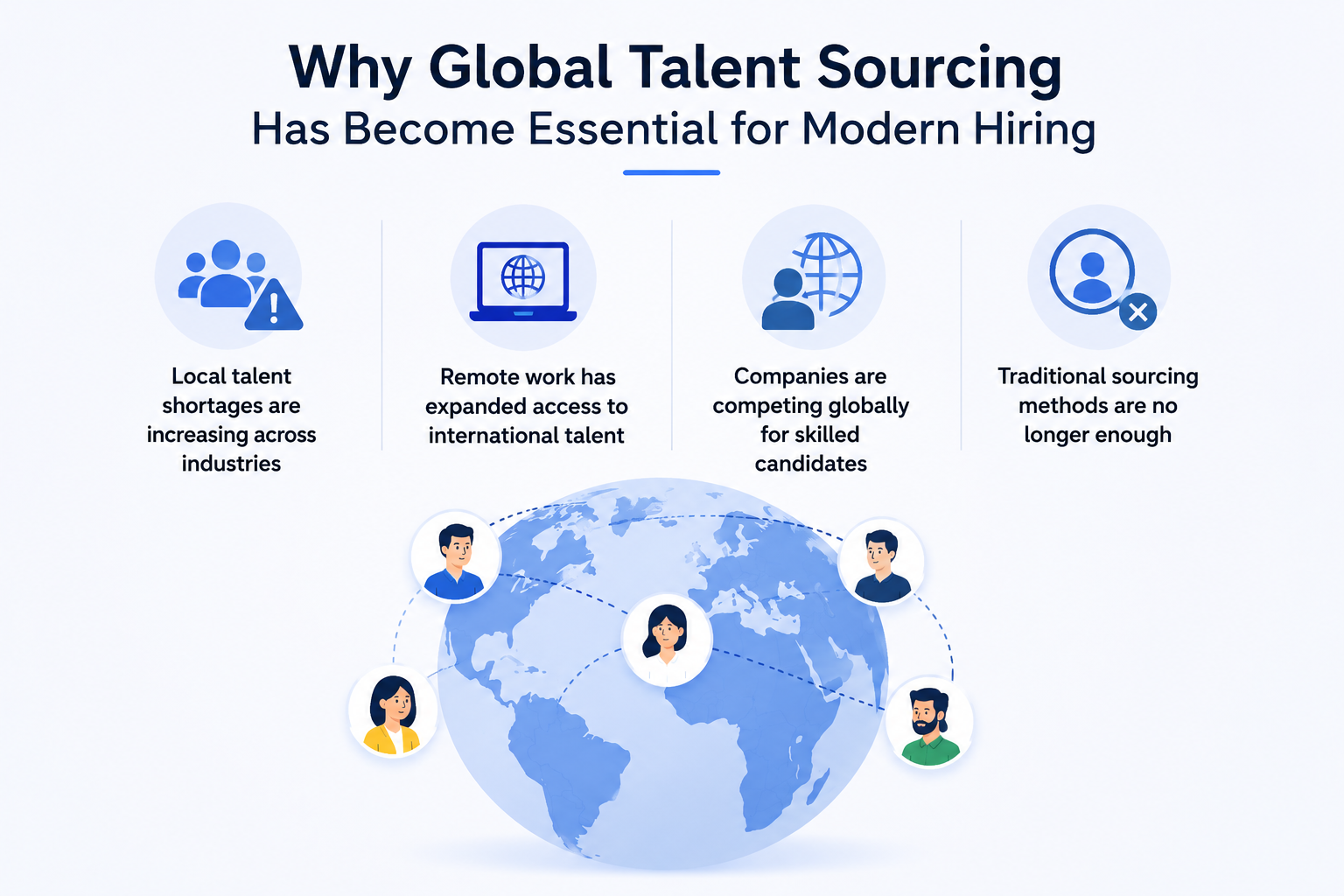
Hiring has changed significantly over the last few years, and many companies are now realizing that local hiring alone is no longer enough to meet growing talent demands.
Businesses across industries are facing skill shortages, longer hiring cycles, and increasing competition for qualified professionals.
Local talent shortages are increasing across industries
Many companies struggle to find skilled candidates within their local markets, especially for specialized, technical, and leadership roles.
As industries evolve faster, the gap between available talent and hiring demand continues to grow.
Remote work has expanded access to international talent
Remote work has made global hiring more practical and accessible than ever before.
Companies can now hire qualified professionals from different countries without requiring relocation, giving recruiters access to much larger talent pools.
Companies are competing globally for skilled candidates
The best candidates are no longer limited to one geographic market.
Today, companies worldwide are competing for the same highly skilled professionals, making faster and smarter sourcing strategies increasingly important.
Traditional sourcing methods are no longer enough
Relying only on job boards or manual LinkedIn searches often slows down hiring and limits candidate reach.
Modern recruiting requires scalable sourcing methods, automation, personalized outreach, and data-driven hiring strategies to consistently attract top global talent.
Core Fundamentals That Improve Global Talent Sourcing
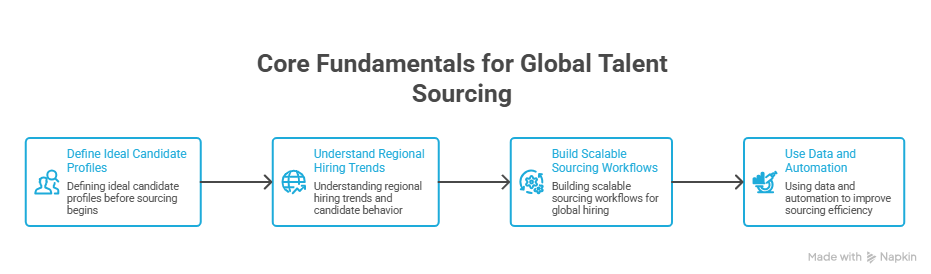
Finding global talent successfully is not just about accessing larger candidate pools.
The quality of your sourcing process depends heavily on how well your hiring strategy, workflows, and outreach systems are structured from the beginning.
Defining ideal candidate profiles before sourcing begins
Without a clear candidate profile, global sourcing can quickly become inefficient and overwhelming.
Recruiters should define required skills, experience levels, communication expectations, time zone preferences, and role-specific qualifications before starting outreach.
Understanding regional hiring trends and candidate behavior
Hiring expectations can vary significantly across different countries and regions.
Candidates respond differently to outreach styles, compensation structures, hiring timelines, and communication preferences, making regional understanding essential for better engagement.
Building scalable sourcing workflows for global hiring
Managing international sourcing manually often creates delays and inconsistent hiring processes.
Scalable workflows help recruiters organize sourcing, screening, follow-ups, and candidate management more efficiently across multiple regions and hiring channels.
Using data and automation to improve sourcing efficiency
Modern recruiting teams rely heavily on automation and analytics to improve sourcing outcomes.
Data helps identify high-performing sourcing channels, while automation reduces repetitive tasks like profile screening, candidate matching, outreach, and interview coordination, allowing recruiters to focus more on building strong candidate relationships.
13 Global Talent Sourcing Methods for Finding Top Candidates
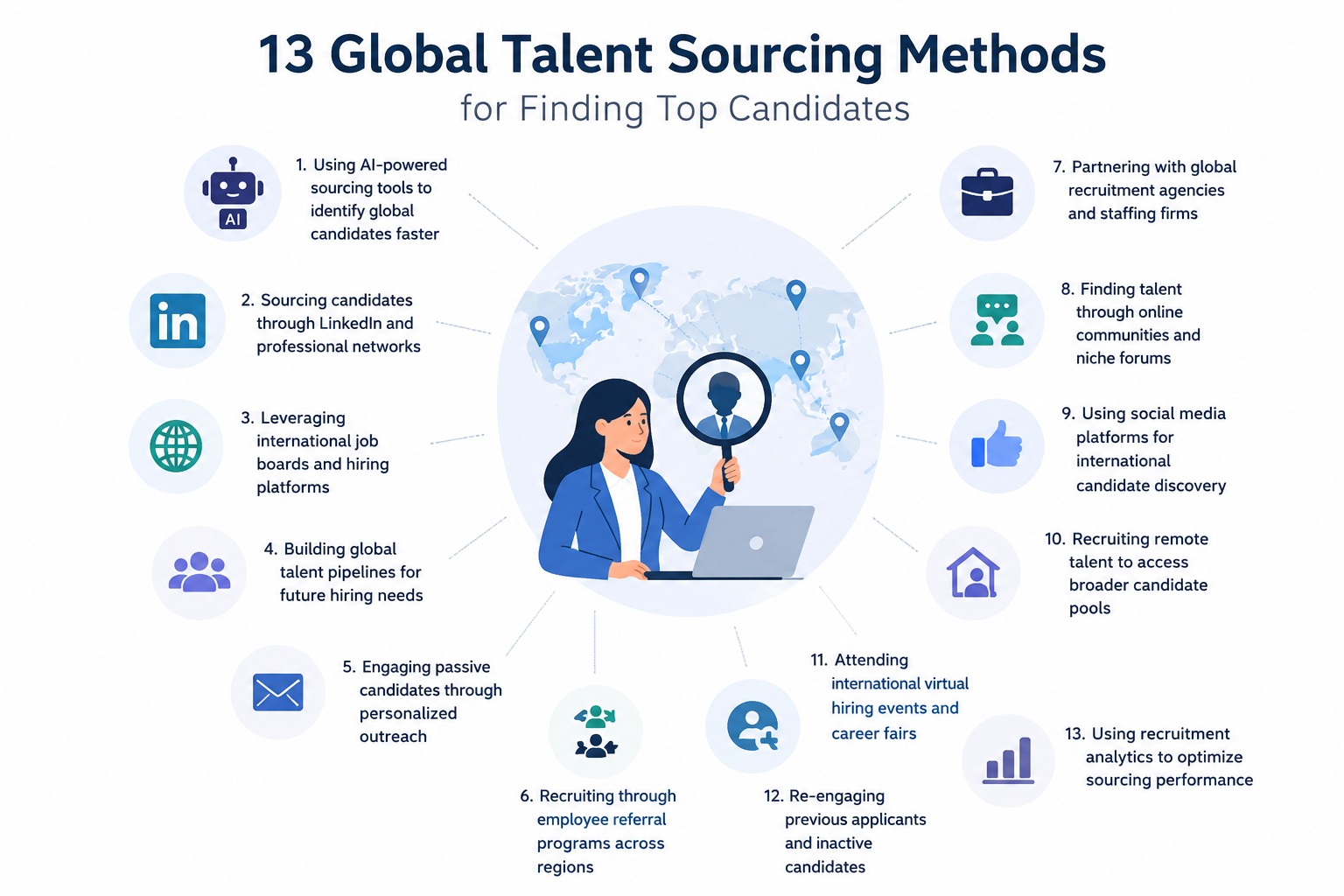
Once you build a strong sourcing foundation, the next step is choosing the right methods to consistently find qualified candidates across global markets.
The most effective recruiting teams no longer depend on a single sourcing channel. Instead, they combine multiple sourcing strategies to improve candidate quality, hiring speed, and long-term talent acquisition outcomes.
Suggested Reading:
Candidate Sourcing Channels That Deliver Better Hires Fast1. Using AI-Powered Sourcing Tools to Identify Global Candidates Faster
AI-powered sourcing platforms help recruiters find and match candidates significantly faster than traditional manual sourcing methods.
Instead of spending hours searching across multiple platforms, recruiters can automate candidate discovery, profile screening, and shortlisting.
AI sourcing tools also help:
- Identify candidates that closely match job requirements
- Reduce manual screening effort
- Improve sourcing accuracy using AI matching
- Scale hiring across multiple regions simultaneously
This becomes especially valuable when hiring for high-volume or specialized global roles.
Platforms like Leelu AI help recruiters automate sourcing, screening, and candidate matching across multiple regions more efficiently.
2. Sourcing Candidates Through LinkedIn and Professional Networks
LinkedIn remains one of the most effective platforms for professional talent sourcing globally.
Recruiters can use advanced search filters, industry groups, and professional communities to connect with qualified candidates across different regions and industries.
Beyond LinkedIn, recruiters should also explore:
- Industry-specific professional communities
- Alumni networks
- Technical forums
- Certification-based communities
- Executive networking groups
Professional networks often help recruiters discover passive candidates who may not actively apply through job boards.
3. Leveraging International Job Boards and Hiring Platforms
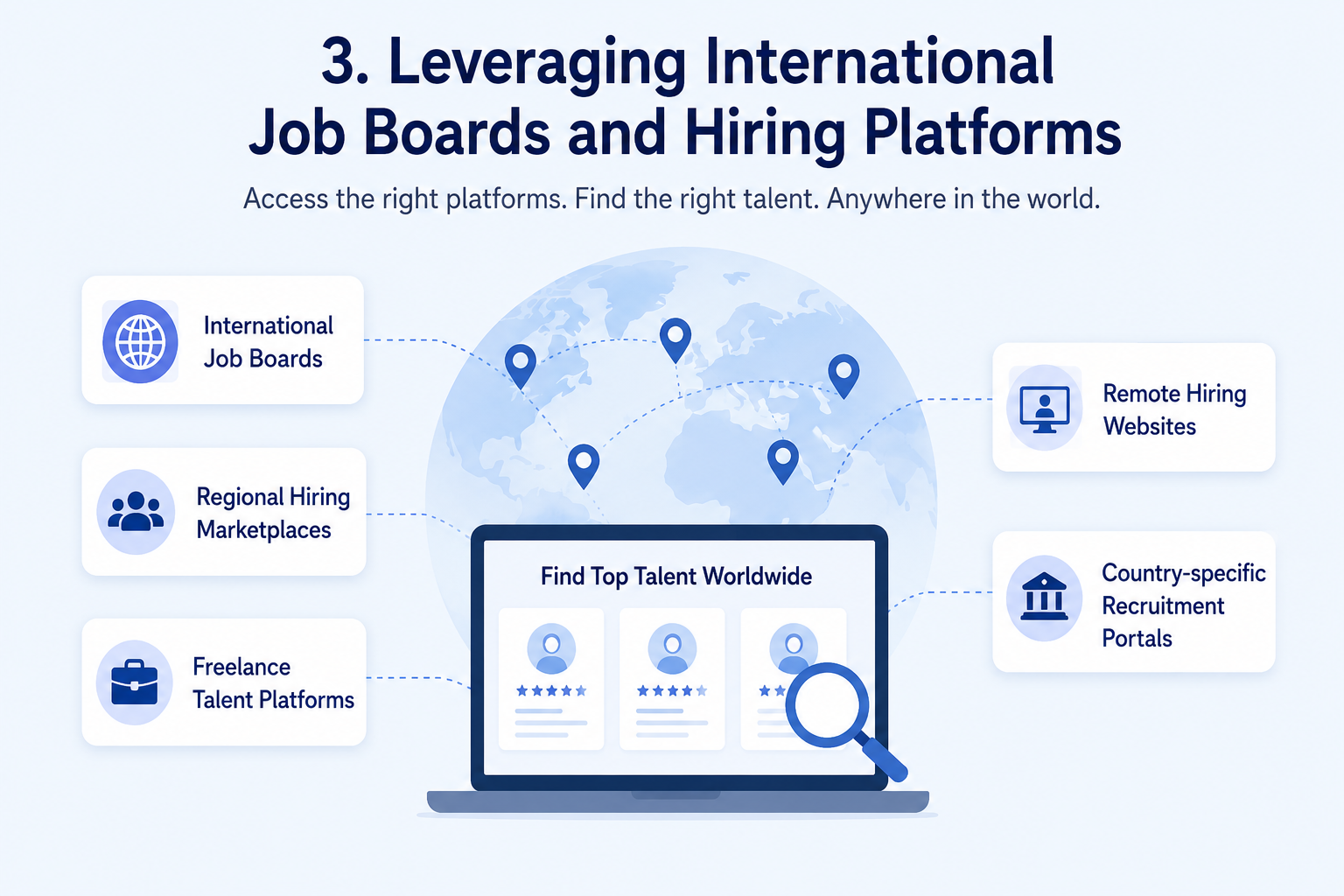
Global hiring requires access to region-specific hiring platforms where local candidates actively search for opportunities.
Different countries often rely on different recruiting platforms, making localized sourcing strategies important for improving visibility and candidate reach.
Some commonly used sourcing platforms include:
- International job boards
- Regional hiring marketplaces
- Freelance talent platforms
- Remote hiring websites
- Country-specific recruitment portals
Using multiple hiring platforms helps recruiters diversify sourcing channels and reach wider candidate pools.
4. Building Global Talent Pipelines for Future Hiring Needs
Strong recruiting teams do not source candidates only when a role opens.
Instead, they continuously build talent pipelines to prepare for future hiring demands and reduce time-to-hire.
Talent pipelines may include:
- Previously engaged candidates
- Silver medal applicants
- Passive professionals
- Referral candidates
- Event or webinar attendees
Maintaining long-term candidate relationships helps recruiters fill roles faster when hiring needs increase.
5. Engaging Passive Candidates Through Personalized Outreach
Many highly skilled professionals are not actively searching for jobs, which makes passive candidate outreach an important sourcing strategy.
However, generic outreach messages rarely perform well in global recruiting.
Personalized outreach improves response rates by making communication feel more relevant and human.
Effective outreach usually includes:
- Personalized references to candidate experience
- Role-specific value propositions
- Clear explanation of opportunity growth
- Flexible remote or global work benefits
- Short and conversational messaging
Candidates are far more likely to respond when outreach feels thoughtful instead of automated or mass-produced.
6. Recruiting Through Employee Referral Programs Across Regions
Employee referral programs remain one of the most reliable ways to find high-quality candidates globally.
Employees often have professional connections across different countries, industries, and remote work communities that recruiters may not easily reach through traditional sourcing channels.
Global referral programs can help companies:
- Access trusted candidate networks faster
- Improve candidate quality and cultural fit
- Reduce sourcing and hiring costs
- Shorten hiring timelines significantly
To improve referral success across regions, companies should create clear referral processes, offer relevant incentives, and encourage employees to share opportunities within their international networks.
Referral hiring also tends to improve candidate engagement because referred professionals often enter the hiring process with greater trust and context about the company.
7. Partnering With Global Recruitment Agencies and Staffing Firms

As companies expand international hiring efforts, managing sourcing internally across multiple countries can become difficult and time-consuming.
Global recruitment agencies and staffing firms help recruiters access local hiring expertise, regional talent networks, and country-specific sourcing knowledge.
These partnerships become especially useful when:
- Hiring in unfamiliar international markets
- Filling specialized or executive-level roles
- Scaling hiring quickly across regions
- Navigating local hiring regulations
- Managing multilingual candidate pipelines
Experienced staffing partners often understand local candidate expectations, salary benchmarks, and communication styles better, which helps improve sourcing efficiency and hiring accuracy.
However, businesses should ensure agency partnerships align closely with their hiring goals, employer branding, and long-term talent strategy.
8. Finding Talent Through Online Communities and Niche Forums
Some of the best candidates are often active in industry communities rather than traditional hiring platforms.
Online forums and niche communities allow recruiters to connect with professionals who are deeply engaged in specific industries, technologies, or skill sets.
Depending on the role, recruiters can source candidates through:
- Developer communities
- Design forums
- Product management groups
- Industry Slack communities
- Research and academic networks
- Open-source collaboration platforms
These communities are particularly effective for sourcing specialized talent because they provide deeper visibility into candidate expertise, contributions, and professional interests.
Instead of immediately pitching job opportunities, recruiters should first focus on building authentic engagement within these communities to establish credibility and trust.
Suggested Reading:
Global Talent Acquisition Strategies to Find Quality Candidates9. Using Social Media Platforms for International Candidate Discovery
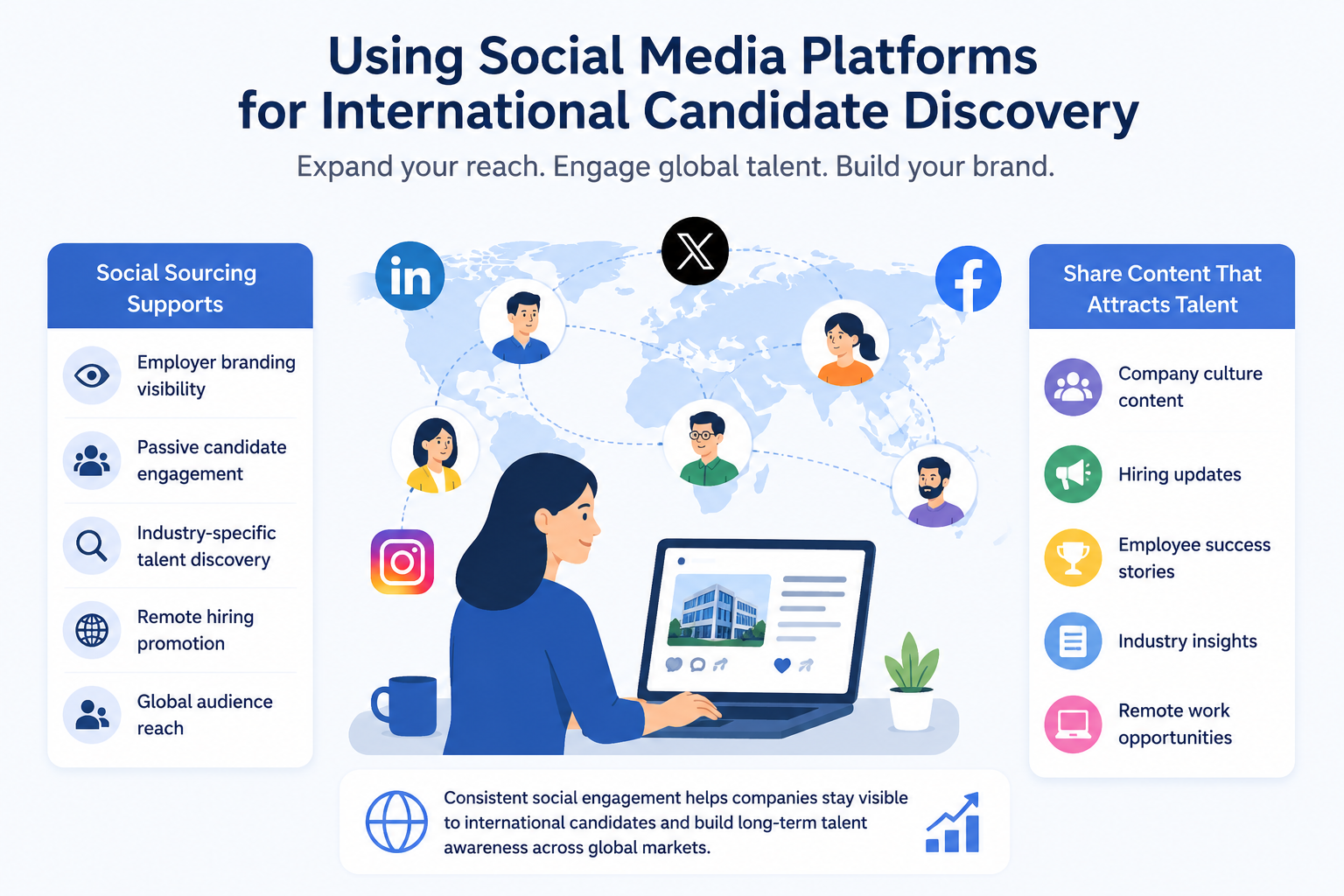
Social media has become an increasingly valuable sourcing channel for discovering and engaging global talent.
Platforms like LinkedIn, X, Facebook groups, Instagram, and even regional social networks help recruiters reach candidates who may not actively search through traditional job portals.
Social sourcing can support:
- Employer branding visibility
- Passive candidate engagement
- Industry-specific talent discovery
- Remote hiring promotion
- Global audience reach
Recruiters can improve results by sharing:
- Company culture content
- Hiring updates
- Employee success stories
- Industry insights
- Remote work opportunities
Consistent social engagement helps companies stay visible to international candidates while building stronger long-term talent awareness across global markets.
10. Recruiting Remote Talent to Access Broader Candidate Pools
Remote hiring has completely changed how companies approach talent sourcing.
Instead of limiting hiring to candidates within commuting distance, businesses can now access skilled professionals across different countries, time zones, and talent markets.
This gives recruiters access to:
- Larger candidate pools
- Specialized global talent
- Faster hiring opportunities
- More flexible workforce options
- Reduced dependency on local hiring markets
Remote recruiting is especially valuable for industries facing severe local talent shortages, including technology, design, customer support, and digital operations.
To attract remote candidates successfully, companies should clearly communicate:
- Remote work policies
- Collaboration expectations
- Time zone flexibility
- Compensation structure
- Career growth opportunities
A strong remote hiring strategy helps companies compete more effectively for global talent while improving hiring scalability.
11. Attending International Virtual Hiring Events and Career Fairs
Virtual hiring events and online career fairs have become important sourcing channels for global recruiting.
These events allow companies to connect with candidates from multiple regions without the cost and logistical complexity of in-person recruiting events.
International virtual hiring events help recruiters:
- Build employer visibility globally
- Engage with active job seekers directly
- Source candidates across multiple locations
- Expand talent pipelines quickly
- Promote remote opportunities more effectively
Industry-specific virtual events can be particularly useful for sourcing specialized professionals in fields like engineering, healthcare, finance, and technology.
Recruiters should focus on creating interactive candidate experiences during these events through live Q&A sessions, networking discussions, and personalized follow-ups.
12. Re-Engaging Previous Applicants and Inactive Candidates
Many companies overlook strong candidates already present in their existing databases.
Previous applicants, silver medal candidates, and inactive talent pools often contain qualified professionals who may now be open to new opportunities.
Re-engaging existing candidates can help:
- Reduce sourcing costs
- Shorten hiring timelines
- Improve hiring efficiency
- Fill roles faster
- Increase response rates
Instead of restarting sourcing from scratch, recruiters can revisit:
- Past interview candidates
- Previous finalists
- Archived applicant databases
- Earlier referral submissions
- Former employees or contractors
Personalized re-engagement campaigns often perform well because candidates already have some familiarity with the company and hiring process.
13. Using Recruitment Analytics to Optimize Sourcing Performance
Modern talent sourcing relies heavily on data-driven decision-making.
Recruitment analytics helps companies understand which sourcing methods generate the best candidates, highest response rates, and strongest hiring outcomes.
Analytics can help recruiters track:
- Candidate source performance
- Outreach response rates
- Time-to-hire
- Interview conversion rates
- Cost-per-hire
- Regional hiring effectiveness
These insights allow recruiting teams to continuously improve sourcing strategies instead of relying on assumptions or inconsistent processes.
When combined with automation and AI-powered recruiting tools, analytics helps companies scale global hiring more efficiently while improving overall sourcing quality.
How Leelu Helps Recruiters Source Global Talent More Efficiently
As global hiring becomes more competitive, recruiters need faster and more scalable ways to source, engage, and manage candidates across multiple regions.
Managing sourcing manually across different platforms often leads to slower hiring cycles, fragmented workflows, and significant recruiter workload.
Leelu helps simplify and automate global talent sourcing by combining AI-driven recruiting workflows into one unified platform.
Source candidates from 500M+ profiles across global platforms
Leelu allows recruiters to source candidates from a database of 500M+ profiles across platforms like LinkedIn, job boards, and ATS systems.
This helps recruiting teams expand candidate reach globally without switching between multiple sourcing tools.
Automate sourcing and candidate matching with AI
Instead of manually screening hundreds of profiles, Leelu uses AI-powered sourcing and matching to identify qualified candidates faster.
The platform automatically ranks candidates based on job fit, helping recruiters focus on the most relevant talent first.
Personalize outreach across multiple communication channels
Candidate engagement becomes more effective when outreach feels personalized and timely.
Leelu helps recruiters automate personalized outreach across channels like email and LinkedIn while maintaining more human candidate communication.
Reduce manual screening and sourcing effort significantly
Manual sourcing, profile screening, and follow-ups often consume a large portion of recruiter time.
Leelu reduces repetitive recruiting tasks through automation, helping teams improve sourcing efficiency while reducing operational workload significantly.
Manage sourcing, outreach, and scheduling in one workflow
Recruiting workflows become difficult to manage when sourcing, outreach, screening, and scheduling happen across disconnected tools.
Leelu brings these workflows together into a single recruiting system, helping teams streamline global hiring processes more efficiently.
Common Mistakes to Avoid in Global Talent Sourcing
Even with access to global talent pools, many companies struggle to achieve consistent hiring results because of avoidable sourcing mistakes.
Small inefficiencies in sourcing strategy, outreach, or workflow management can significantly slow down global hiring performance.
Depending on only one sourcing channel or platform
Relying on a single platform limits candidate reach and reduces sourcing flexibility.
Strong global recruiting strategies combine multiple sourcing channels such as LinkedIn, job boards, referrals, online communities, and AI-powered sourcing tools to access wider talent pools.
Using generic outreach for candidates across all regions
Candidates across different regions often respond differently to messaging styles and communication approaches.
Sending the same generic outreach to every candidate can reduce engagement and response rates significantly.
Personalized communication creates stronger candidate interest and improves outreach performance globally.
Ignoring regional hiring expectations and communication styles
Hiring expectations vary across countries, industries, and professional cultures.
Factors like interview timelines, salary discussions, work preferences, and communication tone can influence candidate experience and hiring success.
Understanding regional hiring behavior helps recruiters build stronger international candidate relationships.
Delaying follow-ups with qualified international candidates
Top candidates often receive multiple opportunities at the same time.
Slow follow-ups can cause recruiters to lose highly qualified professionals to faster-moving competitors, especially in competitive global markets.
Managing sourcing workflows with disconnected recruiting tools
Using separate tools for sourcing, outreach, screening, and scheduling often creates inefficiencies and communication gaps.
Disconnected workflows increase manual effort, slow collaboration, and make it harder to manage global hiring pipelines efficiently.
Conclusion
Global talent sourcing has become a critical part of modern hiring as companies compete for skilled professionals across international markets.
Recruiters that combine multiple sourcing methods, personalized outreach, automation, and data-driven hiring strategies are far more likely to attract and engage top candidates efficiently.
As hiring demands continue to grow globally, scalable sourcing processes and AI-powered recruiting tools can help businesses reduce manual effort, improve hiring speed, and build stronger talent pipelines for long-term hiring success.
Frequently Asked Questions
What is global talent sourcing?
Global talent sourcing is the process of finding and engaging candidates from different countries and international markets instead of limiting hiring to one local region.
It helps companies access larger talent pools and hire skilled professionals globally.
Why is global talent sourcing important for modern hiring?
Many industries are facing local talent shortages and increasing competition for skilled candidates.
Global talent sourcing allows companies to expand hiring reach, improve candidate quality, and fill roles faster by accessing international talent markets.
Which platforms are commonly used for global talent sourcing?
Recruiters commonly use:
- International job boards
- Remote hiring platforms
- Employee referral networks
- Online professional communities
- AI-powered sourcing tools
Using multiple sourcing channels usually improves candidate reach and hiring outcomes.
How can AI improve global talent sourcing?
AI helps automate sourcing tasks such as candidate discovery, profile screening, matching, outreach, and scheduling.
This reduces manual recruiter workload while helping teams identify qualified candidates faster and more accurately.
What are the biggest challenges in global talent sourcing?
Some common challenges include:
- Managing sourcing across multiple regions
- Personalizing outreach at scale
- Understanding regional hiring expectations
- Maintaining fast candidate communication
- Handling disconnected recruiting workflows
Companies often solve these challenges by using structured sourcing strategies and centralized recruiting platforms.


